Every new school year brings fresh questions for parents. This year, one sits at the top of many families’ minds: how do we help our children navigate a world shaped by artificial intelligence? AI is now part of everyday life, and part of everyday learning. For parents, the aim isn’t to fear it or ban it, but to understand it, so children can use technology thoughtfully and safely.
At OWIS Riyadh, an international school that combines the IB Primary Years Programme (IB PYP) with the American curriculum, we believe technology should work for children, not against them. Here’s a practical guide to help your family approach learning in the age of AI.
How is AI changing education for children?
AI is reshaping how children learn. Adaptive platforms can adjust to a child’s pace, tools can give instant feedback, and AI resources can explain difficult concepts in new ways. Used well, technology in education makes learning more personalized and more connected to the real world.
But the bigger shift isn’t about the tools. It’s about the skills children need. In an AI-driven world, memorizing facts matters far less than knowing how to think critically, ask good questions, solve problems, and use technology responsibly. This is why many schools are rethinking what a strong education looks like, moving toward curiosity, creativity, and computational thinking.
What should parents know about AI in schools?
For families comparing international schools in Riyadh, it helps to understand how a school actually approaches AI. The better programs don’t treat it as a gimmick or a single subject added at the end. Instead, they build a clear pathway that grows with the child.
At OWIS Riyadh, technology learning is designed as a progression. Students build computational thinking, digital literacy, coding, robotics, design, AI awareness, and problem-solving skills as they move through the school, with each stage building on the one before.
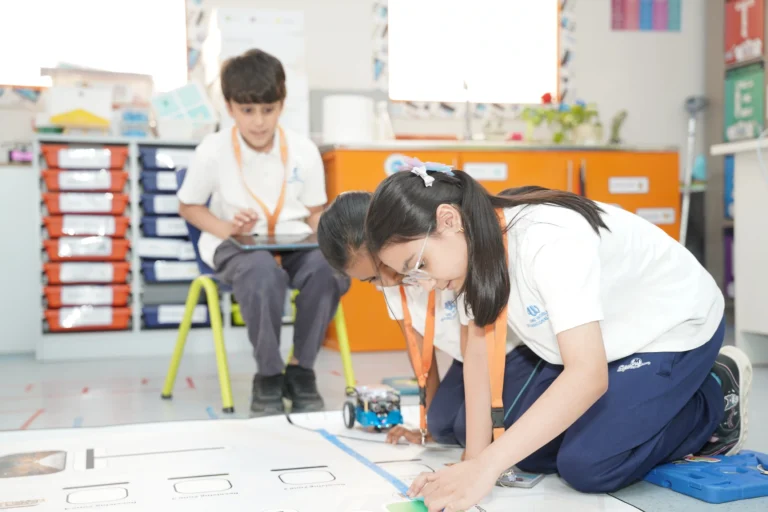
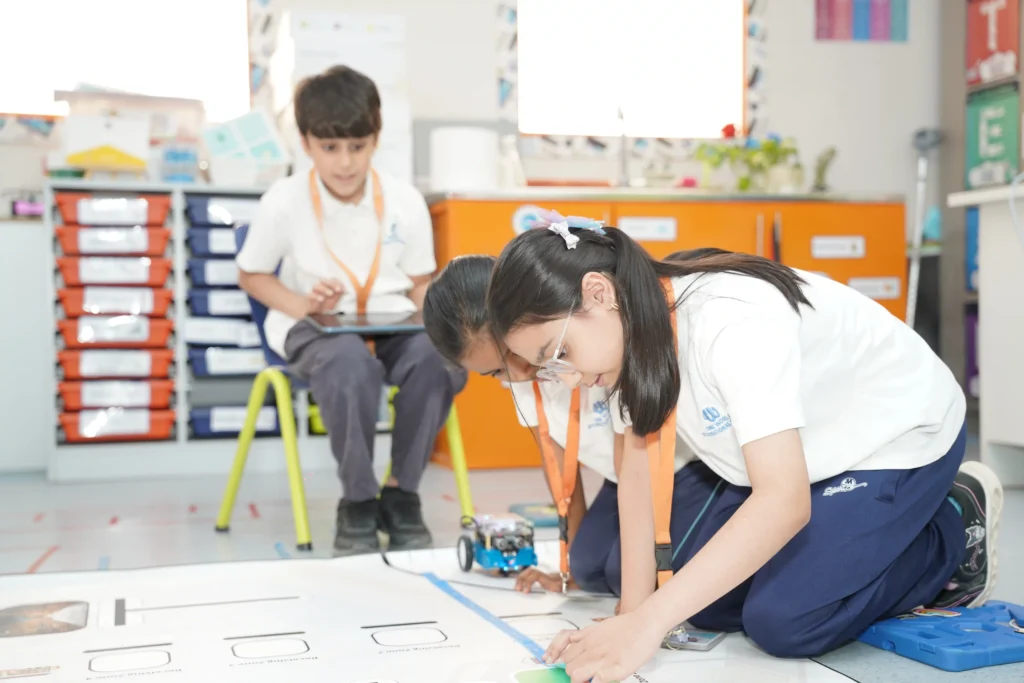
- It starts in the Early Years, where students learn in ZeroOne Hub, our home-grown makerspace, for hands-on, screen-free activities. With coding and robotics kits, they build the basics of sequencing, logical thinking, and problem-solving before they ever touch a keyboard. Projects link to Science and their Units of Inquiry, and VR headsets are used across subjects to add depth to learning.
- As children move into primary school, the pathway deepens. In Grades 1 to 3, students begin coding with ScratchJr and explore screen-free robotics with tools like KUBO and Matatalab, along with introductory 3D design. By Grades 4 and 5, they progressed to Scratch, Sphero robotics, and micro:bit, and take their first steps into AI programming through sensor integration.
- The pathway continues through middle and high school, where students work on digital literacy, Python programming, app and web development, and more advanced AI concepts, including data-based predictions and conversations around ethics and responsible technology use.
How to keep children safe online in the age of AI
Online safety has always mattered, but AI adds new layers for parents to think about. A few practical ways to help:
- Talk openly and often – Make technology a normal conversation rather than a taboo. Ask your child what tools they’re using, what they like, and what confuses them. Open dialogue makes it easier for them to come to you when something feels wrong.
- Teach them to question what they see – Not everything online is true or human-made. Help children understand that AI can make mistakes, invent information, and be misused, and encourage them to check sources.
- Set healthy boundaries. Agree on screen-time limits, tech-free zones, and clear rules about privacy and sharing personal information.
- Partner with your school. Responsible technology use is a shared effort between home and school. Schools that teach digital citizenship give children a strong base, and that learning holds best when families reinforce the same values at home.
AI and Homework: What Should Parents Allow?
Perhaps the hardest question of all: should children use AI tools for homework? The honest answer is that it depends on how it’s used.
AI can be a useful learning aid. It can help a child brainstorm ideas, explain a tricky concept, or check their understanding. The problem is when it replaces thinking altogether. If a child uses AI to produce an answer they don’t understand, the learning is lost.
A helpful rule of thumb: AI should support learning, not do the learning. Encourage your child to use it the way they might use a tutor or a dictionary, as a guide to understand rather than a shortcut to finish. Ask your child’s teachers about the school’s expectations, and keep the focus on real understanding rather than a polished final product.
This is where a school’s values matter. When children are taught from a young age to be honest, curious, and independent, they learn to use tools like AI with integrity.
Preparing children for a future we can’t yet see
Through a clear technology pathway that runs from the Early Years to high school, from computational thinking and hands-on exploration to coding, robotics, AI awareness, and digital design, we give students real chances to apply their skills through projects and competitions, including our robotics clubs across primary and secondary school. And we ground all of it in the values of kindness, responsibility, and integrity that guide how we work.
OWIS Riyadh is an international school offering the IB Primary Years Programme integrated with the American curriculum based on Common Core and NGSS. To learn more about our approach to learning and technology, book a campus tour or connect with our Admissions team.