As a parent, when you choose a school, you are choosing the room your child will spend their days in, the adults who will shape how they see themselves as learners, and the first version of the world outside your home. The early years carry that weight. They are when children form their first relationships with learning, when curiosity becomes a habit, and when foundational skills shape everything that follows. At OWIS Al Jazeera, our Kindergarten and Elementary School program has been designed to give children in Riyadh a thoughtful, well-rounded start through an American curriculum, delivered in an environment that honors both global standards and local values.
For families exploring American international schools in Riyadh, here is what you can expect from our youngest grades.
A Kindergarten built on strong foundations
Our Kindergarten program is designed around the individual child rather than the group. Lessons are structured and developmentally appropriate, but never rigid – every activity, from morning circle to story time, is built to nurture curiosity and inquiry.
In this stage, our students focus on building literacy and numeracy skills that prepare them for Grade 1. Reading for KG2 includes phonics and independent reading. Math at the KG2 level moves from counting and patterns into early problem-solving. Alongside academics, we place equal emphasis on social and emotional development – because a child who feels secure, seen, and capable is a child who learns well.
KG 2 to KG 3 we focus on sensory learning, play-based exploration, and dedicated time for writing practice to support fine and gross motor development. Children paint, build, sort, sing, and move – and through these experiences, they develop the coordination and confidence that more formal learning will later draw on.
Communication with families is consistent and frequent. Our reporting in the Kindergarten stage is skills-based, with practical ideas for how parents can support learning at home.
Lower Primary (Grades 1–2) learning at OWIS Al Jazeera
In Lower Primary, our American curriculum builds on the foundations laid in Kindergarten. Reading, math, science, and Arabic continue to develop through inquiry-based learning, where children are encouraged to ask questions and discover answers.
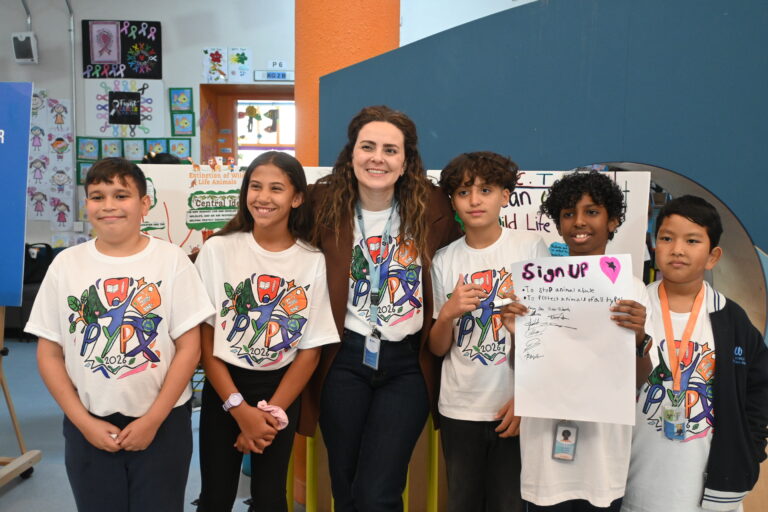
This is the stage where project-based learning and STEAM begin in earnest. Children work on hands-on projects that bring multiple subjects together, and cooperative learning strategies introduced from Grade 1 help them build the leadership and social skills they will rely on for years to come.
A few of the experiences that define this stage at OWIS Al Jazeera:
- A balance of traditional and digital– Children continue to develop fine motor skills through paper-and-pencil work while building the digital fluency expected of 21st-century learners.
- Differentiated instruction – Teachers meet each child at their individual learning level, using assessment to monitor progress and adjust teaching accordingly.
- Learning centers and guided reading – Small-group instruction allows our educators to support each child precisely where they are.
- Advocacy Hour – A dedicated time built into the schedule to promote social skills, kindness, and global awareness
- A connection to the wider world – Virtual pen-pals and scheduled e-visits to our Global Schools partner schools open up early international perspectives.
Specialist subjects including art, music, physical education and more focus on skill development and on participation in age-appropriate community and national competitions, alongside in-house events like science fair and market day.
Upper Primary (Grades 3–5) Learning at OWIS Al Jazeera
In Upper Primary, Reading is no longer the goal in itself – it becomes the tool through which they explore science, history, literature, and Arabic in greater depth. Writing skills take on a more central role, with children learning to organize their thinking, support their ideas, and communicate clearly across subjects.
Academic rigor increases at this stage to ensure our students are meeting Common Core State Standards. Differentiated instruction remains central: children who need additional support receive it early, and those exceeding expectations are challenged through enrichment.
Project-based thematic units are a defining feature of these years. Lessons are organized around real-world questions and connected to our school’s vision of building globally prepared leaders. Assessments shift to a 0–100 grading scale, giving children and families a clearer picture of academic progress while maintaining a focus on the whole child – academics, sports, arts, talents, social skills, and emotional well-being.
In Grades 4 and 5, students are introduced to KSA History classes and OWIS Talents, our in-house program focused on leadership and entrepreneurship. These additions reflect something we believe deeply: that children growing up in Saudi Arabia deserve an education that prepares them for the world while remaining proudly rooted in the place they call home.
Extracurricular Activities Across Kindergarten and Elementary
Our extracurricular offerings are built into the schedule rather than treated as an afterthought. Children participate in sports, arts, music, STEAM clubs, and community-focused activities, and as they move into upper elementary, they gain opportunities to represent the school in competitions and national events.
These programs are not separate from learning. They are part of how we help our students discover what they are good at, what they enjoy, and what kind of leader they want to become.
What sets OWIS Al Jazeera apart
For parents researching new world international school options in Riyadh, the differences often come down to philosophy. At OWIS Al Jazeera, we believe early education should be intellectually rigorous, emotionally safe, and culturally grounded. Our American curriculum offers global academic standards. Located in Riyadh under the patronage of the Royal Commission for Riyadh City and aligned with Vision 2030, our school offers students something equally valuable – a sense of belonging to a country investing decisively in its young people.We welcome families to visit, meet our teachers, and see what learning looks like in our classrooms.