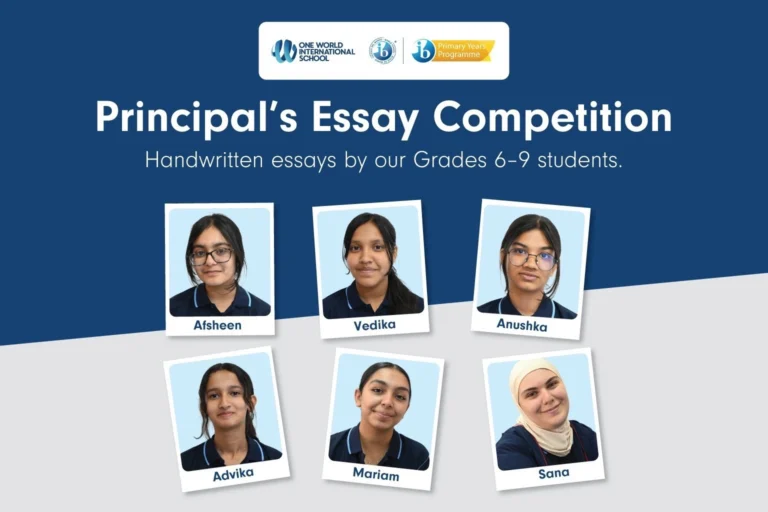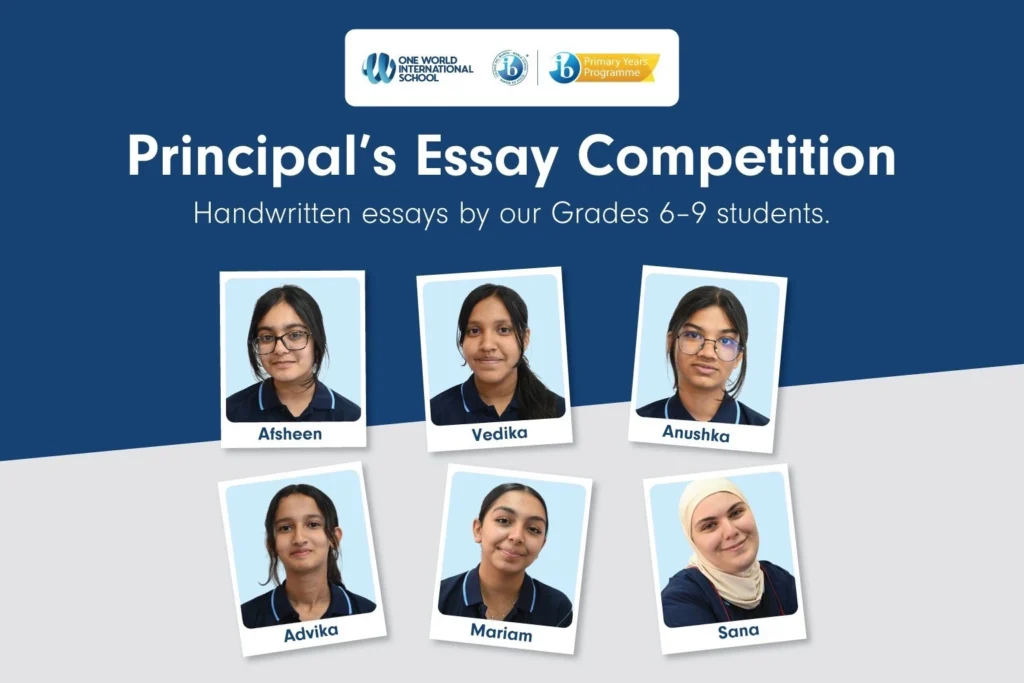
Last week, our Principal’s Essay series opened a space for students to reflect, write, and be heard. This week, the response was just as moving. For Week 2, students across Grades 6 to 9 were invited to respond to the prompt: Describe a challenge you have faced and explain how it helped you grow as a learner and as a person.
What came back were stories of courage, of stage fright faced head-on, of perfectionism unlearned, of habits rebuilt one small step at a time. Some wrote about surgery and recovery. Others wrote about the harder-to-see battles: comparison, self-doubt, and the long road to self-acceptance. Each essay is presented here exactly as the student wrote it, in their own voice and their own words.
Here are their reflections.
Advika Bijit – Grade 8A
One experience that changed my perspective on health and life was undergoing emergency surgery for appendicitis. Before this incident, I had never been admitted to a hospital or experienced severe pain. What started as a normal day quickly turned into one of the most frightening and memorable moments of my life.
The pain began suddenly in the afternoon as a mild discomfort around my stomach. That too I was on a flight to my home country. At first, I ignored it, thinking it was something minor such as indigestion or food poisoning. However, within a few hours into the flight, the pain became sharper and moved to the lower right side of my abdomen. I also started feeling nauseous and weak. Sleeping, sitting and even breathing deeply became uncomfortable. My mother who was with me on the flight noticed that I was sweating and unable to stand properly, so she immediately informed the crew. When we landed, I was taken directly to the airport emergency room immediately.
At the Clinic, the doctors asked me several questions and performed a physical examination. After the examination, they asked my mother to immediately shift me to a hospital as they doubted the appendix was heavily infected and could burst any moment.
At the hospital, I went for blood tests and a scan. The surgeon confirmed that I had appendicitis and needed surgery as soon as possible. Hearing the word “surgery” made my mother extremely nervous. I had my own fears running through my mind: Would the operation be painful? Would there be complications? Although the medical staff tried to reassure my mother, we went for a 2nd opinion. The doctor also informed me that an immediate surgery is required.
The moments before the surgery were the most emotional. I remember lying on the hospital bed, surrounded by bright lights and unfamiliar machines. The nurses spoke kindly to calm me down, and the surgeon explained the procedure carefully. Soon after receiving anesthesia, I fell asleep.
When I woke up, I felt weak and sore. My mother later informed me that I had shouted at the doctor who came to inspect the wound. But I was relieved that the surgery had been successful. The doctors told me that my appendix had become badly inflamed and could have burst if I had delayed the treatment any longer. During the next few days, I stayed in the hospital recovering. Although moving around was difficult at first, I gradually regained my strength. The support of my family and the kindness of the hospital staff made the recovery easier.
This experience taught me several valuable lessons. First, I learned never to ignore serious health symptoms. Second, I realized how important doctors and nurses are in helping people during emergencies. Finally, the experience made me more grateful for my health and for the support of my loved ones. Although it was a painful event, it also became a reminder of how quickly life can change and how important it is to take care of ourselves.
Afsheen – Grade 8A
Everyone faces challenges in life, but sometimes those difficult challenges teach us very important things. One challenge I faced was learning how to speak up and share my ideas with others. I used to be very quiet in life, especially during group work, presentations, and discussion. Even when I knew the answer, I often stayed silent because I was afraid of being wrong or being judged.
At first, being quiet did not seem like much of a problem. I thought it was easier to stay in the background and let others speak. However, over time, I realized that I was missing out on many opportunities to learn and grow. Sometimes I had ideas that could help, but I kept them to myself.
This became more difficult when I had to present group projects. I felt nervous every time I had to speak in front of others. My voice became quieter and I worried about saying something wrong. Even simple tasks felt stressful.
Instead of avoiding these situations, I slowly tried to improve. I started by trying to speak more during group activities and voicing a few of my ideas. To help overcome my fear, I told myself over and over again that everyone makes mistakes and it’s normal to be wrong sometimes. Slowly, I became more comfortable sharing my thoughts and opinions until I could fluently do group presentations.
This experience has helped me grow and improve as a student as I became more confident and involved in class activities. I learned that learning isn’t only about listening. It’s also about participating, asking, and expressing ideas.
Overcoming this challenge also helped me grow as a person. I became braver and started trying new things. Along the way, I understood that confidence doesn’t appear instantly. It develops through effort. I learned that failing and making mistakes is normal and that it shouldn’t stop me or anyone from trying.
Looking back, I’m glad I faced this challenge because it taught me a valuable lesson. My ideas and opinions matter, and staying silent isn’t always the best choice. Today, I have overcome this challenge nearly entirely and even participated in a TED Talk event, something I thought I could never do. Although I still get nervous sometimes, I am more confident than before and am willing to take new opportunities.
Anushka Chitrapu – Grade 8A
I am not the type of person who has everything organized. I’m not the “I follow a daily timetable” or “I wake up at 5AM” or “I finish my assignments a week early” type. In fact, I would say I’m more like the “I’ll start my homework at 8:30 PM, stare at the wall for twenty minutes, and then suddenly remember I have a billion things due tomorrow.” Time management is my BIGGEST weakness (notice the emphasis on biggest?). In fact, if there was a “Best last minute assignment rusher”, I would definitely get the first place, I wouldn’t even have to try! And getting easily distracted? Let’s not even talk about that. And did I mention I procrastinate like it’s my job? And convince myself that I have “a lot of time” when I absolutely don’t and then lose motivation entirely. But even though all this was extremely stressful, it helped me improve. Not entirely, but a little, and that first step matters a lot, every small improvement matters.
My issue was not that I didn’t care about school or grades, in fact I did care a lot, but my laziness won the ultimate battle between doing my assignments and just relaxing and doing nothing. And is it just me who gets sudden motivation at 3AM (yes, 3AM) to do all my unfinished works, my homework from last week, my presentations, the unfinished drawing that has been sitting in the empty sketchbook I begged mom to buy. But I end up watching a thousand episode anime the next day (and yes, you heard that right, it does have a thousand
Assignments keep piling up fast, a new poster to make, a presentation to make. I was constantly rushing last minute everyday. Every single day, telling myself I’ll do it early next time. Spoiler: I didn’t. And this made me very stressed and affected my other hobbies I wanted to do. The change wasn’t sudden. It wasn’t a motivational speech on youtube or a sudden self-control moment. I started slow. I realized I can’t be like this forever. I had to get rid of this violent battle myself, not instantly, just slow but steady.
I first started by working for ten minutes. No electronics, no comics and absolutely no wall-staring. I also split my assignments into smaller parts to trick myself into thinking that it would be just a single math problem, then when I’m fully focused, nothing can distract me easily and I end up finishing all the questions, and think “Wait a minute …I finished the whole thing?!”. These small changes did not make me a “perfect” student but helped me improve and made school work a lot less impossible.
Through this challenge, I learnt that being a strong learner isn’t about being very organised, it’s about understanding and adjusting my habits. Motivation doesn’t just spawn in you, I have to do it even when I don’t feel like it. Because even the small adjustment in your schedule makes a huge difference.
Mariam – Grade 9A
At some point in my life, I was running a race that did not exist. There was no starting point or line painted on the ground. There was no finish line waiting in the distance. No crowd cheered. No medals were awarded. Yet every morning I woke up exhausted from running it.
The race lived entirely inside my head. I raced classmates who earned higher grades. I raced students who seemed more talented. People who appeared more confident, more successful, and somehow more certain of who they were. While everyone else seemed to be moving forward, I constantly worried that I was failing behind. Every achievement felt temporary because there was always someone doing something better. Every success became another reason to compare myself to others.
What made this challenge even more difficult was that nobody could see it. From the outside everything looked normal. I attended school, completed assignments, and participated in activities like every other student. Inside, however, I carried the weight of impossible expectations. I believed that my value depended on how well I performed compared to everyone around me. Without realizing it, I had turned life into a competition.
I remember I was sitting one afternoon, while watching some birds gather. I noticed something strange. Not a single bird seemed concerned about flying higher than the others. Some are soft and quiet. Some soared through the sky. Some arrived later than the rest. Yet each one moved at its own pace. Some reason that moment stayed with me. Why was I spending so much energy measuring my journey against someone else’s? That question became the beginning of a transformation. Slowly I started changing the way I thought. Instead of asking “Am I better than others?” I began asking “Am I better than I was yesterday?” It sounds like a small difference, but it changed everything.
But you know what I learned is that comparison is like standing in a garden and getting mad or criticizing a rose for not being a sunflower. Because the rose was never meant to be a sunflower. It was always meant to become the fullest version of itself. The garden held many beautiful flowers. In the same way every person has different strengths, different dreams, and different paths. Comparing one life to another is like comparing stars to oceans. Both are beautiful, but they were never designed to be the same.
The challenge did not disappear overnight. Some days, I still caught myself comparing my progress to others. However, I began to understand something important: that this is life there are good days and bad, sad and happy. It was never a race. It has always been a journey that you alone have to go through.
Around that time, I learned about a Japanese art called Kintsugi, the practice of repairing broken pottery with gold. Instead of hiding the cracks, artists highlight them, believing that the object’s history makes it more beautiful rather than less valuable. That idea stayed with me. For years, I had treated my mistakes, insecurities, and struggles as cracks that needed to be hidden. Kintsugi taught me the opposite. Our challenges are not flaws that diminish us; they are part of the story that shapes us. Like pottery repaired with gold, people often become stronger, wiser, and greater because of the difficulties they overcome.
As a learner, this realization changed my relationship with education. I stopped viewing mistakes as evidence of failure and started seeing them as opportunities for improvement. Instead of being discouraged by someone’s success, I became inspired by it. I learned to focus on understanding rather than perfection. My confidence no longer depended on being the best; just on becoming the better. For myself.
As a person, I became more compassionate. When I stopped treating life like a competition, I found it easier to celebrate the achievements of others. I discovered that another’s success does not diminish my own potential. The sky does not run out of stars simply because one shines brightly. There were moments when progress felt invisible. There were days when I questioned myself and wondered whether I would ever make it. During those times, I repeated to myself a promise I had made: “If I do not make it today then I will make it tomorrow and if I do not make it tomorrow, then I will make it the day after tomorrow and if not then, I will make it one.” Those words became more than motivation. They remind me that success is not about speed but persistence. The people who achieve their dreams are not always the most talented; they are the ones who refuse to give up.
Like the art of Kintsugi, I have learned that the cracks, the set backs, and challenges in my journey are not weakness to hide but gold to carry proudly. The race I spent years running never truly existed. The only person I was ever meant to compete with was the person I was yesterday. If I do not reach my destination today, I will reach it tomorrow, if not tomorrow then another day. Growth is not measured by how quickly we arrive, but by whether we continue moving forward. In overcoming that challenge, I discovered something far more valuable than winning any race. I discovered myself.
Sana – Grade 9A
Walking into my 7th grade English class on a random Tuesday, I thought it was going to be a normal day. Then, Ms. Samar dropped a bombshell on us. We weren’t just writing a research report on a historical figure, we had to present it out loud to the entirety of 7A and 7B class. My stomach instantly did a backflip. Public speaking has always been my absolute biggest fear. Whenever I think about standing in front of a crowd, my hands start to sweat, and my heart starts to beat faster than usual. Not to mention, my mind completely goes blank. It felt like being asked to climb Mount Everest with no shoes.
For the next 2 weeks, the upcoming presentation was like a dark cloud hanging over my head. Every time I tried to write my report about Amelia Earheart, I could not focus because I was too busy imagining all the ways I could mess up. What if I tripped on my way to the front of the room? What if I forget how to pronounce a basic word? What if everyone laughed at me? The anxiety was eating me alive, and it started affecting my schoolwork. I was procrastinating big time because thinking about the project just made me stressed out.
Finally, a few days before the presentation, ignoring the problem was not making it go away. In fact, it was making it worse. I decided I needed to face this challenge head-on, even if it was terrifying. I told my sis how scared I was, and she gave me some really great advice, and told me that confidence does not just show up out of nowhere; you have to build it through practice.
So I started practicing, alot. First, I read my speech out loud to my boredom wall until I knew the info inside and out. Then, I forced myself to present it to my parents and my fish in the living room. My voice shook a little bit at first, and I kept looking down at my notes, but by the 3rd time, it felt a little bit easier.
When the day of the presentations arrived, my name was called third. As I walked up to the front of the class, my legs felt like jello. I looked out at 25 pairs of eyes staring at me, and for a split second, I panicked, my brain completely froze. But then, I looked at my notes, I took a deep breath, and remembered how I practiced.
I started talking. At first, my voice sounded way higher than normal, and I was speaking too fast. But as I kept going, I found a rhythm. I looked up and saw my best friend, maram, giving me a nod, which helped me relax. By the time I reached my conclusion about Amelia Earhart’s bravery, I was not even shaking anymore. When I finished, the class clapped, and I walked back to my desk smiling. I had actually done it!
Overcoming this challenge taught me so much about myself, both as a student and as a person. As a learner I realized that preparing and practicing is the best way to handle academic stress.
Vedika Hirave — Grade 8A
In the quiet of my bedroom, I was an amazing speaker. Pacing across the carpet and gesturing in front of the mirror and the empty walls, my voice was steady, resonant and alive. I was preparing for my school’s TED Talk auditions, and during my private practices, I nailed every single sentence. I knew my topic inside and out, and I felt completely ready. But a week later, standing in the library under the unblinking eyes of my two teachers; who were the judges for the audition, holding clipboards, that confidence partially evaporated. At the start it went well, but at one point, I completely messed up my lines. In my panic, I actually said a line from a different scenario in a completely different one. Looking up and seeing the judge’s reaction as they immediately started writing on their clipboard made it worse. I knew the material, but in the final, most important moment, I choked. That brutal afternoon forced me to realize a harsh reality: practicing perfectly in private means nothing if you collapse under pressure when it actually counts. This failure completely rewired how I think, forcing me to change from a student who just memorizes facts into someone who knows how to handle stress.
Before this audition, my strategy as a learner was based on staying comfortable. I believed that studying just meant sitting in a quiet room and repeating a concept until it felt easy. If I could remember the answer perfectly at my desk, I assumed I was ready for anything. The audition showed me the huge flaw in that logic. I had practiced in a perfectly safe bubble, completely forgetting to prepare for the pressure of a real audience. This realization fundamentally changed how I handle schoolwork. Now, I no longer protect myself from discomfort when I study; I actually look for it. When preparing for a tough math or a F.L presentation, I intentionally create stressful situations. I set stricter timers to force myself to think fast, I practice with family members, especially my sister. While they try to distract me, do mind calculations instead of using a calculator. I learned knowing something is one thing, but being able to remember it when you are nervous or when things don’t go as planned is a completely separate skill.
On a personal level, this failure broke a dangerous myth I used to believe: the idea that some people are just naturally “clutch” and can nail a performance without trying. I used to think that was the goal. But watching my audition fall apart taught me that relying on last-minute luck or adrenaline is a terrible strategy. I had to learn the maturity to forgive myself for messing up, while also taking responsibility for how I prepared. I realized that real confidence is the absence of fear, and it isn’t a magical power that just shows up. Real confidence is built by practicing through the panic, learning how to steady a racing heartbeat, and choosing to speak even when your hands are shaking. It made me a much stronger person because I stopped waiting for perfection to just happen, and started learning how to build resilience.
I did not get selected for my school’s TED Talk. For a time, mention of TED Talk felt like a punch to the stomach. However, the sting of that rejection eventually turned into a feeling of gratitude. The audition room took away my illusion of easy success, but perfection, but it gave me something much better: a blueprint for true mastery. I still practice my speeches in the quiet of my bedroom. But now, when I look in the mirror, I don’t just see a student reciting lines. I see a performer who is finally ready to step out of their comfort zone, turning the mistake while talking into an actual fact or speech, and speak when it actually matters.
We’re proud of every student embracing the Principal’s Essay series with such enthusiasm. There’s real beauty in watching their ideas take shape – sincere, hopeful, and unmistakably their own.