

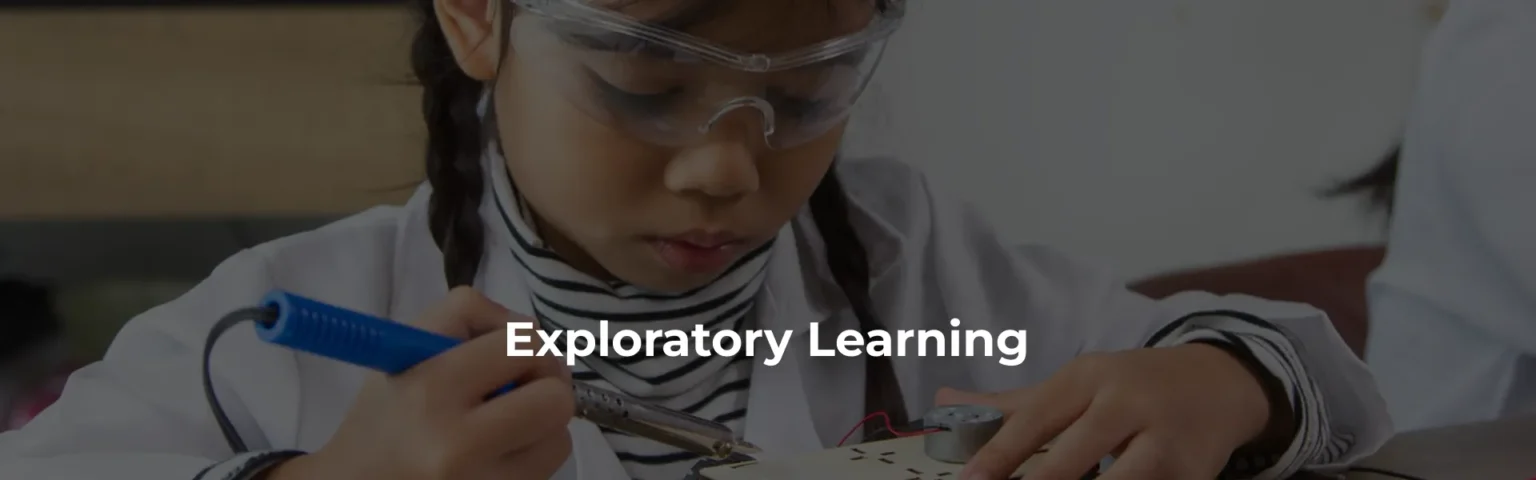
As one of the leading international schools in Bangalore, India, we believe that children learn best when they are genuinely engaged- when they are asking questions, testing ideas, and making sense of the world around them. That is what exploratory learning is all about.
What Is Exploratory Learning?
Exploratory learning is a student-centred approach to education where learners construct knowledge through direct experience rather than passive reception of information. Instead of simply listening to a teacher deliver content, students observe, question, experiment, and reflect. The learning is driven by curiosity, and the process of discovering an answer matters as much as the answer itself.
This approach sits within a broader family of active learning methods, including inquiry-based learning and discovery learning, all of which share a common belief: children are natural investigators, and education should honour that instinct.
Why Does Exploratory Learning Matter?
Research in cognitive development consistently shows that children retain information more effectively when they arrive at understanding through experience. According to educational theorist Jean Piaget, children build knowledge by actively engaging with their environment. Similarly, Jerome Bruner’s work on discovery learning emphasised that learners benefit far more from working through problems themselves than from receiving ready-made answers.
Beyond academics, exploratory learning cultivates skills that matter across a lifetime:
- Critical thinking and problem-solving
- Collaboration and communication
- Resilience and adaptability
- Creativity and independent judgement
These are precisely the competencies that universities and workplaces seek in young people today.
How Does Exploratory Learning Work in Practice?
Exploratory learning takes many forms depending on the age group and subject. Here is a quick overview of what it can look like across different stages:
| Stage | Example of Exploratory Learning |
| Early Years | Sensory play, nature walks, open-ended building activities |
| Primary Years | Science experiments, project-based investigations, storytelling through art |
| Middle Years | Real-world problem solving, fieldwork, design challenges |
| Diploma Years | Independent research, extended essays, community action projects |
At OWIS, one of the best schools in Whitefield, Bangalore, all four IB programmes are designed around inquiry-based learning, encouraging students to ask questions, explore ideas, and draw independent conclusions. In the Early Years, IB-aligned play areas promoted curiosity through hands-on exploration. Primary students showcase learning through the PYP Exhibition (PYPX), while Middle Years students participate in portfolio and Personal Project exhibitions. Diploma Programme students engage in TOK exhibitions that strengthen critical thinking and communication. These experiences help students become confident, reflective, and articulate learners at every stage.
Who Benefits From Exploratory Learning?
Simply put, every learner. However, this approach is particularly powerful for students who struggle with traditional rote-based methods. When children are given the freedom to explore at their own pace, they develop greater confidence and a more genuine love of learning. Teachers benefit too, because exploratory classrooms are dynamic and reveal each student’s thinking in real time.
Which Skills Does Exploratory Learning Develop?
The IB Learner Profile offers a useful lens here. Through exploratory learning, students grow as:
- Inquirers who ask meaningful questions
- Thinkers who approach problems with logic and creativity
- Communicators who share their findings clearly
- Risk-takers who are willing to experiment and learn from failure
- Reflective learners who evaluate their own thinking
When and Where Does Exploratory Learning Happen at OWIS?
At our campuses in Bangalore, exploratory learning takes place every day, across every subject. It happens in science labs, design studios, outdoor green spaces, and even during group discussions in the classroom. As one of the leading IB schools in Bangalore, OWIS structures its timetables and learning environments to give students room to explore, collaborate, and create.
Our Whitefield campus is designed with dedicated spaces that actively encourage hands-on discovery. Our Sarjapur campus offers a full IB continuum from Early Years to the Diploma Programme, all grounded in this exploratory ethos.
Frequently Asked Questions
No. While play is one vehicle for exploration, particularly in Early Years, exploratory learning at all levels involves clear learning goals, teacher facilitation, and structured reflection.
Assessment focuses on the process as much as the outcome, including observations, portfolios, presentations, and reflective journals rather than tests alone.
Yes. Students who develop strong inquiry and analytical skills through exploratory learning are well-equipped for the rigorous assessments of the IB Diploma Programme.
Absolutely. Asking open-ended questions, encouraging tinkering, visiting museums, and allowing children to pursue their interests are all powerful ways to extend exploratory learning beyond school.