


Whitefield’s shift from Bangalore’s eastern outskirts to a central IT corridor brought an unexpected consequence: a concentration of international schools unlike anywhere else in the city. The area now houses multiple IB Middle Years Programme schools within a few kilometres of each other, a density that reflects the specific demographics of families who have settled here.
When tech parks and multinational offices clustered in Whitefield, they attracted employees who frequently relocated for work. Their families needed education frames that would work in Bangalore today and maybe in Berlin tomorrow, and the MYP’s globally recognised framework provided exactly that solution.
Why should parents choose an IB school in Whitefield for their child?
Whitefield’s transient, multicultural community needs an education that travels well. The IB MYP offers a globally recognised framework, so your child’s learning stays seamless, wherever the family’s next move takes them.
The Numbers Behind the Shift
A decade ago, India had fewer than 250 international schools serving fewer than a lakh students. Today, the country has approximately 150 IB schools and 600 Cambridge curriculum schools, educating 4-5 lakh students. Bangalore sits at the centre of this expansion, with 70 international schools, trailing only Delhi nationally.
Whitefield houses a substantial portion of these schools, and the reason is straightforward: multinational corporations established operations here, bringing employees from around the world. When families relocate every few years for work, switching between different national curricula creates real problems. Within the IB framework, an MYP student can move between cities and countries while continuing in the same program.
How the Middle Years Programme in IB Works
Traditional Indian education systems focus heavily on exams and content recall. The Middle Years Programme in IB takes a different approach. Instead of memorising historical dates, it pushes students to spend weeks investigating with questions like “How do societies respond to rapid change?” Instead of memorising scientific formulas, they design experiments to solve real problems.
According to an education sector analysis, international schools shifted “from traditional methods of information and testing to experiential learning. There is a lot more focus on understanding concepts and delving deep into one particular topic, and lots of projects and less testing of memory.”
It resonates with Whitefield’s professional community. Parents working in software development, business analytics, or engineering solve complex problems daily that don’t have textbook answers. They recognise their children will need the same capability to analyse information, work collaboratively, and adapt to unfamiliar situations. The MYP’s emphasis on critical thinking over memorisation lines up with what these parents know about professional success.
What IB Education Actually Costs
The perception that international schools are unaffordable doesn’t match the current reality in Bangalore. While top-tier IB MYP authorised schools charge ₹1.5-2 lakh monthly for extensive facilities and internationally recruited teachers, many schools offer Cambridge and IB programs for ₹1-1.5 lakh annually, similar to established CBSE and ICSE schools.
The affordable pricing has opened international education to middle-class families. Parents who want project-based learning and the development of critical thinking skills for their children now have options beyond premium-priced institutions. The decision to adopt international curricula highlights the parents’ values and beliefs about education, rather than just their ability to pay for them. Even families who are not planning to send their children overseas select the MYP because they value its approach to learning.
Why Whitefield’s Infrastructure Supports MYP
Good schools in Whitefield, Bangalore typically have science labs built exclusively for extended investigations, technology infrastructure supporting collaborative digital projects, and flexible spaces where students can work on interdisciplinary assignments.
The concentration of MYP schools in Whitefield creates advantages beyond individual campuses. Teachers move between institutions, bringing successful practices with them. Schools organise joint events where students present their personal projects to broader audiences. Parents find others managing similar situations: supporting inquiry-based homework, preparing for international university applications, or handling mid-year relocations while maintaining educational continuity. It is a community effect that makes Whitefield particularly conducive for families pursuing international education.
Where Is IB Growth Heading
The international school sector projects 10-15% annual growth, meaning 70-100 new schools yearly across India. Smaller cities are now launching international programs, but Bangalore maintains its lead, and within Bangalore, Whitefield’s established cluster of schools continues to expand.
Between 2019 and 2025, India’s international school sector recorded a notable increase in schools, students, staff and fee income — highlighting sustained growth in both numbers and demand for global curricula.
The upward trajectory appears sustainable. The IT and business sectors in Whitefield are growing, bringing in more families who need internationally recognised education. Indian parents increasingly notice that the National Education Policy’s stated goals, such as experiential learning, reduced exam pressure, and conceptual depth, are already in place in international schools in Bangalore.
The sector’s primary constraint isn’t demand. According to education leaders, “finding quality teaching staff remains one of our bigger challenges.” International schools need teachers with specific certifications. Most recruit from CBSE and ICSE systems, then provide additional international training. Professional associations now offer dedicated platforms for this upskilling, indicating the sector is addressing quality alongside quantity.
Conclusion: What This Means for Families
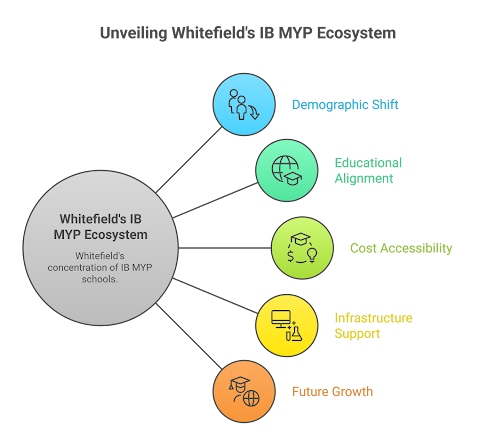
Whitefield became an MYP education hub for practical reasons: multinational companies brought internationally mobile families; these families needed curriculum continuity; tech-sector parents valued skills-based education; and the area had the infrastructure to support quality implementation. Each factor reinforced the others, creating an ecosystem that promotes international education.
The concentration of IB curriculum schools in Bangalore, particularly in Whitefield, gives families options. Parents can compare programs, visit campuses, and choose schools that align with their children’s learning styles and family’s educational philosophy.
The question isn’t whether Whitefield suits international education; the presence of multiple successful IB MYP authorised schools answers that. The question is which specific school fits a particular family’s needs. Having several quality options to evaluate, all within a reasonable distance, represents a genuine advantage that few other areas in India can match.