

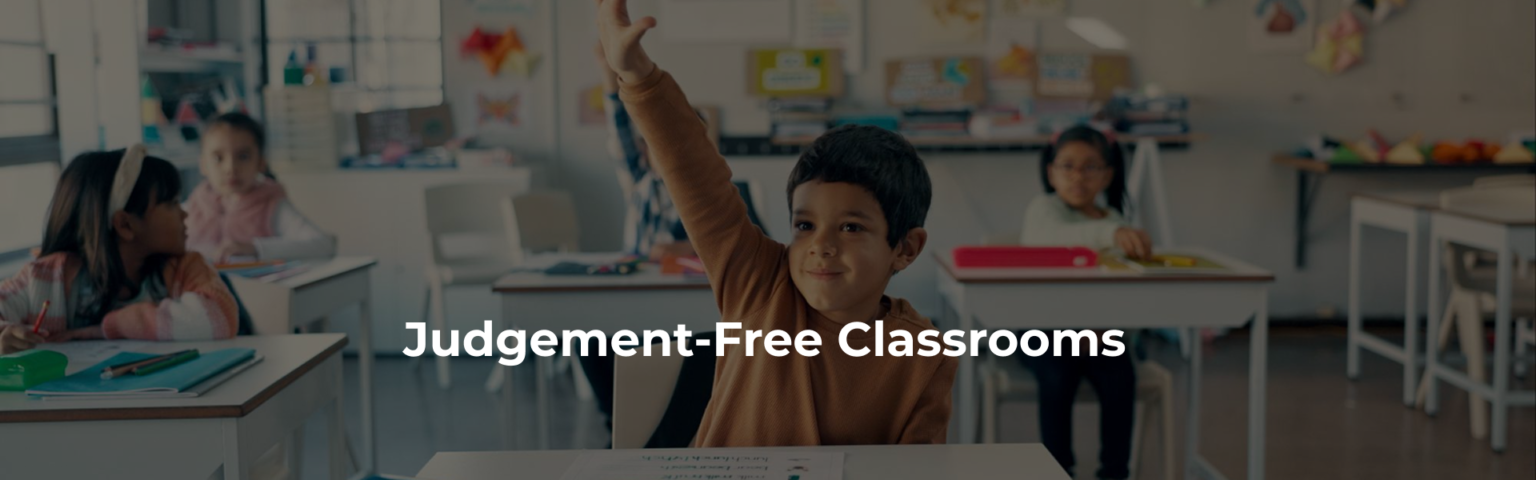
Every student deserves to enter a classroom feeling acknowledged, respected, and free to learn at their own pace. Yet for many children in India and around the world, the fear of making a mistake in front of peers or teachers holds them back. A safe learning environment not only entails physical security but also emotional warmth, psychological comfort, and the confidence to speak up without fear of judgment.
According to research published in the Indian Journal of Community Medicine, at least 50% of high school students in India experience some form of mental health challenge, with anxiety (64%) being the most common, followed by depression (56%). A 2025 cross-sectional study from Delhi found that 25.92% of school-going adolescents faced depression, while 13.70% experienced anxiety. Much of this distress stems from academic pressure, fear of failure, and social factors in which mistakes are penalised harshly.
India’s National Education Policy (NEP) 2020 explicitly calls for the implementation of socio-emotional-ethical development in school education, emphasising play-based, enquiry-driven learning and shunning rote memorisation.
International Schools in Bangalore, India that follow the IB curriculum use practical learning tools to enable risk-taking, open-mindedness, and reflective thinking among students.
What Makes a Classroom Psychologically Safe?
Harvard researcher Amy Edmondson defines psychological safety as the shared belief that a team or group is safe for interpersonal risk-taking.
Six key elements make students feel safe in learning environments:
- Familiarity with peers and educators
- Peer learning opportunities
- Face-to-face availability of teachers
- Learning without high-stakes risk
- Consistency across educators
- Clearly communicated, achievable objectives.
“Fear of failure stifles learning. When learners fear making mistakes, they stop trying. They avoid taking risks, which means they miss out on key learning moments.”
— Elizabeth Zandstra, Senior Instructional Designer
In schools, a safe learning environment means feeling comfortable asking questions, admitting confusion, sharing ideas, and making mistakes without fearing ridicule or punishment.
Why is a Positive Learning Environment Important for IB Students?
The IB framework inspires students to be enquirers, thinkers, and communicators. But none of this would be possible if a student were apprehensive about being wrong. A psychologically safe student can engage in active learning and teamwork. Without it, students hide their mistakes, avoid participation, and miss out on the cognitive benefits of learning from errors.
For students at the best IB schools in Bangalore, a positive classroom environment promotes collaborative projects and interdisciplinary learning, which are central to IB subjects.
How Do Safe and Unsafe Classrooms Compare?
The table below highlights the contrast between classrooms that enable psychological safety and those that don’t:
| Judgement-free Classroom | Intimidating Classroom |
|---|---|
| Mistakes are treated as learning opportunities | Mistakes are severely reprimanded |
| Students feel comfortable asking questions | Students stay silent to avoid judgement |
| Feedback is constructive and specific | Feedback focuses on what went wrong |
| Peer collaboration is encouraged | Competition overshadows cooperation |
| Teachers show humility and openness | Teachers maintain rigid authority |
| Learning goals are achievable and clear | Expectations are vague or unrealistic |
How Can Teachers Build a Judgement-Free Classroom?
Research by Hardie et al. (2022) in BMC Medical Education outlines practical guidelines for educators to build psychologically safe spaces. Here are strategies that IB teachers and educators at international schools can adopt:
- Normalise mistakes openly. Share your own learning errors with students. When a teacher says, “I made the same mistake when I was learning”, it instantly reduces the shame associated with getting things wrong. Using more empathetic teaching approaches helps learners feel that they belong and are included.
- Use low-key practice before high-stakes assessment. Simulations, peer reviews, and mock scenarios let students practise without the anxiety of grades hanging over them. Show students valuable learning experiences that do not count toward their final marks.
- Provide specific, solution-focused feedback. Instead of simply pointing out errors, direct students toward understanding what went wrong and how to improve next time.
“Trauma-informed strategies are not just about managing behaviour—they’re about fostering safety and growth for every child.”
— Shonda Lankford Haynes, OTD, MS, MBA, OTR/L
- Build familiarity and rapport. Students prefer to be addressed by name, share their backgrounds, and collaborate on learning goals. These small actions create an atmosphere of mutual respect and trust.
- Keep group sizes manageable. Smaller groups build safer environments. When groups grow too large, students grow anxious and are less likely to participate.
Conclusion
When classrooms become judgement-free, students become more engaged, creative, and adaptable. Teachers build solid relationships and encounter fewer behavioural challenges. Parents see happier, more confident children. And schools develop a culture in which learning becomes a joyful experience rather than an anxiety-driven one.
As Patrick Wallace, a language education specialist, puts it: community and comprehensibility are the soil in which student engagement grows. When students feel safe, seen, and valued, they lean into discomfort and grow as a result.
FAQs
1. What is a psychologically safe learning environment?
It is a classroom where students feel comfortable taking interpersonal risks, asking questions, making mistakes, and sharing ideas without fear of being judged, punished, or embarrassed.
2. How does psychological safety improve academic performance?
When students are not consumed by fear or anxiety, they can focus on learning. Research shows that psychologically safe environments promote active participation, deeper engagement with material, and willingness to learn from errors.
3. What strategies can IB teachers use to create a safe classroom?
Teachers can normalise mistakes, use low-key practice activities, provide constructive feedback, build personal rapport with students, and encourage peer learning in small groups.
4. Why does India’s NEP 2020 emphasise socio-emotional learning?
NEP 2020 recognises that education must develop not just cognitive abilities but also social, ethical, and emotional capacities. It is essential to train well-rounded individuals who can endure life’s challenges with confidence and empathy.
5. How can parents support psychological safety at home?
Parents can appreciate effort, encourage children to discuss mistakes openly, avoid comparisons with other children, and create a home environment where curiosity is rewarded.