


How Schools Without Homework Manage Learning Successfully
Ever imagined a school where the final bell actually means you are done for the day? No late-night assignments or no rushed worksheets before bedtime; just enough time to explore, relax and recharge. Sounds unreal? Not anymore! The rise of no homework schools is changing how we think about learning and education, giving it a much-needed change.
Across India, conversations around student stress, screen time, and balanced learning are getting louder. Reports from The Indian Express indicate that many Indian students spend around 3-4 hours daily on homework beyond classroom learning, reflecting the growing academic load on students. This growing concern has pushed educators to rethink traditional models and that is where schools without homework step in.
What Does “No Homework” Really Mean in Schools?
First things first: “no homework” does not mean “no learning.” It simply means schools shift all structured learning into school hours. Here is how it works –
- Students complete academic tasks during school time
- Teachers guide learning in real time
- Even practice and revision happen in class
- After school time stays free for rest, hobbies and family
Many Bangalore international schools adopting this approach design schedules that maximise productivity during the day; so students don’t carry academic pressure home.
Why Are Schools Moving Towards a No Homework Model?
Let us be real; traditional homework does not always deliver results. Here is why schools are rethinking it –
- Student Well-being Matters: Long study hours often lead to burnout and stress.
- Quality Over Quantity: More homework does not always mean better understanding and learning.
- Focus on Deep Learning: Schools prioritise conceptual clarity over repetition.
- Changing Parent Expectations: Parents now prefer balanced and holistic development over academic achievements.
In fact, the recent NCERT concern highlights the importance of reducing academic burden, especially in primary years, aligns perfectly with the philosophy of no homework schools.
How Do Schools Without Homework Ensure Effective Learning?
Now comes the big question: if there’s no homework, how do students actually learn? Here is the secret:
- Structured Classroom Learning: Teachers design lessons that include explanation, practice, and feedback; all in one session
- Interactive Teaching Methods: Think discussions, group activities and real world problem-solving.
- Immediate Doubt Resolution: Students ask questions instantly instead of struggling alone at home.
- Continuous Assessment: Regular in-class evaluations replace traditional homework checks.
- Personalised Attention: Teachers adapt lessons based on individual student needs.
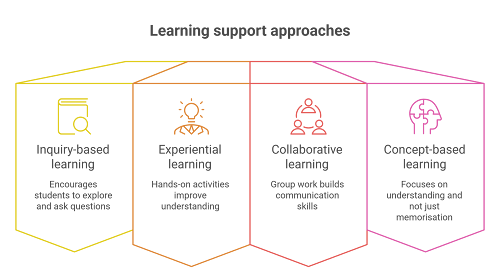
This approach ensures learning stays effective and engaging. Many good IB schools in Bangalore successfully follow this model by aligning with modern teaching frameworks. Here is a quick look:
| Approach | How it supports learning |
| Inquiry-based learning | Encourages students to explore and ask questions |
| Experiential learning | Hands-on activities improve understanding |
| Collaborative learning | Group work builds communication skills |
| Concept-based learning | Focuses on understanding and not just memorisation |
The IB subjects naturally support these methods, as they prioritise critical thinking and real-world application.
How Does This Model Impact Student Performance?
Do students actually perform well without homework? Let us look at the impact –
- Better Conceptual Clarity: Students understand topics deeply and clearly instead of memorising.
- Reduced Stress Levels: More time for rest improves mental well-being.
- Improved Classroom Engagement: Students stay more focused during school hours.
- Stronger Life Skills: Time outside school helps build creativity, hobbies and social skills.
According to education insights, reduced academic pressure often leads to improved student engagement and overall development.
What Challenges Do No Homework Schools Face?
This approach is not effortless. Schools may face –
- Resistance from parents to traditional systems
- Need for highly trained teachers
- Time management challenges within school hours
- Pressure to maintain academic performance
But with the right planning, these challenges become manageable.
How Can Parents Support This Learning Style?
Parents play a huge role in making this model successful. Here’s how they can help:
- Encourage curiosity and discussions at home
- Support hobbies and creative activities
- Avoid comparing with traditional schooling methods
- Trust the learning approach of the school
When schools and parents are involved to work together, students benefit the most.
Final Thoughts
The idea of schools without homework might sound unconventional at first; but it reflects a deeper shift in education that values understanding than overload and balance over burnout.
By redesigning how learning happens during school hours, no homework schools prove that academic success does not have to come at the cost of well-being. With strong teaching methods, supportive environments and innovative approaches; students learn and live better.