


How to Know If Your Child Is Thinking or Just Completing Tasks
Jean Piaget, the Swiss psychologist whose work revolutionised our understanding of child development, observed that “children construct understanding through discovery, rather than memorising facts supplied by the teacher.” The research published in 1958 addresses a significant challenge that parents face today: the gap between what children deliver and what they actually understand.
Research on critical and independent thinking reveals something counterintuitive: Young children sometimes outperform adults on specific cognitive tasks precisely because they haven’t yet developed the rigid thinking patterns that constrain adult cognition.
It presents a paradoxical dilemma for parents: How do you distinguish between a child who’s thinking critically and one who’s simply completing tasks through memorisation or pattern-matching?
How to Identify Thinking in Kids
Critical and independent thinking emerges when children engage in what Piaget called “equilibration” – that uncomfortable state when new information doesn’t fit existing understanding. Further exploration of Piaget’s theory also suggests that rote memorisation fails because it bypasses the assimilation-accommodation cycle, preventing genuine schema development.
We have talked a lot about Lev Vygotsky’s Zone of Proximal Development. According to the framework, when your child works within their ZPD, they actively construct knowledge. When they simply complete tasks, they either operate below their capability due to boredom or above it due to confusion. The dangerously acute observations show that neither produces real thinking.
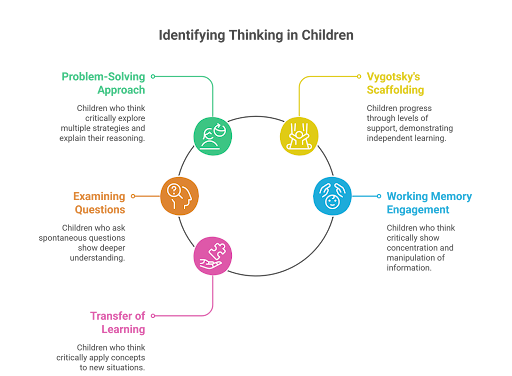
Step 1: Observe Problem-Solving Approach
The National Research Council describes young children as active, motivated, and engaged learners who possess an impressive range of cognitive competencies. So, how to identify thinking in kids? Simply by watching their approach to unfamiliar problems.
Children who think critically and independently exhibit certain traits. They:
- Take a breather before attempting to solve complicated problems
- Don’t stick to a single-solution approach and always test multiple strategies
- Always have a reason to explain why they took a particular approach
- Don’t settle for established rules and notions, and constantly explore to find new concepts
- Exhibit higher-order productivity that leads to problem-solving
And children who merely complete tasks will often
- Immediately apply memorised procedures
- Repeat failed strategies without modification
- Cannot explain why a method works
- Seek constant validation
- Abandon problems when familiar patterns don’t apply
Step 2: Apply Vygotsky’s Scaffolding Test
Present a task slightly above your child’s current level, then provide decreasing levels of support:
Level 1: You show them how to solve the problem entirely
Level 2: You enable them to approach the problem without hesitation by asking leading questions that are comfortable for them to work with and still pose as critical elements in their understanding.
Level 3: You don’t walk them through every step of the problem. Instead, you only facilitate occasionally if they get stuck at a particular step.
Level 4: You let your child choose the problem and work on the solution independently.
When you let children think critically and independently, they show significant progress in cognition, sensory awareness, a multi-modal approach, and social interactions. Educational research at IB curriculum schools shows that when children can teach back what they have learned using their own examples, they go further than task completion to genuine understanding.
Step 3: Examine Their Questions
Piaget also said it is vital to understand the underlying processes of a child’s thinking. Use the 5Ws to comprehend a child’s thinking pattern better:
- Who is facing the problem?
- What are the actual issues?
- When do you intend to solve it?
- Where is the problem relevant?
- Why should you solve?
- Additionally, how do you solve it?
On the other hand, you can tell whether a child is merely involved in task completion if they show:
- No curiosity about underlying principles
- Interest only in completing the task
- No inclination toward learning new things
Bangalore international schools report that children who ask spontaneous questions exhibit 40% higher memory retention than those who simply complete assigned work.
Step 4: Assess Working Memory Engagement
Juan Pascual-Leone’s research revealed that a child’s ability to think doesn’t depend solely on the stage they’re in, but also on how much mental space, or working memory, they have. Specialists in early childhood and education observe that engagement with working memory is evident even in young children.
Children engaged in critical and independent thinking show:
- Visible concentration
- Verbal processing
- Manipulation of information (counting on fingers, drawing)
- Self-correction based on internal monitoring
Step 5: Evaluate Transfer of Learning
The most reliable indicator distinguishing thinking from task completion is knowledge transfer – applying learned concepts to new situations.
How can you test for transfer?
- Present the same problem in a different format
- Ask them to teach the concept to someone else
- Introduce a novel situation requiring the same principle
Children who think critically and independently:
- Apply learned principles in all scenarios
- May even attempt to bridge one or more concepts to derive new hypotheses
- Explain concepts using personal examples
- Show confidence in their understanding
Children completing tasks show:
- Confusion when format changes
- Inability to explain without reference materials
- Forgetfulness of what they have learned
Conclusion
The real test of whether your child is thinking or completing tasks lies in their learning curve. Are they asking more sophisticated questions over time? Do they apply learning spontaneously? Can they explain their thinking with increasing complexity?
If yes, your child is thinking. If they’re producing work but showing none of these signs, they’re completing tasks without cognitive engagement.
Task completion might earn grades now, but thinking develops the capacity for lifelong learning. As Piaget observed, learning requires problem-solving skills that cannot be taught; they must be discovered.