



Scroll. Tap. Pay. Repeat.
That is the rhythm of today’s world and honestly, teenagers are mastering it faster than adults. But here is the catch: while they know how to spend digitally, do they really understand money?
This is exactly where financial literacy for teens becomes a game-changer. In a world of UPI payments, subscriptions and instant gratification, knowing how money works is no longer optional; it is essential. It is about building confidence, independence and smart decision-making for life.
What is Financial Intelligence for Teenagers?
Think of financial intelligence as more than just saving pocket money. It’s about understanding how money behaves. More than the complex spreadsheets or stock market jargon, it is about understanding –
- How money works
- How to spend wisely
- How to save and grow wealth
- How to make informed financial decisions
In simple terms; financial literacy for teens is learning to control money instead of being controlled by it. Financial awareness is essential for building a financially inclusive and responsible society.
Why is Financial Literacy Crucial for Teens Today?
Let us connect financial literacy to real-life situations. Teenagers today –
- Shop online
- Use digital payments
- Get exposed to influencer spending trends
- See early investment content on social media
Without the right guidance, it is easy to fall into poor money habits.
Here is why that is risky:
- Impulse spending is easier than ever
- Subscriptions quietly drain money
- “Buy now, pay later” creates hidden debt
Stat Check:
According to a recent report of PIB, 81% share of all retail digital transactions in India and 49% of India’s share of global real-time payment transactions.
Financial intelligence matters more than anything as it helps –
- Builds Responsible Spending Habits: Teens learn to differentiate between needs and wants.
- Encourages Early Saving & Investing: Even small savings can build long-term discipline.
- Prepares for Financial Independence: From college expenses to career choices.
When Should Teenagers Start Learning Financial Skills?
Short answer: Earlier than you think.
| Age Group | What they should learn |
| 10-13 years | Understand needs vs. wants and saving basics |
| 14-16 years | Budgeting and tracking expenses |
| 16-18 years | Investing basics and digital finance awareness |
The earlier teens build habits, the stronger their financial confidence.
How is the Digital Age Changing Money Habits?
Money today is invisible but powerful. The visible difference in money habits reflects as:
Then vs Now:
| Earlier | Now |
| Cash-based spending | UPI or digital wallets |
| Limited exposure | Social media influence |
| Delayed purchases after proper planning | Instant buying under peer pressure or celebrity influence |
| Basic savings | Early investing awareness |
The shift is massive and students need to adapt to gain financial intelligence.
How Can Teens Practise Financial Intelligence Daily?
Let us get practical. Here is what actually works –
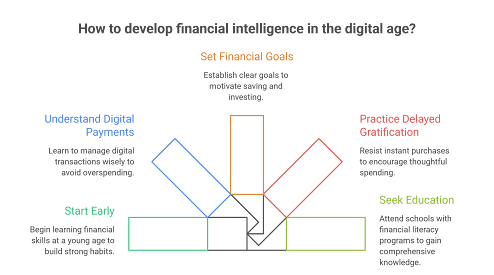
1. Start with Budgeting
- Track income (pocket money, gifts, etc.)
- Divide into spending, saving and investing
2. Learn the Value of Delayed Gratification
- Not every purchase needs to happen instantly.
3. Set Simple Financial Goals
- Saving for a gadget
- Planning a trip
- Building an emergency fund
4. Understand Digital Payments
- Know where your money is going. UPI doesn’t mean unlimited spending.
5. Learn Basic Investing Concepts
- Even understanding “how money grows” is a great start.
Which Skills Make Financially Smart Students?
Financial intelligence is a mix of skills –
- Budgeting (not overspending)
- Saving consistently
- Understanding digital payments
- Basic investing and risk awareness
- Decision-making under pressure
- Critical thinking
- Discipline
- Planning and goal-setting
These are not just money skills; they are life skills.
What Are the Biggest Money Mistakes Teens Should Avoid?
These are some of the common mistakes:
- Spending without tracking
- Following trends blindly
- Ignoring savings
- Misunderstanding credit
- Thinking, “I’ll learn later”
Financial habits built early often stay for life.
How Does the IB Programme Support Financial Intelligence?
Here’s where education plays a big role. The IB programme does not just focus on academics; it builds real-world skills. Through IB, students learn:
- Analytical thinking (through projects and case studies)
- Global awareness (understanding economies and systems)
- Reflection (learning from decisions and outcomes)
- Problem-solving (real-life scenarios)
Subjects like business management, economics and mathematics introduce financial concepts in practical ways. This is why many parents prefer international IB schools in Bangalore to prepare children for real-world challenges and not just exams.
Where Do Students Learn Financial Intelligence Best?
The environment matters a lot. The best IB schools in Bangalore:
- Integrate real-life learning into academics
- Encourage independent thinking
- Promote practical exposure
And this is where OWIS truly stands out. At OWIS, financial learning is not treated as a separate subject; it is part of the overall development approach.
Here’s how OWIS makes it happen:
- Real-World Learning Approach: Students engage in projects that simulate real-life financial decisions.
- Inquiry-Based Education: Students ask questions like “Why do prices change?” or “How do businesses grow?”
- Strong IB Curriculum Integration: The IB programme naturally includes financial awareness through subjects and interdisciplinary learning.
- Focus on Life Skills: Budgeting, planning, and decision-making are encouraged through activities.
- Global Perspective: Students understand how economies work across different countries.
This results in students who are confident, aware, and capable of making smart financial choices in a digital world. That’s why OWIS is recognised as one of the best choices for holistic and future-ready education for students.
How Can Parents Build Financial Intelligence at Home?
Here’s where things get practical and honestly, a little fun.
- Track Expenses Like a Pro: Encourage teens to track spending using apps, notes, or even old-school diaries.
- Set Savings Goals: Be it sneakers or a gadget, saving feels real when there is a goal.
- Teach Needs vs Wants: This one is huge. Food = need. Latest phone upgrade = want. Simple yet powerful clarity!
- Let Them Earn: Earning money builds respect for it instantly.
- Create a Savings Space: Bank account, debit card or even a digital wallet to make their savings visible.
- Allow Small Mistakes: Overspending once is good, but not regularly. That lesson sticks longer than lectures.
- Lead by Example: Teens watch more than they listen. Your habits become their blueprint.
These habits slowly build strong financial literacy for teens without making it feel like a lesson.
Final Thoughts
Here is the bottom line: money is a part of life and it is no longer about just earning. It is about understanding, adapting and making smart choices in a fast-moving digital world where understanding money is a skill.
And that is exactly what financial literacy for teens unlocks. It helps teenagers to understand money at an early age. They do not just manage it, but they make it work for them. From smarter spending habits to confident decision-making and future-ready thinking, it shapes how they approach life beyond school.