

It was a sombre evening. The clouds huddled together, pregnant with water droplets that seemed like they would burst any moment. Thunder rolled, and before the echoes could even settle, a sharp flash of lightning tore across the sky.
My kid, who had been playing outside, came screaming, “Mumma, I just saw the sky open!”
He stood there, drenched, wide-eyed and laughing, pointing upwards as if the world had just shown him its secret. I wrapped him in a towel and sat him by the window, but he refused to sit still. He kept jumping up and down, asking too many questions – about lightning, about rain, about where the water comes from, and why the sky makes “that loud sound.”
It’s not easy to answer an eager child. But it is easy to let them search for their own answers. Our ancestors believed in living in rhythm with nature, learning their best lessons by watching the seasons, the soil, and the skies.
We can sit in classrooms, stare endlessly at bright screens, or fidget while the teacher drones on. But real learning takes place in the right environment. Learning with nature sparks something that textbooks can never do.
Why Nature-Based Learning Matters
Educators have long observed that children learn best when their minds and bodies are both engaged. Nature-based learning provides an environment that is open, unpredictable, and rich in sensory experiences.
Research shows that children who spend time outdoors develop better focus, memory, and language skills. The sounds, textures, and smells of the natural world activate multiple senses, which helps them understand concepts more easily. They also spend more time in collaborative play, learning to negotiate, share space, and solve problems together.
Unlike classrooms with fixed routines, the natural environment is full of variables: the weather, the terrain, and the animals that wander around. When there’s unpredictability, there’s curiosity. A puddle of water can be construed as anything – a splash zone, a mirror, even a tiny ocean for a child’s toy boat.
When children learn about nature in real-time, such as watching worms after a rain, observing a butterfly emerge, or feeling the wet grass, they are not just absorbing information; they are forming stronger neural connections that support long-term memory.
How Nature Builds Creativity and Connection
You know what they say about creative people? They work well in open-ended and dynamic settings. That’s what learning with nature does – an unstructured outdoor play supports divergent thinking, the ability to generate multiple solutions to a problem.
Nature offers children materials with no fixed “rules”: sticks, stones, leaves, mud. A stick might become a fishing rod, a magic wand, or part of a fort. When children are free to transform everyday objects into something new, they practice flexible thinking, an essential predictor of problem-solving ability later in life.
Outdoor environments are also rich in sensory input. The smell of wet soil, the sound of rain, and the feel of rough bark make learning more vivid and help children build descriptive language and narrative skills.
The benefits don’t end with imagination. Nature is also an influential teacher of cooperation and emotional regulation. Shared challenges, like building a dam together, carrying a log, or taking turns on uneven terrain, teach children how to collaborate and resolve conflicts by improving empathy and teamwork.
Even a short time outside helps lower cortisol levels, reducing stress and enhancing focus once children return to structured learning. In a screen-heavy world, having a reset is invaluable.
How Schools Can Encourage Nature-Based Learning
The most effective early childhood and education programmes make outdoor learning a regular part of the day rather than an occasional activity. Nature is where children experiment, ask questions, and make discoveries that connect directly to what they learn indoors.
Some practical ways schools incorporate nature-based learning include:
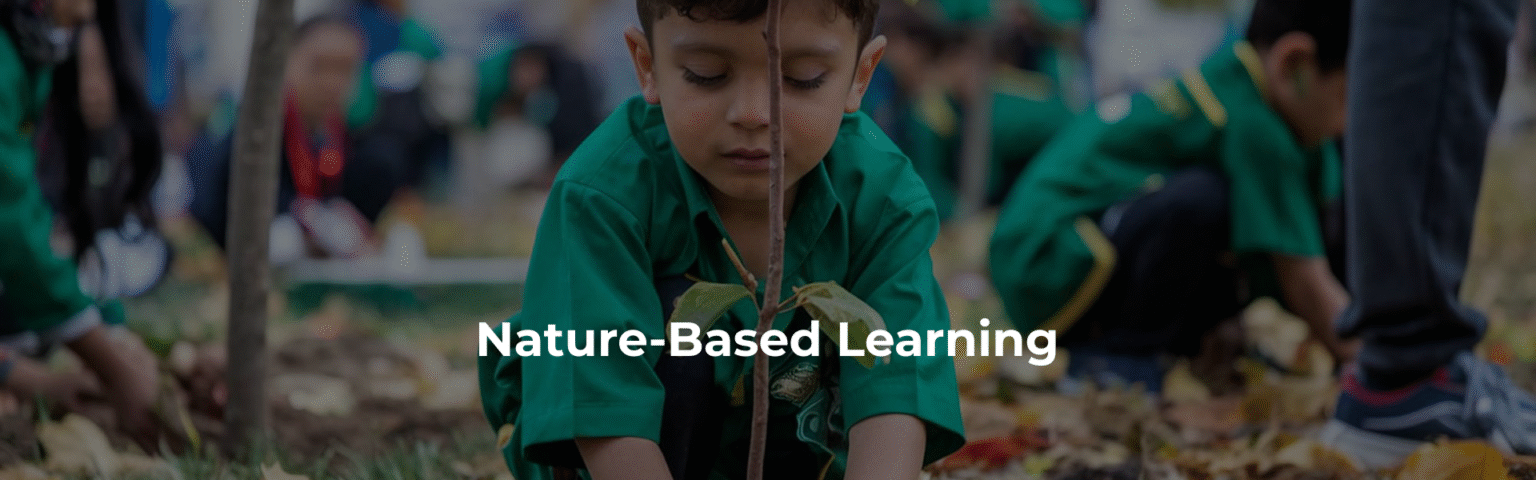
- Outdoor Classrooms: Spaces for gardening, measuring rainfall, or observing insects up close.
- Inquiry Projects: Nature walks where children collect leaves, observe patterns, and bring back questions to explore further.
- Unstructured Exploration: Supervised outdoor time that lets children follow their curiosity and create their own games.
- Movement and Risk: Logs to balance on, rocks to climb, and space to run, essential for building confidence and resilience.
The approach works exceptionally well in the IB Primary Years Programme, which is built on inquiry-led learning. Children are encouraged to ask questions, document observations, and reflect on what they discover.
IB curriculum schools in Bangalore expose children to:
- Track the life cycle of a plant they are growing.
- Create rainfall charts over a month and discuss weather patterns.
- Observe local biodiversity and link it to lessons on ecosystems.
Learning with nature helps children connect theory with reality, making abstract concepts tangible.
Conclusion: Cultivating Curiosity and Creativity
Nature-based learning is not only an outdoor play but also a research-backed teaching mechanism that strengthens memory, builds focus, nurtures social skills, and ignites creativity. When children spend time outdoors, they are running around, learning to notice, to question, and to experiment.
Parents who want their children to grow into curious, confident learners should look for schools where nature is part of the curriculum.