


Why Some Students Perform Well but Struggle in Real Life
Imagine a child who has never missed a homework deadline, never failed to score well and made every parent-teacher meeting something to look forward to, but the moment they step out of school, life hits them harder than it should.
This happens far more than we realise. Which brings up a question that every parent should ask: If our children are doing so well in school, why are so many of them struggling when it comes to real life? Read ahead to find out where the gap between good grades and real life begins and how you can help your child bridge it.
What Does It Mean to Be ‘Good at School’?
Being good at school, in the way most schools measure it, means one thing: performing well on tests. It means remembering accurately, reproducing reliably, and consistently meeting expectations.
None of that is a bad thing. But it is an incomplete thing. Because the qualities that make a child excel in a controlled exam, precision, compliance, and repetition, are not always the same qualities that help them navigate a difficult conversation, recover from a professional setback, or make a decision without a textbook to consult.
School, at its best, is a starting point. At its worst, it can become a comfort zone, one that rewards the right answers but rarely prepares children for the reality that most of life’s most important questions do not have one.
Why Do Top Students Sometimes Find Real Life Harder?
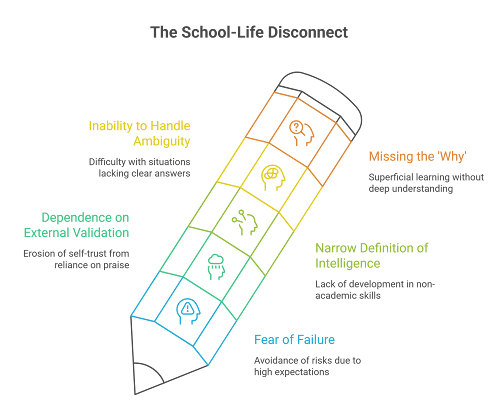
The honest answer is that school and life test very different things. Here is where the gap most commonly shows up:
- Fear of failure. Students who have always performed well often feel that they have the most to lose. As a result, they tend to avoid risk, experimentation and any kind of creative thinking that real-world problems often demand
- Dependence on external validation. Years of grades, rankings, and teacher approval can quietly erode a child’s ability to trust their own judgment. When they no longer receive praise for their work, it can diminish their confidence.
- Narrow definition of intelligence. A child who scores brilliantly in science may struggle with empathy, leadership, or simply knowing how to disagree respectfully.
- Inability to handle ambiguity. Exams have correct answers. One’s life rarely does. Students who have just been taught to find the right answer can lose their footing when faced with other challenges in life.
- Missing the ‘why’. When children focus only on what’s in the syllabus, without understanding the concepts behind it or how it connects to the world around them, the knowledge stays behind in the exam hall, not carried into the world.
Which Skills Does School Forget to Teach?
The most in-demand qualities in adult life are also the most under-taught in school. Here is a look at what the world asks for, and what the classroom often does not offer enough of:
| Skill | What It Looks Like in Real Life |
| Critical thinking | Questioning assumptions, evaluating options |
| Emotional intelligence | Managing emotions, reading others, resolving conflict |
| Communication | Speaking clearly, listening well, persuading thoughtfully |
| Resilience | Bouncing back from failure, adapting to change |
| Collaboration | Working with different people toward a shared goal |
| Self-directed learning | Knowing what to learn next and how to learn it |
These are not extras. These are the foundations of life success, and the absence of them is showing up in India’s workforce in a quite noticeable way.
What Does the Data Tell Us About India’s Skill Gap?
The numbers are difficult to ignore. According to the India Graduate Skill Index 2025 by Mercer-Mettl, only 42.6% of Indian graduates were employable in 2024. The primary reason cited was not a lack of technical knowledge; it was a lack of non-technical, real-world skills.
Business Standard, citing a TeamLease report, noted that only 10% of India’s 1.5 million engineering graduates are expected to secure employment in a given year, not because they lack degrees, but because they lack the applied skills employers are looking for
Strong scholarly performance and strong employability, it turns out, are not always the same destination for your child.
How Can Parents and Schools Begin to Close the Gap?
Something to be happy about is that the student skills that matter in life can be nurtured at home, in the classroom, and in the spaces between the two.
Let children fail safely. When your child has never experienced a small failure, they are entirely unprepared for a large one. Encourage risk. Celebrate the attempt, not just the outcome.
- Ask ‘why’ more than ‘what’. When your child studies, help them connect the topic to the world around them. Why does this matter? Where does this show up in real life? Curiosity is a skill, and it needs to be exercised.
- Create space for opinions. Dinner table debates, family decisions that include the child’s voice, moments where they are asked to disagree respectfully, these are more educational than they look.
- Value process over performance. Ask your child what they found difficult today, not just what score they got. The struggle is where the real learning lives.
- Choose learning environments that reflect these values.
Curricula like the IB syllabus are specifically designed to build these principles into their everyday practice with this in mind from project-based learning to reflective portfolios that track how a child thinks, not just what they know.
Rather than testing only content recall, they ask students to inquire, reflect, and connect, producing learners who are not just academically prepared but genuinely ready for the world. One World International School is one of the best schools in Bangalore, India, which emphasises this.
Wrapping Up
There is a child somewhere right now who is doing everything they have been told leads to success. Studying hard. Scoring well. Making their family proud. And none of that is wasted.
But the world they are walking into will ask things of them that no exam ever did. It will ask them to adapt, to lead, to fail and try again, to listen as much as they speak, and to discover meaning in what they do not just marks.
The most important thing a parent or school can do is not to add more to a child’s plate, but to make sure that what is already there is building the right things. Because a truly educated child is not just one who knows the answers, it is one who knows how to find them. To explore schools that take this approach, consider visiting international schools in Bangalore, India, such as One World International School, that places whole-child development at the heart of learning.