

How Multicultural Exposure Influences Decision Making in Students?
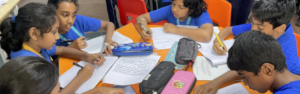
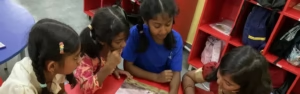
Is your child the new kid? Settled in a different state, a new school, words and voices that they have never heard. A mind-boggling situation indeed. It can get awkward, a little lonely and a little terrifying at times. But it is one of the most unexpected and powerful things that can happen to a growing mind. Because the classroom your child walks into is a room full of kids who grew up differently, celebrate differently and see the world through a different lens. And whether they realise it or not, they are already learning how to understand people who are not like them. This is precisely why families searching for international schools in Bangalore often prioritise diversity as much as academics.
This will have a profound effect on your child. It changes how they make decisions. When your child has sat in classrooms with students from five different regions, heard different languages in the corridor and shared lunch with friends across the map, they think differently when faced with a choice. They learn to carry diverse perspectives from the worlds they have moved through.
What makes India one of the most multicultural classrooms in the world?
India is one of the most culturally diverse countries in the world. According to a census conducted by the Census of India (2011), over 1950 dialects and 1600 languages were recorded. To add to that, there are over 2,000 ethnic groups with distinct cultural identities.
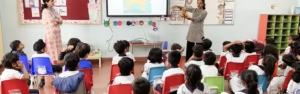
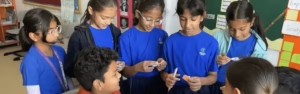
This means that every classroom in India, whether in a metro city or a small town, is a multicultural space. Children grow up unconsciously absorbing different festivals, foods, languages, and ways of thinking. That everyday exposure is more valuable than any textbook lesson on empathy.
Why does multicultural exposure matter for how students think and decide?
Decision-making is a blend of logical, social and emotional processes. And as it turns out, the more perspectives your child has been exposed to, the better equipped they are to make inclusive decisions. IB subjects are specially designed with this in mind encouraging students to think across disciplines, cultures and contexts. Here’s how multicultural education influences decision-making:
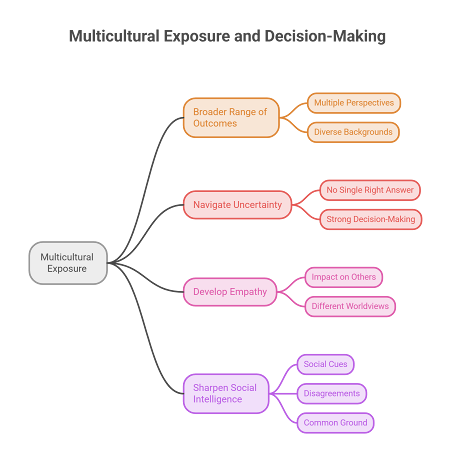
- A broader range of outcomes is considered – When your child has interacted with peers from different states and cultures, they naturally weigh in multiple perspectives.
- Navigate uncertainty with ease – A multicultural environment teaches that there is rarely one right answer, an approach that is significant to strong decision-making.
- Develops empathy – They develop the ability to factor in how a decision might impact someone who sees the world a little bit differently than you.
- Sharpens social intelligence – Children who navigate diverse classrooms learn to read social cues, handle disagreements and find common ground. All of these feed directly into mature decision-making.
When does multicultural exposure begin to shape a child’s thinking?
This happens much earlier than most of you think. The years of schooling are where all the magic happens, as research consistently points out. When your kid is introduced to peers from different backgrounds between the ages of 5 and 10, the impressions formed are deep and lasting.
- The moments that shape your child’s multicultural outlook look something like this:
- Sharing their favourite foods with a friend who eats something unfamiliar and asking questions about it rather than recoiling from it.
- Sitting through a school assembly conducted in a language they do not comprehend, and staying curious rather than just tuning it out.
- Solving disagreements and reaching a middle ground without an adult’s intervention.
These are small moments, but they will play a pivotal role in the decision-making instincts your child will carry into adulthood.
Supporting your child through multicultural transitions
If your child is a new kid or about to become one, the way you frame that transition will shape how they experience it. And here are a few things that you can do to ease them into it:
- Acknowledge the discomfort. Let your child know that it is normal to feel out of place and that it will not last.
- Ask them what is different, igniting their curiosity will urge them to ask questions.
- Celebrate the little efforts. Every new word learnt, a new friend made, a new favourite dish is a tiny step forward.
- Model openness at home. Children absorb attitudes and behaviours a lot more than instructions. If you speak respectfully and curiously about other cultures, your child will too, given time.
- Choose a school that fosters multicultural values.
Winding up
Multicultural exposure does so much more than making your young one more open-minded. It makes them a sharper and more considered decision-maker. So, the next time your kid comes home unsettled by the newness of it all, remember that the feeling is doing something. It is stretching the way they see the world, the way they listen, and eventually the way they make decisions. The classrooms they move through, the friends they make across the map, the languages they pick up; all of it adds up to a perspective. One of the most valuable things there is. If you are looking for a good school in Bangalore that does well to look beyond rankings and encourages multicultural exposure then One World International School is definitely one to consider.