


Key Takeaways
- Over 85% of a child's brain development happens before age six, according to facts stated in India's National Education Policy 2020.
- Quality early learning builds language, thinking and emotional skills that carry into Grade 1 and beyond.
- India's foundational stage (ages 3 to 8) now formally includes early years learning under the 5+3+3+4 structure.
- Play-based, inquiry-led programmes tend to produce more confident, curious learners than rote-based ones.
- Choosing the right early years setting matters as much as choosing the right school later on.
Introduction
Ask most parents when “real” schooling begins, and many will point to Grade 1. Yet by that stage, a child has already built most of the mental wiring they will use for the rest of their academic life. The years between birth and age five are where school readiness, curiosity, and confidence are actually built. For parents in Bangalore weighing their options, understanding this window changes how they think about preschool education altogether.
This guide walks through what happens in a young child’s brain during these years, what quality pre-primary education looks like in practice, and how parents can support strong foundations at home and in the classroom.
What Happens Inside a Child’s Brain in the First Five Years?
Neuroscience research consistently points to one fact: early childhood is when the brain grows fastest and forms the most connections. India’s National Education Policy 2020 recognises that over 85% of a child’s cumulative brain development takes place before the age of six. Every conversation, story, song and game during this window is quite literally shaping neural architecture.
| Age | What is Developing | Why it Matters |
| 0 to 2 years | Sensory processing, attachment, early language | Builds trust and the roots of communication |
| 2 to 3 years | Vocabulary, motor skills, early social play | Supports independence and self-expression |
| 3 to 5 years | Reasoning, memory, emotional regulation | Prepares the child for structured, formal learning |
This is precisely why India’s National Education Policy folded early learning into a formal “foundational stage” spanning ages three to eight, rather than treating it as an optional add-on before Grade
Why Does Preschool Education Matter So Early?
Many parents still see the early years as a gentler version of daycare. In reality, thoughtfully designed preschool education does something daycare alone cannot. It introduces structure, language-rich interaction, and guided problem-solving at exactly the age when a child’s brain is most receptive to them.
Government data collected through India’s Annual Status of Education Report shows preschool enrolment among young children has been rising steadily over recent years, reflecting growing parental awareness of its value. Children who receive quality preschool education tend to enter Grade 1 with stronger vocabulary, better attention spans and greater comfort with classroom routines. That head start rarely fades. It tends to compound, showing up later in reading fluency, mathematical reasoning and how willingly a child raises their hand to answer a question.
What Does Good Pre-Primary Education Actually Involve?
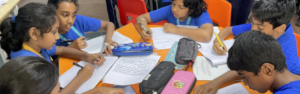
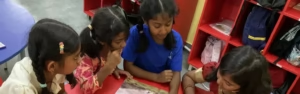
Quality pre-primary education goes well beyond alphabet charts and rhymes. It is built around play, enquiry and social interaction, deliberately designed rather than left to chance.
Strong pre-primary education programmes typically include:
- Storytelling and conversation to build vocabulary and listening skills
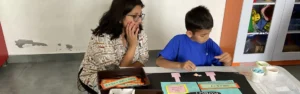
- Hands-on activities such as sorting, building and counting to develop early numeracy
- Guided play that encourages sharing, turn-taking and conflict resolution
- Outdoor and sensory exploration to support physical and cognitive growth
- Consistent routines that build independence, from tidying up to dressing themselves
None of this looks like a traditional classroom, and that is the point. Learning sticks best at this age when it feels like discovery.
How Does an IB-Style Approach Build Confidence Early?
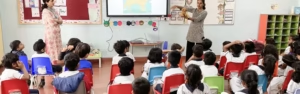
Curriculum choice matters more at this stage than many parents realise. Inquiry-based frameworks, where children ask questions and explore themes across IB subjects rather than memorising isolated facts, tend to build genuine curiosity rather than exam anxiety. A child encouraged to ask “why” from the age of three carries that habit of thinking into every later stage of school.
This is part of why globally recognised curricula have grown steadily in India over the past decade, with authorised IB World Schools expanding by around 31% between 2019 and 2023. Parents are increasingly choosing programmes that value how a child thinks alongside what a child can recite.
Which Skills Should Parents Watch For, Stage by Stage?
Every child develops at their own pace, but certain milestones offer a useful guide.
| Age Range | Language | Social and Emotional | Thinking Skills |
| 2 to 3 years | Simple sentences, growing vocabulary | Parallel play, early sharing | Basic cause and effect |
| 3 to 4 years | Storytelling, asking questions | Group play, turn-taking | Sorting, matching, counting |
| 4 to 5 years | Full conversations, early reading interest | Cooperative play, empathy | Problem-solving, sequencing |
Parents supporting preschool education at home can reinforce these milestones simply through daily conversation, shared reading and unstructured play. Formal worksheets are rarely necessary at this age. Rich, everyday interaction does far more.
Where Does Bangalore Fit into This Picture?
Bangalore’s early education landscape has grown considerably, with families now researching options rather than defaulting to the nearest neighbourhood choice. Parents searching for the best preschool in Bangalore increasingly weigh curriculum philosophy, teacher-child ratios, and how well a programme supports the whole child.
This shift has also driven demand for globally benchmarked options. Families exploring the best IB school in Bangalore often begin that search at the pre-primary stage, recognising that curriculum continuity from early years through to secondary school matters for long-term academic confidence.
Who Can Parents Turn to for Guidance?
Choosing an early years setting is easier with the right information. If you are comparing curricula, our guide on factors to consider before choosing an IB school breaks down what to look for beyond brochures.
For a closer look at how inquiry-based learning plays out in practice, how the One World International School (OWIS) Bangalore IB PYP encourages lifelong learning is a useful next read, alongside our piece on why more Bangalore parents are opting for the IB board.
Give Your Child the Strongest Possible Start with OWIS
The first five years set the tone for everything that follows. At One World International School (OWIS) Bangalore, our Early Years programme is built around inquiry, play and genuine care for each child’s pace of growth. Our globally recognised IB curriculum nurtures curiosity from day one, helping children build the confidence, language and thinking skills they will carry through primary school and beyond.
If you are exploring early years options in Bangalore, we would love to show you around and help you understand the workings of the programme. Book a campus visit, speak with our Early Years educators, or apply for the upcoming academic year to secure your child’s place.
Visit our website to learn more about our IB Early Years, Primary Years and beyond, and take the first step towards a strong, confident start for your child.
Frequently Asked Questions
Most experts suggest starting between two and a half to three years, once a child can manage short periods away from primary caregivers.
It builds language, reasoning and emotional regulation skills during the years when the brain is most receptive to learning, setting the stage for Grade 1 and beyond.
Pre-primary education follows a structured, developmentally appropriate curriculum focused on language, cognitive and social growth, rather than simply supervising children.
Look for play-based learning, low teacher-child ratios, trained early years educators and a curriculum that develops thinking skills alongside academics.
Yes. Curriculum continuity from early years through secondary school helps children build on the same learning philosophy year after year, rather than adjusting to a new approach at every stage.