



If you’re a parent exploring the IB board for your child, chances are you’ve come across a mix of opinions online. Choosing the right path in education is a big decision, as every parent wants to give their child the best of everything available. In recent years, International Baccalaureate schools in India have been gaining trust and popularity for the well-rounded, high-quality education they offer, focusing not just on academics, but on the overall growth of the child.
However, despite its various advantages, many myths surrounding the IB Board schools in India discourage parents from taking the leap of faith. From the admission process to the curriculum, there is a lot of misinformation out there.
So, if you are a parent considering IB for your child, scroll down as we will break down the common myths surrounding International Baccalaureate India in this blog!
What Are the Common Myths About IB Board Schools in India?
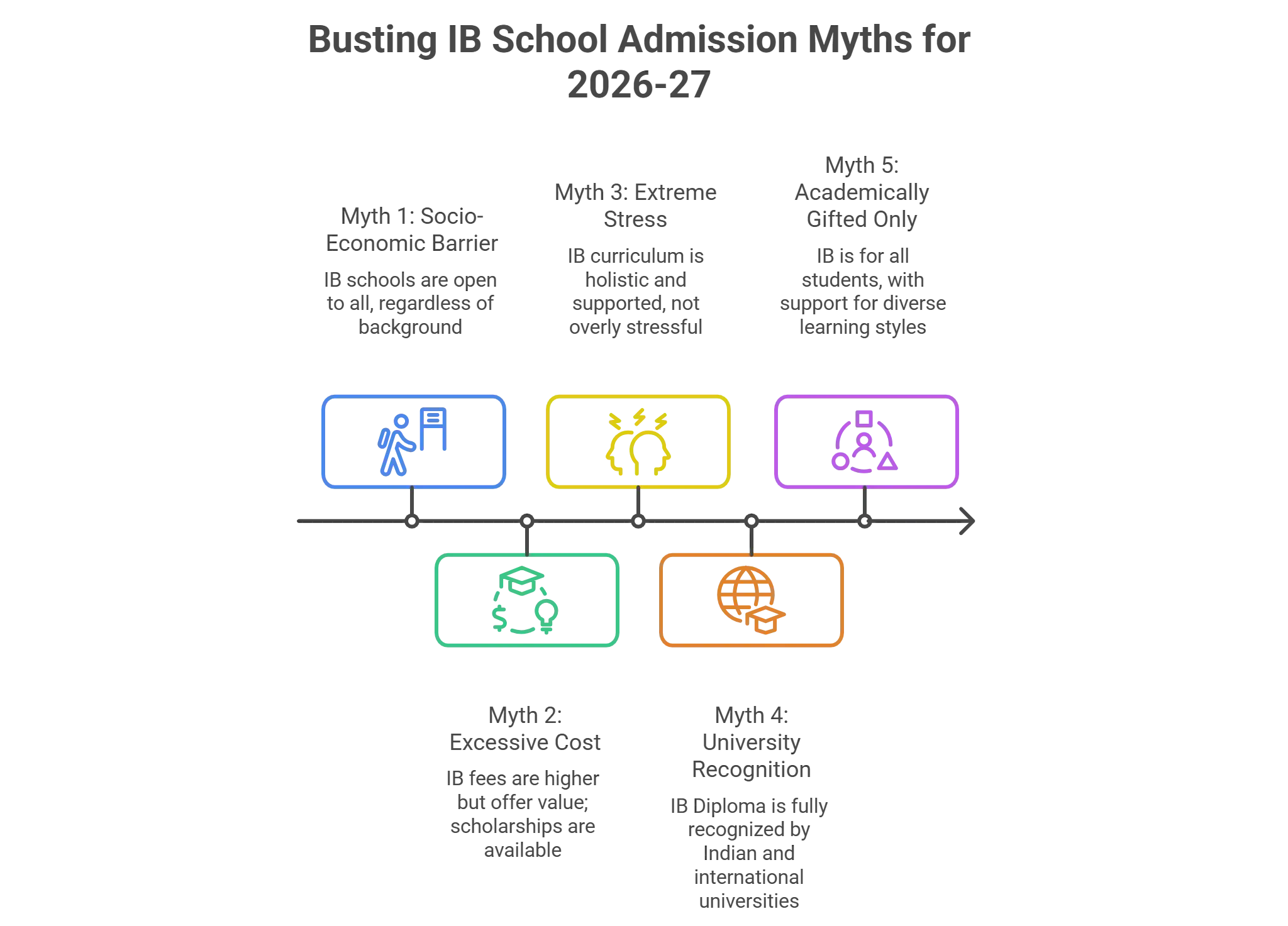
IB School Admission Myths vs Reality
| Myth | Reality |
| Only for wealthy families | Open to diverse backgrounds |
| Too expensive | Scholarships available |
| Very stressful | Balanced learning approach |
| Not recognised in India | Accepted by Indian universities |
| Only for toppers | Suitable for varied learners |
Without further ado, let us dive into the common myths floating around the International Baccalaureate schools in India and what the actual reality is!
Myth 1: Students Need a Specific Socio-Economic Background to Get Admitted
One of the most common myths about IB Board schools in India is that it is only accessible to the affluent section of society. It is often believed that IB schools in India only prefer students from certain families or backgrounds. The belief often stems from an expensive fee structure and the curriculum’s focus on inculcating a global-mindedness.
Reality
IB schools are open for all! You need not belong to a specific socio-economic background to get admitted. International Baccalaureate schools in India offer admission to students regardless of social status, nationality, race, etc. All that matters is merit and a willingness to learn the new way.

Myth 2: IB Education is Very Expensive
The high fees associated with many IB schools often lead to a perception that IB education is expensive and almost unaffordable for the average Indian family. This discourages parents from even exploring the possibility of enrolling their child(ren) in reputed IB Board schools in India.
Reality
IB board schools tend to have higher fees when compared to other boards. However, the fee difference is generally not that high, especially when the various facilities offered by IB schools are also considered. Additionally, the fee is not uniformly high across all IB schools, and various institutes also offer scholarships. For example, good IB schools in Bangalore like OWIS India offer scholarships to students based on performance in academics and co-curricular activities.
Myth 3: The IB Curriculum is Extremely Difficult and Stressful
The IB curriculum is often believed to be extremely stressful and difficult. It is a common conception that students enrolled in the International Baccalaureate India go through various mental and physical issues due to the high difficulty level of the subjects and the stress caused by deadlines.
Reality
While the IB curriculum can be extensive, it is not the most difficult or stressful one out there. The IB board syllabus is designed to go beyond generic rote learning and to offer students a holistic learning environment. It emphasises practical learning, independent study, and collaborative projects to ensure a healthy learning experience for students. The teachers at IB schools are also trained to offer proper guidance to students so they can deal with the curriculum without feeling any stress.
Myth 4: IB Diploma is Not Recognised by Indian Universities
It is believed that the IB diploma is not recognised by Indian Universities. This belief stems from the assumption that only students who want to study abroad choose IB schools. Many parents do not favour an IB board school as they think it will hamper their child’s chances of admission to a reputed Indian university.
Reality
An IB Diploma is fully recognised by Indian Universities. Students who have studied in an IB board school are eligible to apply for all the entrance tests conducted by Universities in India. And of course, when it comes to International Universities, IB students tend to get an edge due to the nature of IB’s course curriculum.
Myth 5: IB is Only for Academically Gifted Students
Another common myth about IB board schools in India is that it is only for academically gifted students. It often discourages parents as they believe their child is not smart enough to thrive in an International Baccalaureate school in India.
Reality
The IB education is for everybody and does not discriminate between students based on their ability or intelligence levels. The IB curriculum is extremely diverse and offers students an opportunity to explore different learning styles. The syllabus can be extensive, but proper support is provided to all the students to ensure they can thrive in the area of their interest.
To Sum Up
International Baccalaureate India is the perfect choice for your child’s early childhood years education. There are various myths about the IB curriculum, but all of them are unfounded. It is an inclusive system that motivates students to develop their ways of learning and understanding. These schools have a curated approach towards teaching that goes beyond academics and takes care of a student’s social, emotional, and psychological needs.
OWIS India, recognised among the leading IB Board schools in India, offers a holistic curriculum that nurtures not just academic excellence, but also individuality and self-expression. With dedicated educators and innovative teaching methods, we create an environment where your child is empowered to grow, discover their unique voice, and thrive — both in school and beyond.