


Why Students Remember Stories More Than Textbooks?
Stories are woven into your child’s life from the very beginning. From the melting gazes in their toddler years, begging for one last bedtime story, to the storytimes with their grandparents, filled with dramatic gasps and squeals of delight.
Now, storytelling is not just about the delight. Behind every tale, the brave bunny, the clever fox, there is something far more profound happening inside young, blooming minds. Something that no textbook, however carefully designed, can quite replicate . Children remember stories, and there is a very good reason for it.
What happens when a child hears a story?
The moment a story begins, a magical experience unfolds.
- The senses wake up, and your child feels like they are inside the story, not just reading it.
- The body responds as if the action is actually happening to them.
- Emotions are stirred, and when we feel something, the more ingrained it becomes in our minds.
- A bond forms between the story, the teller, and the child.
The scientific term for this phenomenon is called neural coupling, when a story pulls the listener’s brain into sync with the teller’s. To put it simply, a story just doesn’t reach a child’s mind. It makes a home there.
Why do facts alone fail to stick?
Here is a picture painted by India’s Annual Status of Education Report (AESR) 2024, conducted by Pratham across 605 rural districts and nearly 6.5 lakh children.
- As many as 76.6% of 3rd-grade students cannot read a 2nd-grade text despite being enrolled in school.
- 66.3% of 3rd-grade and 70% of 5th-grade students are unable to perform simple arithmetic calculations, and even if they are, they do not understand the operations that run behind it.
These numbers reflect the fact that how the content is delivered matters as much as the content itself. When learning is dry and abstract, it simply does not hold.
But what’s beautiful is that a child who cannot read a paragraph from a textbook will often remember every detail of a story their grandmother told them from last Diwali. The difference? While one reaches the brain through data, the other reaches it through experience.
How stories are 22 times more memorable than facts
Research conducted by Stanford University offers a rather striking insight that students are 22 times more likely to remember information when it is delivered through a captivating story than when presented as plain facts.
In another study, students were asked to give a one-minute pitch. On average, each student used statistics. Only one in ten chose to tell a story. When asked to recall what they had just heard, 10 minutes later. The results were astonishing and remarkable:
- Only 5% of the audience remembered any statistic.
- 63 % remembered the story.
This is not a fluke. Stories give facts a home. They give information about a character to live inside, a moment to reminisce and a consequence that matters. Without context, facts do not stick.
Which elements of a story make it stick?
Not all stories are equally riveting; the most effective stories for children share a few things in common:
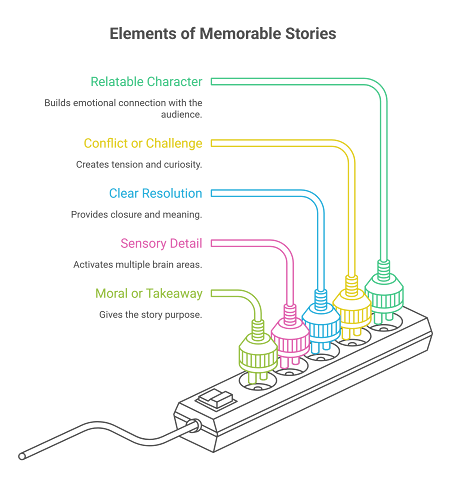
| Story Element | What it does |
| A relatable character | Builds emotional connection |
| Conflict or challenge | Creates tension and curiosity |
| A clear resolution | Provides closure and meaning |
| Sensory detail | Activates multiple brain areas |
| Moral or takeaway | Gives the story purpose |
Think of how your children, you, and your parents have grown up hearing tales from Panchatantra. Generations have passed, but the lessons of clever thinking, patience and trust remain. That is the architecture of great storytelling doing what it was always meant to do.
How can you, as parents, bring storytelling into learning?
The good news is that no one needs a degree in storytelling to make a difference. In fact, understanding a little about learning psychology can go a long way. Here is what experience suggests actually works:
- Wrap concepts in a character’s journey. Teaching fractions? Tell the story of a naughty child learning to share a mango. Teaching history? Begin with the person and tell them fascinating stories plucked out of history.
- Use stories that reflect your child’s world. Using silly languages, familiar settings, and contexts makes your stories easier to absorb.
- Let your child retell the story. Narration is one of the most powerful tools for cementing learning.
- Read aloud together. Even for older children, being read to activates the story-brain in ways that silent reading sometimes does not.
- Connect every lesson to a ‘why’. Stories connect as they answer the question every child is silently asking: Why does this matter?
- Leverage India’s tradition. Grandparents, folk stories, and regional myths are education in the oldest and most effective form.
It is important to note that storytelling in education is not a new idea; it is a practised one. Many international schools in Bangalore, India, such as One World International School, have already woven narrative-based learning into their everyday classrooms, recognising that children engage more deeply when a lesson feels like a story worth following.
Frameworks like the PYP syllabus are built on exactly this principle, that children learn best through inquiry and exploration, all of which storytelling naturally supports. It is about giving knowledge a shape that a child’s mind can hold.
Wrapping up
Storytelling in education is one of the oldest roads to learning. Long before textbooks, before classrooms, before curricula, there were stories. Told around fires, narrated at bedsides, passed from a child’s beloved grandparents. And through them, everything that mattered was remembered.
Science agrees with tradition here. And somewhere a child is proving it right now, recalling every twist of a bedtime tale told months ago, word for word, with shining eyes. So, the next time your child struggles to remember what they read, try telling them a story instead. Because an intriguing story can teach them far more than any lesson in a textbook can. If you are looking for a great school closer to home, One World International School is a Bangalore international school that blends storytelling with a globally minded curriculum, making it a good choice for your child. To explore more visit our website.