


What actually prepares a student for the future? Is it merely memorising facts and getting marks? Or is it acquiring life skills such as critical thinking and problem-solving? If you think it’s the latter, you must consider the IB syllabus for your child.
According to figures, 97.7% of IBDP Year 12 students secured a university place— 10% higher than non-IBDP students. That is a big number, isn’t it?
What are the core competencies that fuel this success? Let’s check it out.
What skills do students gain from the IB curriculum?
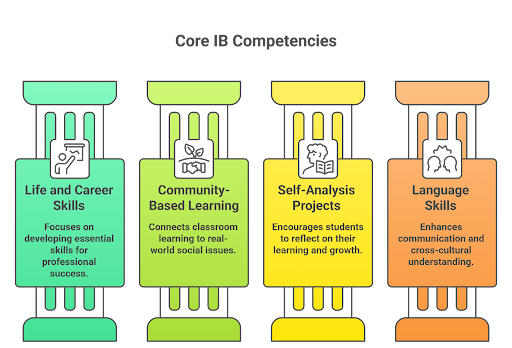
Life skills form the bedrock of professional success. Fortunately, the IB curriculum is predominantly dedicated to developing them. Look at the key career skills that are developed through the curriculum:
- Problem-Solving: Students address many authentic issues through challenging projects as part of their academics. Soon, they will know how to analyse their performance and improve gradually.
- Communication Skills: Most subjects include student presentations to help them clearly express their ideas in front of a classroom. Even group projects and other such team activities are also allocated to improve the collaborative skills of the student.
- Resilience: IB’s demanding curriculum prepares the students to manage stress and deal with failure. Students will find it easier to adapt to new challenges.
That will render your child both academically and emotionally equipped to handle the world beyond school.
Why is community-based learning important in IB?
Some of the best IB curriculum schools in Bangalore adopt a community-based learning methodology that connects classwork to real life as well as to social issues. Instead of reading about problems affecting the environment, students can get involved in a tree-planting drive.
According to ASER 2024, about 77.4% of rural children aged 3 are now enrolled in early education programmes, showing a growing shift towards experiential and early learning in India.
As students gain more knowledge about the community, they are able to apply the knowledge more effectively. For example, students undertake projects that address actual needs in the community such as environmental conservation. Sessions with the community will be organized at the end of the project to allow students to suggest practical solutions to the professionals. This type of learning develops fundamental competencies such as problem-solving, empathy, collaboration, etc. All of these are crucial for individual as well as professional success.
In addition, IB promotes the ability of students to think beyond their local surroundings. They will have a high level of social responsibility and understand that education is also about contributing to the world. That’s pretty crucial in forming future leaders who can address pressing societal issues effectively.

How do IB projects build self-awareness?
Yet another core competency of the IB curriculum is self-analysis. This is where the self-analysis projects of the syllabus come in — an inherent part of IB education that you will seldom find in any other standard curricula.
The curriculum offers many projects that prompt students to show their learning process. Students will sometimes be asked to write personal essays or even present before the class to illustrate how much they have learned in a span of time. The primary purpose of all this is to enable them to find out the areas of personal development and set realistic goals.
A Harvard Study figured out that self-analysis is a top characteristic for effective high-performing leaders, yet only 10-15% of individuals possess it. As many high schools in Bangalore under the IB syllabus introduce this practice right from the primary level, students are ahead of the curve and have an advantage that stays with them forever.
Improving Language Skills
Effective communication and strong language skills are prerequisites in the current highly interdependent world. Researches point out that bilinguals earn 5-20% more than monolingual peers. This is the reason why the IB syllabus makes language skills an integral ability so that students can learn to communicate their ideas clearly and assertively.
IB students are also constantly exposed to debate clubs, group discussions, teamwork projects, etc., to develop their language— both written and spoken. They are also asked to read extensively, from global news to literature, to expand their vocabulary.
But there’s more. As IB is an international curriculum, students usually learn a second language, developing cross-cultural communication skills. Some of the best schools in Bangalore even take a step ahead by offering special language support classes, where each student receives personal attention to improve their language skills.
Conclusion
Want to see your child develop into a confident and competent individual? Then, an IB syllabus is your way to go.
But remember: a good syllabus is only half the path. The school you select also matters a lot. Only a great IB school can nurture your child in a positive learning environment and prepare them for the future.
That’s what we are. At OWIS Bangalore, we focus on all the above-mentioned core competencies that will stay with them forever. We follow an interactive learning process where students are encouraged to ask questions and discover new ideas. Let’s begin our journey to a brighter future!