

Key Takeaways
- Separation anxiety is a normal part of early childhood development, typically peaking between ages 18 months and 3 years.
- Preschool anxiety is common but very manageable with the right strategies at home and at school.
- Consistent goodbye routines, calm parental behaviour, and warm classroom environments are among the most effective tools.
- Schools following the IB framework, like OWIS Bangalore, build social-emotional learning into the daily curriculum to support early transitions.
- Early action matters. If distress continues beyond 4–6 weeks without improvement, speaking to a counsellor is the right step.
What Is Preschool Separation Anxiety?
If your child clings to your leg every single morning at the school gate, you are certainly not alone. Separation anxiety is one of the most common concerns parents raise in the early years, and it is completely understandable why it tugs at your heart too.
At its core, separation anxiety is the distress a child feels when separated from their primary caregiver. In the preschool years, this shows up as crying, clinging, tantrums, or even physical symptoms like a stomach ache before school. This is a developmentally normal response, not a sign that something is wrong with your child or your parenting.
Most children begin showing signs of it around 8 to 12 months of age. It can resurface when they start preschool, typically between ages 2.5 and 4, because school is the first significant environment outside the family home. That is a big deal for a small person.
Why Does Separation Anxiety Happen at This Age?
Young children experience the world through attachment. Their parents are their safe base, the people who make everything feel predictable and secure. When that base disappears, even temporarily, their nervous system shifts into distress mode.
A few things make preschool especially triggering:
- Novelty: A new building, new faces, and new routines all arrive at once.
- Object permanence gaps: Children this age understand you have left but do not yet fully trust that you will always come back.
- Language limits: They may lack the words to describe what they feel, so the emotion comes out as behaviour instead.
- Temperament: Some children are naturally more sensitive or slow to warm up. This is a personality trait, not a flaw, and it often comes with remarkable empathy and depth.
Here is the reassuring part: your child’s distress is actually a sign of healthy, secure attachment to you. Worth holding on to at the school gate.
How Do You Recognise the Signs in Your Child?
Most preschoolers show some level of preschool anxiety when starting school, and that is completely expected. The question is whether what you are seeing is a normal adjustment phase or something that needs a closer look.
| Signs of Normal Adjustment | Signs That Need Attention |
| Crying at drop-off but settling within 15–20 minutes | Crying that continues most of the school day, repeatedly |
| Morning clinginess only | Refusing to attend school regularly |
| Mild stomach aches on school days | Persistent physical complaints (headaches, vomiting) |
| Asking about parents during the day | Extreme withdrawal or regression at home |
| Settles in after a few weeks | Distress continuing beyond 4–6 weeks with no improvement |
If your child’s experience looks more like the right-hand column consistently, it is worth a conversation with their teacher and, if needed, a paediatric counsellor. Asking for support early is always the right call.
Why Does Addressing It Early Make Such a Difference?
It can be tempting to take a wait-and-see approach, hoping the phase passes on its own. Sometimes it does. But when anxiety is left unaddressed, it has a way of growing roots.
Research shows that separation anxiety disorder in childhood is a significant risk factor for anxiety disorders in adolescence and adulthood. One study found that 75% of adults with anxiety disorders had experienced separation anxiety as children. Closer to home, epidemiological studies across India have reported that the prevalence of anxiety disorders in children and adolescents ranges from 1.3% to 4.2%, according to the Indian Council of Medical Research. These figures represent a significant number of children whose early distress went unrecognised.
The National Mental Health Survey (NHMS) found that around 9.8 million children aged 13–17 in India needed active mental health support. Many of them showed early warning signs well before their teenage years. That is precisely why the preschool window matters so much. Catching and addressing preschool anxiety early, with the right support at home and school, gives children the emotional scaffolding they need for all the years ahead, academically, socially, and personally.
Early action is not about over-pathologising a normal childhood experience. It is about giving your child the tools to navigate it successfully, before the pattern becomes entrenched.
How Can Parents Help Their Child Overcome Separation Anxiety?
This is the part every parent is looking for. The good news is there is a great deal you can do, starting tomorrow morning.
- Build a consistent goodbye ritual. Children thrive on predictability. A short, warm sequence, such as a hug, a high-five, and one steady phrase like “I will pick you up after lunch,” repeated every day, tells your child’s brain that this situation is safe and normal.
- Never sneak out. It is tempting to slip away when your child seems distracted, but this often deepens anxiety over time. Your child needs to see you leave so they can learn, gradually, that you always come back.
- Stay calm at drop-off. Children are remarkably good at reading parental emotions. If you look anxious or guilty, your child registers this as confirmation that the situation is worrying. A warm, confident farewell is one of the most powerful things you can offer, even if you have a quiet cry in the car afterwards.
- Talk about school at home. Try specific questions rather than a general “How was school?” Ask “Who did you sit next to at snack time?” or “What made you laugh today?” This steadily builds positive associations with school in your child’s mind.
- Read books about starting school together. Stories featuring characters who navigate new beginnings help children feel understood and less alone in what they are feeling.
- Communicate regularly with the teacher. A skilled early years teacher will have strategies ready. The more they understand your child at home, the better they can support them at school.
Which School Environment Helps Children Settle Faster?
The school environment plays a significant role in how quickly a child moves from anxious to comfortable. A warm, structured, and emotionally intelligent classroom can make the entire transition feel far less daunting.
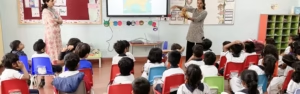
At One World International School (OWIS), one of the top IB schools in Bangalore, the Early Years Programme is built on the International Baccalaureate framework, which places the whole child at the centre of learning. From their very first day, children are encouraged to name their emotions, build friendships, and develop independence in ways that feel genuinely safe and supported.
The IB subjects at primary level are structured around Units of Inquiry with themes like “Who We Are” and “How We Express Ourselves” — themes that are deeply relevant to a child navigating their first weeks away from home. They give children language, context, and a sense of community to anchor themselves.
Parents looking for the best IB schools in Bangalore would do well to look beyond academic rankings and ask: how does this school actually support a 4-year-old who misses their mum? At OWIS, that answer is woven into the curriculum design, the training of every early years educator, and the purposeful spaces built specifically for young learners.
Frequently Asked Questions
For most children, the adjustment period lasts two to six weeks. Every child moves at their own pace. If distress continues well beyond six weeks without any sign of settling, a conversation with the school counsellor is a wise and sensible step.
Brief transition visits can help in the very first few days. However, extended parental presence can sometimes delay independence. Work with your child’s teacher to find an approach that suits your child’s temperament and the school’s transition programme.
Yes, it genuinely can. Children are highly attuned to parental emotional states. Practising a calm, confident goodbye, even when it feels difficult, is one of the most effective things you can do for your child in those early weeks.
If your child’s distress is severe, persistent, and clearly interfering with daily life after several weeks of school, consult your paediatrician or a child psychologist. Seeking support early leads to far better outcomes. There is no need to wait and hope it passes on its own.
At OWIS, we believe that a child’s emotional wellbeing is the foundation of everything else they learn.
If you have questions about how our Early Years Programme supports children through transitions, we invite you to get in touch with us.