


As artificial intelligence torpedoes every corner of the world, educators face a critical question: “Is traditional education still relevant?”
As an IB coordinator who has witnessed firsthand the evolution of AI in education, the International Baccalaureate programme remains highly relevant in preparing students for an AI-driven future.
While AI tools like ChatGPT have sparked concerns about academic integrity and the future of assessment, they’ve also illuminated precisely why the IB syllabus remains indispensable.
Why AI in Education Is An Opportunity
When ChatGPT emerged in late 2022, many educational institutions panicked. India is already seeing rapid AI adoption, with 89% of respondents stating AI will be important in their daily lives and over 50% actively learning AI-related skills, according to a 2025 survey by Bosch. Some banned the technology outright, viewing it as an existential threat to academic integrity. The IB took a forward-thinking approach. Instead of viewing AI as a crisis, the IB recognised it as an opportunity to reinforce students’ critical thinking, ethical decision-making, and authentic learning.
The IB’s position is clear: AI-generated work is not a student’s own work. Like any external source, AI content must be appropriately cited and referenced. While the IB acknowledges the importance of AI, it also emphasises maintaining the integrity that defines the IB subjects and simultaneously teaching students to use AI as a tool.
How the IB Subjects Are Relevant in the AI Era
The structure of IB subjects inherently resists the shortcuts that AI might provide. Consider the Extended Essay, a 4,000-word independent research project that requires months of development, regular check-ins with supervisors, and demonstrated understanding through viva voce discussions. An AI cannot replicate the journey of intellectual growth.
Key IB Components That AI Cannot Replace:
- Theory of Knowledge (TOK): The course asks students to examine the nature of knowledge itself. AI can provide information, but it cannot engage in the nuanced philosophical discussions that TOK demands. Students must grapple with questions about bias, reliability, and the construction of knowledge; these skills become even more critical when evaluating AI-generated content.
- Creativity, Activity, Service (CAS): The experiential learning component requires students to engage in real-world projects that benefit their communities. AI cannot attend volunteer sessions or participate in theatrical productions. The reflections students write about these experiences must be authentic and personal.
- Internal Assessments (IAs): The coursework involves sustained engagement with teachers who observe student development over time. Teachers know their students’ voices, capabilities, and thought processes. Any AI-generated work stands out like a jarring note in a familiar melody.
- Oral Examinations: From language assessments to Individual Oral presentations, the IB requires students to think on their feet and show understanding through spoken communication, which AI cannot do for them.
How Can Students Develop Approaches to Nuanced Learning in an AI-Driven World?
The most compelling argument for the IB’s relevance is its Approaches to Learning (ATL) framework. While traditional education systems focus on content memorisation, tasks AI can now perform instantaneously, the IB subjects emphasise metacognitive skills that enable students to “learn how to learn.”
Recent research highlights a growing concern among employers: one in six companies hesitates to hire recent college graduates due to their lack of practical skills, which is the gap that the best IB schools in Bangalore and worldwide are addressing through ATL skills.
ATL Skills for Holistic Student Development:
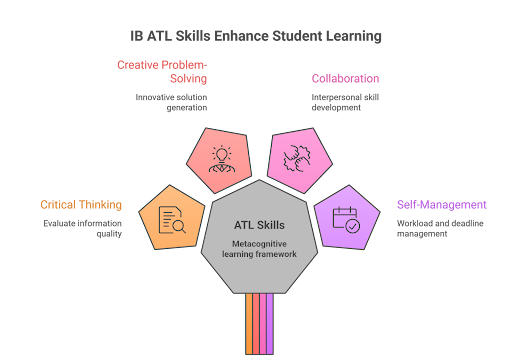
- Critical Thinking: AI can process information rapidly, but it cannot evaluate the quality of its sources. IB students learn to question assumptions, identify logical fallacies, and construct well-reasoned arguments.
- Creative Problem-Solving: While AI excels at following patterns and routines, it struggles with novel problems that require lateral thinking. The IB curriculum deliberately places students in unfamiliar situations that demand innovative solutions.
- Collaboration and Communication: The IB’s emphasis on group work and presentations develops interpersonal skills that remain distinctly human. AI cannot negotiate team dynamics, read body language, or build consensus.
- Self-Management and Resilience: The demanding nature of the IB programme teaches students to manage complex workloads, meet deadlines, and persist through challenges.
Teaching Students to Use AI Ethically and Effectively
The IB’s approach to AI isn’t to ban it but to teach students how to use it responsibly. Each technological advancement initially sparked concern, yet each ultimately enhanced learning when properly integrated.
In IB curriculum schools, teachers role-model ethical AI use. For example, they might:
- Use AI to generate example essays for students to critique, teaching them to identify AI’s characteristic limitations: generic arguments, lack of specific examples, absence of personal voice, and potential factual errors
- Demonstrate how to use AI as a brainstorming partner while maintaining ownership of ideas
- Teach students to identify and address AI bias, understanding that AI tools inherit the biases of their training data
- Show how to craft effective prompts and evaluate AI outputs critically
What Are the Built-in Safeguards of IB Assessment?
The IB assessment system has several features that naturally detect and deter inappropriate AI use:
- Process-Based Assessment: IB coursework isn’t designed to be completed in a single evening. Teachers observe student work development over weeks or months through mandatory supervision meetings, making it nearly impossible to submit entirely AI-generated work without detection.
- Viva Voce Discussions: Students must defend their work orally, explaining their reasoning, methodology, and conclusions. It reveals whether they truly understand their submission or have merely copied AI-generated content.
- Teacher Knowledge: IB teachers know their students’ capabilities, writing styles, and intellectual development. A sudden leap in sophistication or a shift in voice raises immediate red flags.
- Focus on Understanding Over Coherence: IB mark schemes reward understanding, original analysis, and critical thinking, not merely well-structured prose. AI-generated content often produces superficially impressive writing that lacks depth and original insight.
How Can Schools Prepare Global Citizens for an AI-Driven Future?
As one experienced IB educator notes, when teachers read AI-generated papers, they “sound like aliens have written them.” The formulaic, generic nature of AI output highlights exactly what the IB cultivates: human voice, original thinking, and intellectual curiosity.
- Learning to Identify AI Limitations: IB students practice evaluating AI-generated content and recognising its characteristic flaws: a lack of specific examples, an absence of nuanced argumentation, and a tendency toward generic conclusions that sound impressive but lack substance.
- Understanding AI as a Learning Tool: As IB educators emphasise, AI should be used for assistance, helping students find the right path, generating ideas, or providing feedback, but never as a replacement for their own thinking.
- Developing Digital Literacy and Ethical Awareness: The IB teaches students to ask critical questions about AI’s role in society. Who creates these tools? Whose perspectives are represented in the training data? What biases might AI perpetuate? How do we ensure equitable access across different communities and cultures?
What makes the IB approach particularly effective is its insistence on process over product. Teachers evaluate a student’s entire learning journey through their final submission.
The Verdict: More Relevant Than Ever
Is the IB curriculum instrumental in the age of AI?
Absolutely, perhaps more so than ever before. While AI can generate essays, solve equations, and provide information instantly, it cannot replace the holistic education that the IB offers.
The programme’s emphasis on critical thinking, ethical decision-making, interpersonal skills, and authentic learning experiences prepares students for a world where AI is ubiquitous but human judgment, creativity, and integrity remain irreplaceable.
As we continue to evolve our educational practices, the IB curriculum serves as a map for what education should be: not a repository of facts to memorise, but a framework for developing the uniquely human capacities that will define success in the AI era.