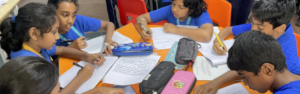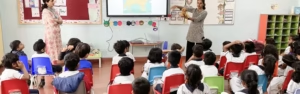



Stepping into the IB Classroom, learning is fundamentally different, shifting the focus from memorising facts to mastering skills through inquiry, application, and real-world connection.
Unlike traditional methods that often focus on memorisation, the IB education system promotes questioning, exploration, and deep reflection. In IB schools, teaching is student-centred, with teachers serving as guides or facilitators instead of lecturers.
This approach empowers students to take ownership of their education, leading to deeper understanding and better retention of knowledge.
What makes IB Classrooms Different from Traditional Classrooms?
IB classrooms look and feel different because they prioritise understanding over memorisation, and exploration over instruction.
According to the International Baccalaureate Organisation, IB students demonstrate stronger critical thinking and research skills than non-IB peers.
IB Classroom Vs Traditional Classroom
| Aspect | IB Classroom | Traditional Classroom |
|---|---|---|
| Learning Approach | Focuses on inquiry-based and conceptual learning where students are encouraged to ask questions, research, and explore topics. | Focuses on teacher-centred learning where instructors deliver specific content through lectures. |
| Curriculum Approach | An interdisciplinary and holistic approach that connects subjects to real-world issues and fosters personal growth. | Subject-specific and often follows a national or state-prescribed syllabus, with an emphasis on a strong foundation in core subjects. |
| Assessment | Assessments help to measure a range of skills and deep understanding. | Primarily relies on standardised tests and examinations that often emphasise memorisation and recall of information. |
| Teacher Role | Facilitators or mentors guide students through inquiry and exploration. | Instructors manage the classroom and deliver lessons. |
| Student Role | Students are encouraged to experiment, collaborate, and take ownership of their learning journey. | Students listen, take notes, and primarily work alone on assignments. |
IB Education Promotes Inquiry-Based Learning
The IB Education promotes Inquiry-based learning by building a curriculum around compelling questions and challenging, real-world issues.
It encourages students to actively participate in their education by asking questions, exploring real-world issues, and constructing their own understanding.
- Students begin by asking questions that spark their curiosity, which then encourages them to dive deeper into research and exploration.
- They gain skills in gathering, analysing, and interpreting data.
- Working together in teams, students discuss issues and tackle problems, which helps strengthen their communication and teamwork skills.
- When education is linked to real-world experiences, it becomes truly meaningful and impactful.
The role of the teacher is to be a facilitator and co-learner, guiding through the inquiry process, asking challenging open-ended questions, and creating a safe environment where students feel free to explore new ideas and learn from failures.

Critical Thinking – The Core of IB Classroom
Critical Thinking is the core of IB learning, as the curriculum is designed to push students beyond simple recall, demanding they analyse, evaluate evidence, and construct reasoned arguments.
These skills are developed among the students across all subjects through inquiry-based learning, project-based tasks, and specific courses like Theory of Knowledge (TOK).
Tasks like the Extended Essay (EE) and other research-oriented projects require students to conduct in-depth research, analyse sources, and construct well-supported arguments.
Moreover, the IB exams and assessments go beyond multiple-choice formats, requiring students to interpret data, apply concepts, and justify their reasoning in complex, evidence-based responses.
Ongoing Evaluation Instead of Rote Learning
IB schools are not based solely on rote learning and final assessment examinations. Instead, they utilise ongoing evaluation such as presentations, essays, and projects.
Unlike traditional grading systems, the IB assessment views learning as a continuous journey using various methods to monitor student progress throughout the year and provide feedback for improvement.
The IB Classroom is a multi-faceted assessment approach that ensures students are allowed to demonstrate their understanding in different ways.
For example, science students are assessed based on their ability to understand concepts, design investigations, process data, and reflect on science’s impact on society.
Why IB Classroom Feels Different and Why Parents Choose Them?
IB classrooms feel different because they prioritise understanding, exploration, and skill-building over rote memorisation. Students become curious thinkers, confident communicators, and compassionate global citizens.
At OWIS India, one of the best international baccalaureate schools in Bangalore, the IB approach is woven into everything, from inquiry-based lessons to OWIS fosters global perspectives and reflective learning through experienced educators, a welcoming classroom atmosphere and a solid academic framework. It encourages students to develop with curiosity and confidence.
Parents looking for an International school in Sarjapur, and international school in whitefield Bangalore that promotes not only academic success but also independence, creativity, and global awareness will find the IB experience at OWIS to be genuinely transformative.
FAQs
- How is Assessment done in IB Classrooms?
IB classrooms use ongoing evaluation through projects, presentations, and inquiry-based tasks that help measure real understanding of skills.
- Do IB Classrooms follow the same curriculum across all schools?
Yes, the IB education system uses a globally consistent framework, but the learning environment and environment differ based on students’ needs to make it more personalised.
- What are IB’s unique benefits?
IB fosters personal and academic growth, emphasising understanding over memorisation, multilingualism, global perspectives, and nurturing inquiring, caring students – an approach deserving commendation.