


“Methought I heard a voice cry, ‘Sleep no more! Macbeth does murder sleep’—the innocent sleep, Sleep that knits up the ravelled sleave of care…”
When Shakespeare wrote those lines in Macbeth, he was describing the guilt of a king. But honestly? He could just as easily have been describing a teenager at a coaching institute, unable to sleep or eat until they cracked the exam.
We’ve all seen them, or perhaps we were them. The sunken eyes, the heavy backpacks, the frantic flipping through pages of formulae while standing at a bus stop. For decades, it was the accepted rite of passage. If you wanted success, you had to surrender your sleep, your hobbies, and your sanity to the “factory.” You had to become a machine that outputs correct answers.
But lately, parents and students are waking up (pun intended) and asking a crucial question: Is the cost of this pressure worth the prize? And increasingly, they are finding their answer not in a cramped coaching centre, but in the sprawling, vibrant campuses of IB Schools in Bangalore, India.
Are You Stuck in the Coaching Trap?
Coaching culture has expanded quickly. Revenues have exceeded ₹58,000 crores, and cities like Kota have become destinations for students seeking a coaching institute.
Students go to school just to mark attendance, while they do most of their actual learning at coaching centres. Activities like arts, music, and sports, which make childhood enjoyable, are pushed aside. As a result, stress increases and mental health problems become more common.
What Makes Learning Different?
International Schools in Bangalore, India, focus on overall development rather than just exam preparation. They see learning as an ongoing journey, not as a race to ace one test.
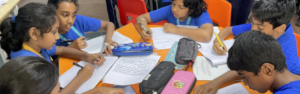
At OWIS, one of the best IB schools in Bangalore, children learn best when they are curious, involved and happy. The school’s enquiry-based method encourages students to ask questions, seek answers, and develop critical thinking skills.
ASER 2024, which surveyed more than 650,000 children across over 600 districts in India, highlights why improving foundational learning remains an important part of strengthening education beyond rote-based outcomes.
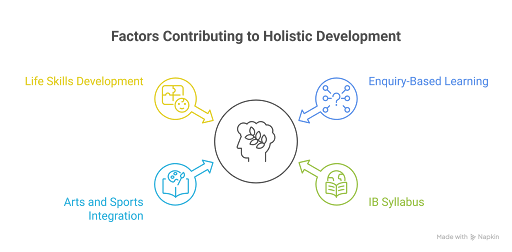
These activities are a key part of the IB syllabus, which values different types of intelligence. In real life, you don’t get multiple-choice questions. The world values creativity, teamwork, and adaptability.
That’s why OWIS integrates academics with arts, sports, and life skills. Students learn time management by balancing interests rather than cramming. They solve real-world problems.

The Cost of Coaching
When students spend too much time at coaching institutes, they miss out on essential years for personal growth, making friends, and finding hobbies.
Students who only focus on exams often have trouble understanding concepts deeply. They can spot patterns but struggle to use ideas in new ways. They know how to find answers, but not how to ask questions.
When children compete for a few spots, they learn that winning means someone else has to lose.
What Makes International Schools Different
Choosing IB curriculum schools is about viewing the international school vs. coaching choice as an opportunity to adopt a new way of teaching that focuses on helping children grow in all areas.
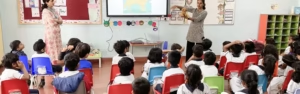
Teachers use creative ways to keep students interested. Classes include interactive boards and group discussions. In science labs, students do hands-on experiments. All learning occurs through an enquiry-based approach, so students build their critical thinking and problem-solving abilities.
The purpose of education is not to produce exam toppers. It should help create curious, capable, and caring people who can handle life’s challenges.
Students should learn to research, question ideas, and think critically. They also should see that failure is a regular part of growing and not something to be afraid of.
They also learn in a setting that values diversity and global citizenship, helping them develop the international outlook our connected world needs.
The Freedom to Explore
I met an OWIS student who is passionate about robotics, plays the violin, and volunteers at an animal shelter. How does she manage? “It’s not about managing time for extras. Everything I do is part of learning who I am.”
That’s the key difference. One system sees childhood as something to give up. The other understands that childhood is valuable, a time for exploring and growing into who we are.
The IB curriculum is respected worldwide because it helps students develop holistic qualities. You don’t have to choose between academic success and overall growth; academic success comes from developing the whole person.
A Path Forward
Coaching culture started to fill gaps in education, but we may need to rethink it. Instead of believing that school is not enough and adding more pressure, what if we picked schools that truly meet students’ needs? Imagine schools where learning is something to enjoy, not just get through.
Children deserve more than just preparing for a single exam. They need time to find their interests, build their talents, and grow into themselves.
As Polonius said, it’s important to be true to yourself. But before that, you need time and space to find out who you are. International schools don’t just offer an alternative to coaching culture; they redefine education by putting children, not exams, at the heart of learning.
Isn’t that what education is really meant to be?
FAQs
1. Why are international schools replacing coaching culture in Bangalore?
Parents increasingly prefer international schools because they prioritise holistic development, critical thinking, and student wellbeing instead of intense exam-focused coaching pressure.
2. What makes international schools different from coaching centres?
International schools encourage enquiry-based learning, creativity and collaboration, while coaching centres primarily focus on repetitive exam preparation and rote memorisation.
3. Why choose OWIS India over coaching culture?
OWIS India nurtures curiosity, global perspective, and balanced development, combining strong academics with arts, sports, and life skills for meaningful learning.