


ib myp curriculum what makes student distinctive
Parents often hear about the IB Middle Years Programme and wonder what it really does for children in Grades 6–10. How is it different from a regular syllabus? And what kind of learner does it actually shape?
If you are exploring the Middle Years Program in IB for your child, this guide breaks it down in simple terms, backed by IB research.
What is the IB Middle Years Programme (MYP)?
The MYP is an education framework developed by the International Baccalaureate Organisation (IBO) for students aged 11–16. It is an intersectional course between the Primary Years Programme (PYP) and the Diploma Programme (DP).
The IB Middle Years programme is built around eight subject groups, taught for at least 50 hours per year:
- Language and Literature
- Language Acquisition
- Individuals and Societies
- Sciences
- Mathematics
- Arts
- Physical and Health Education
- Design
What distinguishes the MYP structure is its intentional interdisciplinary nature, where students regularly make connections across subject boundaries.
The curriculum’s emphasis on inquiry-based learning encourages students to question, investigate, and construct their own understanding rather than passively receive information.
What does the MYP focus on?
In the MYP, content is essential. But how students learn is equally important.
The programme emphasises:
- Concept-based learning that doesn’t advocate chapter-by-chapter coverage
- Global contexts that link topics to real issues
- Interdisciplinary units that combine two or more subjects
- Approaches to Learning (ATL) skills like communication, collaboration, creative and critical thinking
An IB-commissioned study on critical thinking found that MYP students, across 870 learners in Australia, England and Norway, had significantly higher levels of critical thinking than matched non-MYP peers, even after controlling for background factors.
So, the focus is clear: address students’ developmental needs and prepare them for further academic study and life in an increasingly interconnected world.
Core elements of the MYP curriculum
Here are the key building blocks that shape an MYP student:
1. Subject groups
Students study a broad range of subjects each year, gradually getting more choice in Years 4 and 5. The flexible curriculum keeps options open for future pathways, including the IB DP and national boards.
2. Approaches to Learning (ATL)
ATL skills are the programme’s “toolkit”. Students practise:
- Communication and collaboration
- Organisation and self-management
- Research and media literacy
- Creative and critical thinking
- Reflection and transfer of learning
They are explicitly taught and assessed against established criteria.
3. Service as Action
Students are encouraged to apply learning through community service and real action projects. Service as action is an integral part of the programme, especially in the MYP community project.
4. Long-term projects
In the final year, every MYP student completes a Personal Project. They choose a topic, research it deeply, and create a product or outcome that profoundly impacts them. The process builds independence, resilience, and authentic research skills.
What does an MYP classroom look like?
MYP classrooms are different from traditional set-text, lecture-style lessons.
- Inquiry-based tasks: students ask questions and investigate, instead of only copying notes
- Use of real sources: maps, news articles, primary documents, lab data, and digital repositories
- Projects and presentations: prototype-building, community exploration, and field trips
- Criteria-based assessment: students are assessed against explicit descriptors at Levels 1–8, rather than a single percentage or rank.
An independent comparison of MYP and GCSE assessments in English, Mathematics and Science found that the two are comparable in cognitive demand and in the level and range of skills tested.
While the teaching style is different, the academic expectations are rigorous.
What makes MYP students distinctive?
Research on the MYP highlights both academic and personal advantages.
1. Strong academic skills
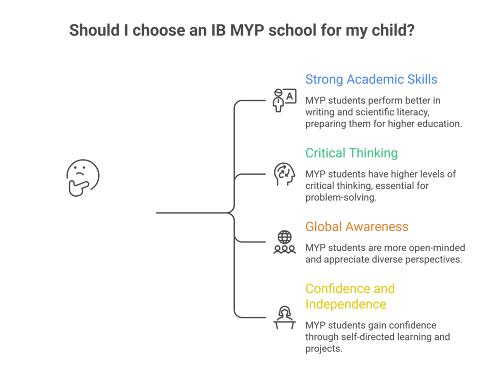
A study using international ISA tests found that MYP students performed significantly better than non-IB students in narrative writing, expository writing and scientific literacy, especially by Grade 10.
In Turkey, over four in ten Grade 8 MYP students scored in the top 4% in a national examination, demonstrating substantial academic achievement alongside the new teaching approach.
In a large US school district, former MYP students were about 1.3 times more likely to take at least one AP or IB exam in high school and more likely to achieve at least one “college-ready” score, even after controlling for demographics.
2. Higher-order critical thinking
The international study on critical thinking found that MYP students:
- Scored significantly higher on a standardised critical thinking test than non-MYP peers
- Maintained the IB advantage across grades and across multiple countries
Interviews with students and teachers revealed that self-directed learning, the incorporation of clear critical-thinking language in assessments, and an inquiry-based approach are crucial to effective education.
3. Global awareness and open-mindedness
The MYP emphasises intercultural understanding, global contexts and appreciation of diverse perspectives.
Studies from the UK and Australia reported that MYP students rate themselves higher on attributes such as international and civic-mindedness and show positive social, emotional, and psychological well-being, with many students “flourishing” and satisfied with school.
4. Confidence and independence
Students plan projects, investigate real questions and reflect on feedback; they gain confidence in managing their own learning. MYP teachers in global studies noted that students become progressively better at analysing different perspectives and reflecting on their thinking over the years.
In short, MYP students stand out as analytical, globally aware and comfortable with unfamiliar tasks.
How the MYP supports future learning
In the latest IB results, 6,083 students from India received their Diploma and Career-Related Programme results, reinforcing the significant participation of Indian learners across the IB continuum
Research tracking former MYP students into high school shows tangible long-term benefits. Students who had studied in MYP:
- Took more AP/IB exams on average
- Earned more college-ready scores
- Were more likely to reach benchmark SAT/ACT scores set as indicators of college readiness
Comparative research also shows that the MYP prepares students well for demanding qualifications such as GCSEs and the IB Diploma Programme, while maintaining curricular flexibility for local requirements.
For parents, this means a smoother transition to Grade 11–12 programmes, whether that is IB DP or other recognised pathways.
Why choose an IB MYP authorised school in Whitefield?
If you are comparing IB curriculum schools in Bangalore, the MYP years are often the “make or break” phase in a child’s mindset towards learning.
As an IB MYP Authorised school, Whitefield, OWIS delivers inquiry-based learning, with clear assessment criteria and a strong focus on ATL skills. The campus is officially recognised by the IB Organisation as a World School for the MYP, meaning the programme is planned, taught, and evaluated in accordance with global standards.
For families, it means that the school:
- Maintains the same academic and pastoral rigour expected worldwide
- Builds real-world skills through service, projects, and interdisciplinary learning
- Creates a smooth pathway into the IB Diploma Programme or other senior-school options
- Offers continuity for students who begin in the early years and move up the IB continuum
If you are considering International Schools in Bangalore, India, choosing an authorised MYP campus offers something simple but valuable: confidence that your child is getting the IB experience as it’s meant to be delivered.
Final thoughts
The IB Middle Years Programme is not a “different syllabus”. It is a research-backed framework that:
- Builds strong academic foundations
- Develops critical and independent thinkers
- Enables global awareness and well-being
When delivered in a well-supported environment like OWIS, the IB Middle Years Program can shape students who are not only ready for Grades 11 and 12 but also ready to navigate an unpredictable world with confidence and empathy.