

Preparing Indian Students for the IB Curriculum 2026
The IB curriculum is a collaborative effort designed to create an excellent and internationally-minded, research-based curriculum along with supportive materials that truly help students grow and develop their skills.
With the parents exploring International Board Schools in India want reassurance that the curriculum keeps pace with a changing world.
The IB’s latest update cycle for 2026 and beyond focuses on strengthening critical thinking, inquiry, and subject depth, while making assessments more authentic and accessible for students.
For families considering IB Boarding Schools in India, understanding these shifts helps them see how the IB continues to refine learning for both current and future cohorts.
According to recent Indian educational reporting, the number of IB World Schools in India more than doubled over the last decade, with the country hosting over 225 IB World Schools as of 2024, compared with far fewer ten years earlier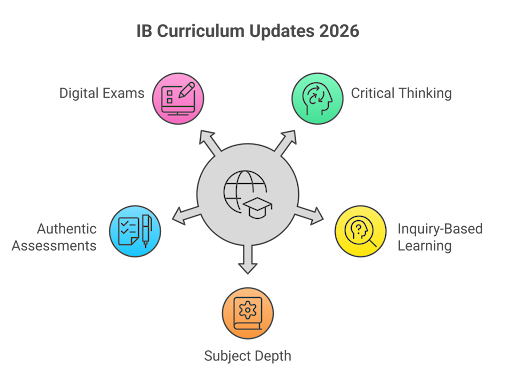
What is IB’s 2026 Update Cycle and Why It Matters?
Every few years, IB reviews and updates its curriculum to reflect the latest in educational research, global developments and the needs of students entering higher education.
The IB reviews all subjects regularly to ensure that each one incorporates the latest educational research and lessons learned from thorough evaluation of the existing curriculum.
That means students enrolling now need awareness, and schools offering IB must prepare to implement these changes.
At OWIS India, where we emphasise holistic global education, these updates aren’t just administrative but matter deeply to how we shape thinking, learning, and readiness for the world.
What’s Actually Changing? A Parent-Friendly Breakdown
Around 2026, several Diploma Programme (DP) subjects will finish their review cycle and be updated. The main changes include:
- Updated subject guides emphasise concepts, inquiry, and practical real-world applications.
- Revised assessment frameworks that emphasise reasoning, evaluation, and synthesis rather than mere recall.
- Slowly introducing digital exams in some DP subjects starting in 2026, with expansion in the 2030s.
These changes affect how students experience their final years of school in IB World Schools, including many international schools in Bangalore, India.
Key 2026 Updates: What’s Changing
One of the most visible updates in the IB curriculum 2026 is the new DP History course, first teaching in 2026 and first assessment in 2028.
Updated Subjects and Curriculum Designs
- History
Remember when history class meant memorisation dates and battles? Not anymore.
The new History syllabus highlights four key concepts – cause and consequences, continuity and change, perspectives, and significance, along with a flowchart ensuring students don’t just acquire theoretical knowledge, but utilise it in a meaningful way.
The redesigned History course places stronger emphasis on historical inquiry, multiple perspectives, and skills development, encouraging students not just to learn facts but to think like historians.
| Shifts | Previous | 2026 Update |
| Focus | Emphasis on content-heavy and factual recall. | Conceptual, interpretive, and focuses on “doing” history by analysing evidence. |
| Concepts | Limited conceptual focus. | Focus on four core concepts: cause and consequence, continuity and change, perspectives, and significance. |
| Content Options | Used fixed, prescribed regional topics. | Flexible “inquiry areas” with a wider, more inclusive range of global content choices. |
| Internal Assessment | Use a descriptive IA with a reflection section | Uses a structured three-part historical investigation. |
- Sciences Get a Conceptual Makeover
Biology, chemistry, and physics are changing to emphasise a conceptual approach to learning and teaching. This method will directly reference concepts, skills, and the nature of science. Instead of just memorising formulas, students will grasp how scientific principles connect with one another.
For example, when your child studies climate change, they will not only learn about carbon emissions. They will also examine urban systems, resource management, and environmental ethics from various viewpoints.
The new Environmental Systems and Societies syllabus now offers both Standard Level and Higher Level options. Higher Level students will explore specific areas such as Environmental Law, Ecological Economics, and Environmental Ethics.
Assessment & Integrity Updates
The 2026 update also brings new assessment formats that emphasise authentic understanding over mechanistic responses.
- Digital Exams Launch
Starting May 2026, IB will begin offering digital assessments for the Diploma Program (DP) and Career-related Program (CP).
The IB is piloting a combination of paper-based and digital exams for some DP and CP subjects, with a long-term plan to expand digital options. Across subjects, new guides and mark schemes put more weight on explanation, evaluation, and application of knowledge, rather than only factual recall.
Moreover, while some schools will begin offering digital exam formats for certain DP subjects in May 2026, other schools can choose digital or paper formats during the transition period.
The assessment criteria and grade boundaries are the same for both formats.
| Aspect | Current System | 2026 New Update |
| Exam Format | Paper-based only | Digital option available |
| Launch Timeline | Traditional pen-and-paper. | May 2026 pilot launch, full transition by early 2030. |
| School Choice | All subjects paper-based | Language, Literature, and Language Acquisition Courses first |
| Grading Standards | Fixed Grade Boundaries | Same grade boundaries for both digital and paper formats. |
Why Indian Families are Choosing and Why These Updates Matter
At OWIS India, we’ve seen an interesting trend.
Parents aren’t looking for “International Schools.” They want schools that help their children become global citizens while staying true to their identity.
The 2026 updates highlight what makes IB appealing:
- Skill-Based Learning Over Rote Memorisation: When students connect real-world applications to their learning, such as understanding environmental law through ESS or examining historical perspectives through inquiry, they build skills that they can use in many situations.
- Flexibility Within Framework: IB gives schools the freedom to use local situations to shape their teaching. This lets students learn traditional Indian art forms or write about local issues. Your child can examine Bangalore’s water crisis in the context of environmental science while also understanding global sustainability challenges.
- Assessment That Matters: The new assessment formats emphasise authentic understanding over mechanistic responses. This prepares students for university-level thinking and professional problem-solving.
| Aspect | What’s New | Why It Matters |
| Critical Thinking | Subjects like history now emphasis skills as much as content. | New conceptual approach in sciences, inquiry-based history with framing questions. |
| Global Recognition & Local Balance | Updated IB DP remains internationally accepted and recognised. | Flexibility to use regional examples; can explore Bangalore’s water crisis alongside global sustainability; regional issues in Extended Essays. |
| University Readiness | Preparing students for top universities in India and abroad. | Assessment formats emphasise authentic understanding over mechanistic responses, and collaborative projects mirror university-level work. |
| Holistic Development | Not just academic, but it also focuses on character building. | Prepares students not just academically, but as global citizens, ready for real challenges. |
Preparing Your Child for the Transition
If your child is entering or currently in an IB program, here’s what you should know:
- First Assessments: For most subjects, the first tests under the new curriculum start in May 2026. History’s first assessment takes place in May 2028, giving schools and students extra time to adjust to the new, concept‑rich course.
- Increased Collaboration: The new curriculum promotes working together while keeping individual responsibility. Group projects in sciences and paired case studies in history reflect real-world professional settings.
- Enhanced Critical Thinking: Across the updated IB curriculum, students are rewarded for how they think, not just what they remember. Helping your child practise explaining “why” and “so” in subjects will align them closely with these expectations.
Conclusion
The 2026 update from IB clearly shows that education isn’t fixed. As the world changes, what students need to succeed also evolves. The updates aren’t about making education more difficult or easier – they focus on making it more meaningful.
At OWIS India, these improvements offer a chance to further strengthen how students learn to question, connect, and contribute.
For families considering IB curriculum schools in Bangalore or IB board schools in India, the 2026 updates emphasise that the IB remains a flexible, globally recognised pathway that helps young people adapt, analyse, and grow.