



Children today are growing up in a world very different from the one their parents knew. Online classrooms, social media, gaming, and AI tools are now a big part of daily life. With that comes a different set of challenges that earlier generations never faced.
How can we help children use technology ethically and responsibly?
This guide draws on recent global research, including UNICEF’s 2025 Childhood in a Digital World report and NITI Aayog’s work on online safety, to offer practical, evidence-based advice for parents and educators.
Why Should We Focus on Digital Ethics?
India is home to one of the youngest and most digitally active populations on the planet. According to the National Crime Records Bureau, cybercrime against children surged by 32% between 2021 and 2022. A LocalCircles survey found that 47% of Indian children spend three to six hours online daily, and another 10% clock more than six hours.
These numbers are more than just screen time statistics. They show how many hours children spend facing real ethical questions. Should they share a classmate’s embarrassing photo? Is it okay to copy homework from the internet? What should they do if a stranger sends a friend request?
The UNICEF Innocenti report highlights that in 29 out of 31 countries studied, children who spent more time online developed stronger digital skills. However, the same report found that children exposed to online bullying or sexual abuse had much higher levels of anxiety, self-harm, and suicidal thoughts in all 21 countries analysed. The key takeaway is that spending time online is not the problem; it’s the quality of that time that goes awry.
Teaching children to use technology ethically is now critical. It is a basic need.
What Are the Core Ethical Challenges Children Face Online?
Before we can help children, we need to know what they face. Here are the main ethical challenges young people meet online:
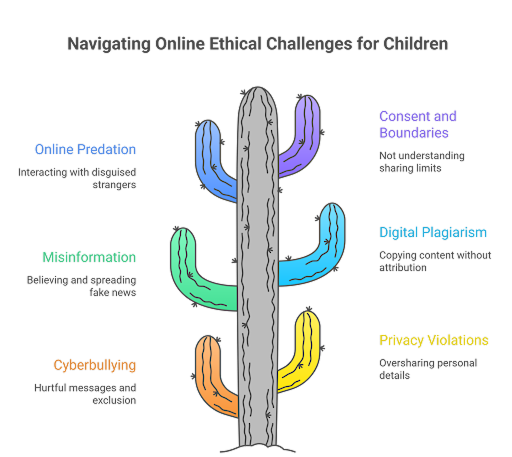
| Ethical Challenge | What Does It Mean |
| Cyberbullying | Sending hurtful messages, sharing embarrassing content, and exclusion from group chats |
| Privacy violations | Oversharing personal details, posting photos of others without consent |
| Misinformation | Believing and spreading unverified claims, falling for fake news |
| Digital plagiarism | Copying content from AI tools or websites without attribution |
| Online predation | Interacting with strangers who disguise their identity. In fact, NCRB-linked data shows that in most child abuse cases, over 90% of offenders are known to the child, including acquaintances met online, highlighting how trust and identity are often manipulated. |
| Consent and boundaries | Not understanding when sharing someone’s data or image crosses a line |
As designer Matthew Stephens wrote in his framework for ethical digital design, “If a product relies on tricking children into engagement or payment, it shouldn’t exist.” The same idea applies to the habits we let children develop. If a behaviour is based on tricking others or ignoring their feelings, it should be addressed early.
How Can Parents Create Digital Responsibility at Home?
Forget surveillance-heavy parenting. Research consistently shows that restrictive approaches alone don’t work. The UNICEF report found that in 21 of 22 countries, children whose parents heavily restricted internet use had lower digital skills, without any meaningful reduction in exposure to online risks.
What does work is active, engaged guidance. Here’s how:
- Start unfiltered conversations about surfing the internet. Even five-year-olds can understand basic online concepts like being kind, asking permission before sharing photos, and telling a trusted adult when something feels wrong.
- Show the behaviour you want and impose strict but reasonable rules. If you scroll through your phone during dinner or share other people’s information casually, they will too. Talk to them about online behaviours that will not be tolerated at home.
- Create a family digital agreement. Sit down together and decide on shared guidelines. Discuss things like screen-free times, which platforms are okay, and what to do if they see something upsetting.
- Encourage critical thinking. When your child sees a sensational headline or a too-good-to-be-true social media post, ask them: Why is the news sensational? What are its ethical implications? What might their motive be? Is it an acceptable behaviour?
Students start learning digital responsibility at home, well before any formal lessons at school.
What is the Role of Schools in Developing Ethical Digital Citizens?
Schools are well-positioned to create structured, age-appropriate lessons on digital ethics. The IB PYP Curriculum is a strong example. Its inquiry-based approach helps students explore fairness, responsibility, and community in digital settings.
Top IB schools in Bangalore help students examine real-life situations through case studies on data privacy or discuss the ethics of AI art, and they build moral reasoning skills that apps cannot teach.
NITI Aayog’s Information Security Education and Awareness (ISEA) initiative promotes digital literacy for all. It shows that keeping children safe online is a combined effort from parents, educators, schools, and communities.
How Should We Talk to Children About Online Safety Without Frightening Them?
The aim is to build awareness, not fear. Here are some ways to talk to children at different ages:
- Ages 5–8: Use stories and role-play. Frame digital ethics through characters they relate to. Ask questions like, “How would you feel if someone shared your drawing without asking?”
- Ages 9–12: Introduce real scenarios. Discuss news stories about cyberbullying, data leaks, or misinformation. Let them form their own opinions and challenge each other respectfully.
- Ages 13 and up: Treat them as young adults. Talk about consent, digital footprints, and the long-term effects of online actions. Let them help set their own boundaries.
The UNICEF report emphasises that while it is never a child’s responsibility to protect themselves from online harm, it is vital that they can recognise danger and know where to seek help.
What Can We Do Better?
India has made real progress. The National Cyber Crime Reporting Portal has received over 1.3 million complaints. The Cyber Crime Prevention Against Women and Children scheme has allocated ₹131.60 crore and established forensic labs in 33 states and union territories.
However, there are still gaps. Most Indian schools do not yet provide tested, evidence-based online safety education. Some of the best schools in Bangalore, India, are leading, but expanding these efforts nationwide will require ongoing investment in teacher training, curriculum, and community involvement.
Conclusion: When Is the Right Time to Start?
The answer is now. There is no minimum age for kindness, honesty, or respect. These are the values behind ethical digital behaviour. When a three-year-old asks before using someone else’s toy, they are learning the same lesson as a teenager who asks before sharing a photo.
The digital world is here to stay. Our children deserve to use it with confidence, compassion, and strong values.