


What Makes IB Students Use Unusual Study Hacks?
I still remember the most unusual study hack my friend suggested to me in tenth grade, and I almost fell for it. She told me to drink castor oil before math revisions. And the ridiculous reason she gave me? When your bowels clear, so does your mind. When your mind is clear, there’s space for fresh ideas to nestle.
There might be some merit to her hypothesis, though I would never know, for I never tried. Researchers, however, have time and again suggested that there are unique hacks for studying that most definitely work for even the most challenging subjects.
Albert Einstein had dyslexia. Instead of relying on words, he would visualize concepts. For instance, if he were working on a theory about light, he would imagine himself as a horseman riding on a beam of light. He liked to call them his ‘thought experiments,’ and that’s how he came to hypothesize some of the most potent concepts in physics.
So, what’s weird to you may not entirely be strange for someone else. In fact, the International Baccalaureate Programme encourages students to have bizarre study hacks, because that way, you know what you are dealing with and don’t feel overwhelmed or pressurised.
Let’s do a deep dive into some of the wildest study hacks that only IB students know are not really wild, but doable.
As of 2023, India has 226 IB World Schools, showing a 31% increase in just four years
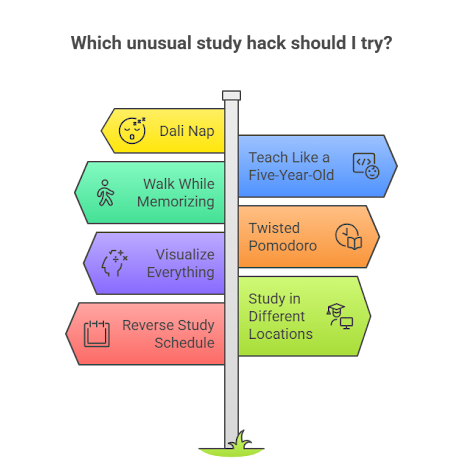
What Is the Dali Nap Technique and Why Does It Work?
Salvador Dali, a renowned Spanish surrealist artist, had a peculiar ritual that sounds absurd until you realize it actually works. He would settle into an armchair with a metal key gripped between his fingers, positioned directly above a metal plate on the floor. As he slept, his grip would loosen, the key would clatter against the plate, and he’d jolt awake. The entire nap would last less than a minute, sometimes only a few seconds.
Why would anyone do this? Dali understood something neuroscientists would confirm decades later. That drowsy, in-between state right before you fall asleep, called the hypnagogic state, is when your brain makes the most unusual connections. It’s charged, strangely active, perfect for problem-solving. Thomas Edison used the same technique, except he held ball bearings instead of a key.
Modern research at the Paris Brain Institute has validated this approach. Students preparing for IB exams use this micro-nap technique, especially when they are stuck on Extended Essays or Theory of Knowledge questions that require creative thinking. You are not really sleeping, you are lounging in that strange space where logic loosens its grip and ideas flow freely.
Study Like You Are Teaching It To A Five-Year-Old
There is this brutal test of whether you actually understand something: try explaining it to someone who knows absolutely nothing about the topic. No jargon. No fancy terms. Just simple words and clear ideas.
If you can explain something in plain English, then you have mastered that subject. That was the approach of Richard Feynman, the Nobel Prize-winning physicist, to learning. Whenever he encountered a complex concept, he would try to explain it in the simplest possible terms. It’s an effective technique that exposes every gap in your understanding because when you can’t explain something simply, you don’t really understand it.
Many students at International schools in Whitefield, Bangalore, have adopted this method for subjects such as Chemistry and Economics, where concepts can become dense and complex. Pick a topic from your syllabus. Write it down on a blank piece of paper. Now explain it as if you are talking to a five-year-old. When you stumble, when you reach for jargon or realize you are going in circles, that’s where you need to study more. Go back to your notes, fill the gap, and try again.
Why Does Walking Improve Memorization?
We are discovering study hacks that ancient philosophers already knew. Aristotle taught while walking. His students would follow him around the Lyceum, discussing logic, ethics, and metaphysics as they moved. They were called the Peripatetics, which literally means ‘those who walk around.’
There is solid science behind the whole ‘walking-learning’. When you walk, your brain gets more oxygen, your heart rate increases, and different neural pathways light up. That’s why some of your best ideas come to you in the shower or during a morning jog.
For IB students drowning in content, walking while reviewing flashcards or reciting formulas can come in handy for subjects like History or English Literature, where you need to remember vast amounts of information. Instead of sitting at a desk re-reading your notes for the fifth time, take them outside. Walk around your neighborhood or pace in your room. Speak the information out loud. Your brain will anchor those facts to the physical movement, making recall easier during exams.
What Is the Twisted Pomodoro Technique?
Here’s where most students get it wrong. They study for hours, then take a break by scrolling through social media. That’s not really a break. Your brain is still processing information, still responding to stimuli, and still firing on all cylinders.
Einstein had a different approach. When he was stuck on a problem, he would pick up his violin and play Mozart. He said that music helped him think. Not background music while studying, but active, engaged playing. The shift in mental activity would reset his brain, and often, when he returned to his work, the solution would be obvious.
Students at Bangalore International Schools have started applying Einstein’s “principle of hacking the study” by pairing intensive study sessions with brief creative breaks. Twenty-five minutes of focused work on Calculus, then five minutes of sketching or playing a few chords on a guitar. It’s not wasted time. It’s strategic rest that keeps your mind sharp. The key is doing something completely different that engages a different part of your brain.
How Does Visualization Enhance IB Learning?
Some people have the uncanny ability to see concepts in their minds with perfect clarity. Nikola Tesla would build entire machines in his mind, visualizing them with such precision that he could mentally rotate, test, and even identify flaws, all without touching a single tool. It wasn’t a supernatural gift. It was a skill he developed through constant practice.
Visualization is one of the trickiest yet most effective hacks for studying, especially for tackling sciences and mathematics. Don’t just read about mitosis or the Krebs cycle; instead, explore them in depth. Close your eyes and watch it happen in your mind. See the chromosomes lining up, the cell splitting. For physics problems, visualize the forces, the motion, and the energy transfers before you write down a single equation.
It also works for abstract subjects. If you are studying economics, visualize supply and demand curves shifting. When analyzing a poem, picture the imagery the poet describes. When you engage your visual cortex, you utilize more of your brain, and that means deeper, more meaningful learning.
Study in Different Locations
Here’s something that sounds too simple to be effective, but research consistently shows it works: studying in different locations improves retention. Your brain subconsciously associates information with the environment where you learned it. If you study everything in the same chair at the same desk, your brain starts to think that information only exists there.
But if you study Biology in a cafe, Chemistry in the library, and History in the park, your brain creates multiple retrieval pathways. During an exam, if you can’t remember something, you might recall, “Oh, I learned this at that coffee shop sitting by the window,” and suddenly the information comes flooding back.
Students at International schools in Sarjapur have developed a habit of switching between study rooms, outdoor spaces, and even different areas of their homes. It feels inefficient because you are moving around too much, but it’s one of the most research-backed study strategies out there. Your brain is better at retaining information when it has environmental cues to help it remember.
The Reverse Study Schedule
Most students study hardest right before exams. I know. That’s how we are wired – to cram at the last moment. But the International Baccalaureate Programme tells you to do the opposite. IB students tend to study the hardest at the beginning of a course, when the material is fresh and their mental energy is at its highest. Then, as exams approach, they mostly review.
It is known as distributed practice, and it is considered the most effective study method. But it requires discipline. It means working on your Extended Essay months in advance of the deadline, not weeks. It means reviewing Chemistry concepts in September for exams in May.
The reason it works is that memory needs time to consolidate. When you learn something and then revisit it after a gap, your brain strengthens that memory. But if you cram everything the night before, it goes into short-term memory, and you will forget most of it by the following week. The students who seem effortlessly bright aren’t necessarily more intelligent. They just started earlier and reviewed consistently.
Conclusion: Weird Or Not, They Work
The aforementioned study hacks seem unusual because they contradict everything we have been taught about studying. We have been conditioned to think that learning means sitting still, staying quiet, and powering through until it’s done. But the brain doesn’t work that way. It craves novelty, movement, rest, and repetition at intermittent intervals.
The best thing about the International Baccalaureate Programme is that it lets you experiment, doesn’t strong-arm you into thinking that there is a right and wrong way, and most definitely welcomes exploration. And that’s where these unconventional study hacks shine. When you are not just trying to pass a test but actually trying to learn, these methods stop being weird and start being essential.
So the next time someone suggests drinking castor oil before studying, politely decline. But if they tell you to take a one-second nap with a spoon in your hand, or to explain calculus to an imaginary child, or to walk around while reciting poetry, give it a try. The most effective study hacks are those that initially seem a little ridiculous until they prove their worth.