


The IB learner profile is not just a list of ten words on a poster. It forms the core philosophy of every International Baccalaureate programme and defines what it means to be an IB learner. These traits guide how students think, interact, and develop in the Primary Years Programme (PYP), Middle Years Programme (MYP), and Diploma Programme (DP).
As modern education changes quickly, employers, universities and communities now value character as much as qualifications. The IB experience is about helping students develop these 10 attributes and showing why they matter today.
What Is the IB Learner Profile?
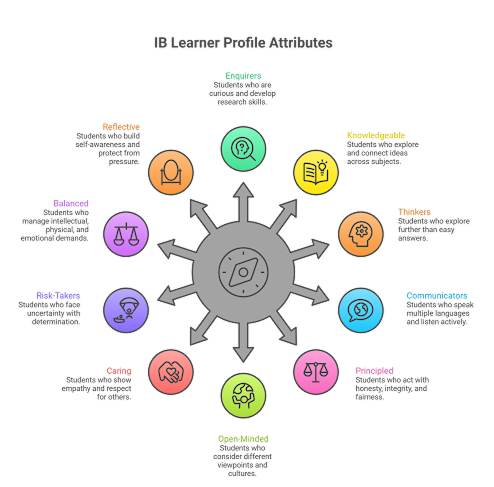
The IB learner profile is a set of qualities that all IB World Schools aim to develop in their students. These are:
- Enquirers
- Knowledgeable
- Thinkers
- Communicators
- Principled
- Open-Minded
- Caring
- Risk-Takers
- Balanced
- Reflective
Each of these attributes has its own meaning. For example, ‘enquirers’ are students who are curious and develop research skills. ‘Principled’ means acting with honesty, integrity, and fairness. ‘Risk-Takers’ are students who face uncertainty with determination and are willing to try new ideas and strategies.
The profile is part of all three IB programmes and is used with students of all ages. It is not limited to one subject or test. Instead, it gives teachers a shared way to plan lessons and helps students think about their own growth.
The IB explains that these qualities “can help individuals and groups become responsible members of local, national, and global communities.” In other words, the learner profile shows what kind of person the IB believes schools should help students become.
Why Does Modern Education Need More Than Academic Excellence?
India has the world’s largest young population, with 65 percent under age 35. That’s a huge amount of potential, but potential alone is not enough. The Graduate Skill Index shows that only 42.6% of Indian graduates were considered employable in 2024, meaning more than half are not job-ready. The issue isn’t college degrees, but rather skills such as communication, critical thinking, problem-solving, and adaptability, the same skills the IB learner profile focuses on.
Students feel pressure from a young age. A 2022 NCERT survey on student mental health found that 81 percent felt strong anxiety about studies, exams, and results, and 45 percent had a negative body image. Many also felt sad or lonely: 34 percent felt tearful, 27 percent felt lonely two to three times a week, and 14 percent reported extreme emotions. These findings come from a national survey by India’s main education research body. When the system is broken, we should ask if what we measure in schools is significant.
In modern education, the IB syllabus stands out. Its learner profile treats well-being, ethical reasoning, and self-reflection as central components of daily learning. A student who is “Balanced” learns to manage intellectual, physical, and emotional demands simultaneously. A “Reflective” learner builds self-awareness that helps protect them from academic pressure.
How Do the 10 Attributes Shape Everyday Learning?
Understanding the attributes on paper is one thing, but the real difference comes from practising in classrooms. It is especially true in international schools in Bangalore, India, where IB programmes are expanding.
According to the International Baccalaureate Organization, India has seen consistent growth in IB World Schools over the past decade, reflecting increasing demand for globally aligned education. This naturally leads parents to ask: How do IB schools in Bangalore prepare students for global opportunities?
Enquirers and Knowledgeable students learn to ask questions, conduct their own research, and connect ideas across subjects. For example, a Grade 5 student studying water scarcity learns about evaporation in science, river systems in geography, and the ethics of resource distribution in social studies, all within one unit that covers several subjects.
Thinkers and Risk-Takers explore further than easy answers. The IB wants students who are not afraid to face new problems. Here, risk-taking does not mean being reckless. It means having the courage to try new approaches, make mistakes, and learn from them.
Communicators and Open-mindedness are especially important in a country as diverse as India. IB classrooms encourage speaking multiple languages, active listening, and consideration of different viewpoints. It helps students build the intercultural skills they need in a varied society.
Principled and Caring students are expected to act with honesty, fairness, and respect for others. In the Diploma Programme, CAS (Creativity, Activity, Service) asks students to work with their communities through service-oriented projects. In younger grades, it appears in how students learn to resolve disagreements, share tasks, and consider how their actions affect others.
Balanced and Reflective may be the most underrated attributes. In a culture where academic pressure on young students is well known, IB focuses on student well-being and self-awareness.
What Makes the IB Curriculum Different from Others?
For parents, a common question is: how does the IB compare to the boards we already know? Here is a comparison that shows where these systems are similar and where they differ:
| Aspect | CBSE | ICSE | State Boards | IB Curriculum |
| Governing body | Central Board of Secondary Education | Council for the Indian School Certificate Examinations | Respective state governments | International Baccalaureate Organisation |
| Assessment style | Board exams in Classes 10 & 12, internal assessments | Semester-based with detailed internal assessment | Annual board exams | Blended: internal assessments, projects, and external exams |
| Core emphasis | Standardised national syllabus with NCERT focus | Broader subject range with emphasis on English and analytical skills | Region-specific syllabus aligned with local context | Critical thinking, global awareness, and interdisciplinary learning |
| Teaching approach | Structured, textbook-driven | Relatively application-oriented | Varies widely by state | Enquiry-driven, concept-based, student-led |
| Skill development focus | Academic achievement, competitive exam readiness | Academic depth with some creative exposure | Academic fundamentals | Holistic: character, creativity, research, and community service |
| Global recognition | Widely recognised in India; accepted internationally with additional requirements | Recognised in India; growing international acceptance | Primarily recognised within respective states | Universally recognised across 150+ countries |
| Unique elements | NCERT textbooks, national-level recognition | Detailed project work, ISC literature focus | Local language instruction, regional relevance | TOK, Extended Essay, CAS, learner profile attributes |
CBSE offers scale and consistency; it is the backbone of Indian education and prepares millions for national exams. ICSE gives more analytical depth. State boards make sure education is relevant and accessible in each region. The IB stands out for focusing on who a student becomes rather than test scores.
How Can Teachers Adopt the IB Learner Profile?
Teachers use the IB learner profile as a tool for planning, reflection, and giving meaningful feedback. Let’s list some practical ways that the best IB schools in Bangalore use to develop globally-competent individuals :
- Begin each unit by identifying the most relevant attributes and making them clear to students.
- Use reflective journals so students can regularly monitor their growth in specific traits.
- Create assessments that evaluate not just correct answers, but also the thinking process, teamwork, and ethical reasoning.
- Encourage risk-taking openly.
- Recognise courage and creativity.
Conclusion
India is expected to have the world’s largest workforce by 2030, according to the Ministry of Labour & Employment. The World Economic Forum’s Future of Jobs report says that skills such as analytical thinking, creative problem-solving, resilience, and leadership will be important for jobs over the next decade. All these skills are part of the IB learner profile.
Modern education frameworks like the IB help students handle new situations, work well with different people, and take responsibility for how they affect others.