


Reflective learning is a key skill for children. It means looking back on experiences, reflecting on what happened, and finding meaning in them. However, many children are not taught how to do this effectively.
Research from different countries shows that structured journaling in education and timely feedback can shape how students think, write, and grow. If you are considering international schools in Bangalore or holistic programmes, learning about reflective learning is a good first step.
What Is Reflective Learning?
Reflective learning is the practice of deliberately thinking about an experience, analysing the impacts, identifying feelings and lessons, and planning what to do differently next time. It moves a child from passively receiving information to actively making sense of it.
A 2025 study in BMC Medical Education by Hedge and Dayanidhi found that students who used reflection tools improved their critical thinking, analysis, and ability to make connections. Although the study focused on medical students, the idea applies to all ages: when learners are guided to reflect, they learn more and better.
The NEP 2020 focuses on adaptive skills, including self-assessment, portfolios, and project-based evaluations. In December 2024, NCERT’s PARAKH Rashtriya Sarvekshan analysed learning outcomes for over 22.9 lakh students in Grades 3, 6, and 9 from more than 75,000 schools. They found that how students think is as important as what they remember. Journaling and feedback are simple ways for schools and families to help children build critical life skills early.
How Does Journaling Build Reflective Thinking in Children?
Educational journaling gives children a private, comfortable space to organise their thoughts. When they write about what surprised them, what was difficult, or what made them proud, they start to reflect on their own thinking, a process called metacognition.
A 2025 study by Verzonilla and Velasco studied how journaling affected Grade 8 students using the 5Rs framework: Reporting, Responding, Relating, Reasoning, and Reconstructing. Students who journaled regularly improved in all five areas. The biggest change was in Relating, where students learned to connect lessons to their own lives, which many found difficult at first.
The 5Rs of Reflective Writing: A Quick Guide for Parents
| Component | What It Means | Example Prompt for Your Child |
| Reporting | Describing what happened | “What did you learn in class today?” |
| Responding | Sharing feelings about it | “How did that make you feel?” |
| Relating | Connecting to past knowledge | “Does this remind you of something you already knew?” |
| Reasoning | Explaining why it matters | “Why do you think this is important?” |
| Reconstructing | Planning what to do next | “What will you do differently next time?” |
Use similar prompts in your daily conversations to elicit higher-order thinking and measured responses. They will help children, in the long run, identify and be aware of their thinking processes.
Why Is Feedback Just as Important as the Journal Itself?
Writing in a journal is just one part of the process. Without feedback, children might keep writing the same simple entries each week. Feedback helps them move from saying “Today was fine” to thinking more deeply about a specific moment and what it meant.
Hedge and Dayanidhi’s 2025 study found that personal feedback helped students connect emotionally with their reflections, while guiding questions improved structure and critical thinking. Both methods led to big improvements, and the researchers suggested using them together for the best results.
As one education professional noted on LinkedIn: “Feedback is not about correcting a child. It is about showing them you read their thoughts and care enough to respond.”
For parents, this means reading your child’s journal entries with their permission, asking follow-up questions, and praising their effort to reflect rather than focusing on how perfectly they recounted an event or how wonderful their narration is.
Which Frameworks Help Schools Teach Reflection Effectively?
Schools that follow the International Baccalaureate curriculum already include reflection in their teaching. The IB Learner Profile encourages students to be “reflective,” and many IB subjects ask students to reflect in their assessments and projects.
Apart from the IB, other research-based frameworks help schools support reflective writing:
| Framework | Developed By | Key Feature |
| PIE-RECAP | Hughes et al. (2019), Pacific University | Eight-step model covering prioritisation, exploration, evaluation, and action planning |
| Boud’s Stages of Reflection | Boud, Keogh & Walker (1985) | Focuses on returning to the experience, attending to feelings, and re-evaluating |
| 5Rs of Reflective Writing | Bain et al. (2002) | Reporting, Responding, Relating, Reasoning, Reconstructing |
| Guiding Questions (What, So What, Now What) | Hedge & Dayanidhi (2025) | Sequential prompts that structure the reflection process |
The PIE-RECAP model, tested with 296 pharmacy students by Hughes et al. (2019), found that 84% of journal entries met expectations on the first try. Students liked the process because it helped them set goals and connect classroom learning to real-life experiences.
Parents considering IB schools in Bangalore, India, should ask how reflection is included in daily learning, not just during exams but as a regular classroom habit.
How Can Parents Start Journaling at Home?
You do not need a special notebook or any teaching experience. Here are some practical steps:
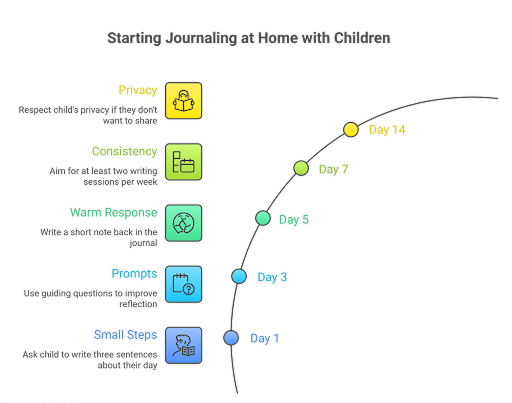
- Begin with small steps. Ask your child to write three sentences about their day, focusing on something interesting or challenging.
- Use prompts. The guiding questions from the Hedge and Dayanidhi study are helpful: What happened? Why does it matter? What will you do next? Use them to improve reflective writing.
- Respond warmly. Write a short note back in the journal. Even a simple message like “I liked reading about this” or “What do you think you could try?” helps keep the conversation going.
- Be consistent. Even writing twice a week can help build the habit over time. The Verzonilla and Velasco study saw improvement with just three structured sessions in one month.
- Respect your child’s privacy. If they do not want to share, that is okay. Just writing helps them build the habit of reflection.
What Do the Numbers Say About Writing and Thinking Skills in Schools?
NCERT’s National Curriculum Framework (NCF) 2023 brings in a new assessment model with 360-degree progress cards. These include self-evaluation, peer evaluation, and portfolio-based evaluation. It is a huge leap from the old marks-based report cards and shows that schools are now expected to help every student build reflective skills.

With campuses located in Osaka's Ikuno ward & Ibaraki's Tsukuba City, OWIS Japan delivers IB-certified inquiry-based education to children aged 3-18. We foster a multicultural environment where students grow into future-ready independent thinkers, equipped with critical thinking, creativity and a love for learning. Our commitment to rigorous academics and personal development prepares students to excel in a global landscape.