


As parents, we spend years making decisions for our children before they are ready to make decisions for themselves. What they eat, how they sleep, and how much screen time they get. But few decisions feel as heavy as choosing the right school curriculum.
Because deep down, we know this choice does not just decide what our child studies. It shapes how they think, how they handle pressure, how confident they feel asking questions, and how prepared they are for the world beyond school.
When parents compare the IGCSE curriculum and the IB curriculum, the question often starts academically. But it quickly becomes psychological, emotional, and practical.
This blog explores IB vs IGCSE through the lens parents care about most:


- How children actually learn at different ages
- How curriculum impacts confidence, stress, and independence
- What classroom life looks like
- Practical realities like fees, teacher-student ratios, and long-term outcomes
How Children Learn: A Child Development Perspective
Children do not learn the same way at every age. Cognitive science and developmental psychology show us that learning evolves in phases.- Early childhood (ages 3–7): Learning is sensory, emotional, and experiential
- Middle childhood (ages 8–12): Children develop reasoning, curiosity, and social awareness
- Adolescence (ages 13–18): Abstract thinking, identity formation, independence, and critical analysis emerge
The IGCSE Curriculum Through a Developmental Lens
The IGCSE curriculum is designed to build strong academic foundations, particularly during the adolescent phase when students begin to specialise.Psychological Strengths of IGCSE
From a child development perspective, IGCSE works well for students who:- Feel secure with structure and predictability
- Gain confidence from measurable progress
- Are motivated by clear goals and assessments
- Defined syllabi
- Clear subject boundaries
- Transparent assessment criteria

But What About Skills Beyond Academics?
While IGCSE builds strong subject knowledge, parents often ask:- Will my child learn to think independently?
- Will they develop communication and collaboration skills?
- Will they be prepared for uncertain, fast-changing environments?
The IB Curriculum: Designed Around How the Brain Learns
The IB curriculum is deeply influenced by educational psychology and inquiry-based learning models. Rather than treating students as passive recipients of information, IB views them as active participants in their learning journey.How IB Aligns with Child Psychology?
IB education recognises that:- Children learn better when learning feels meaningful
- Curiosity strengthens memory
- Reflection deepens understanding
Classroom Experience: What Your Child’s Day Actually Looks Like?
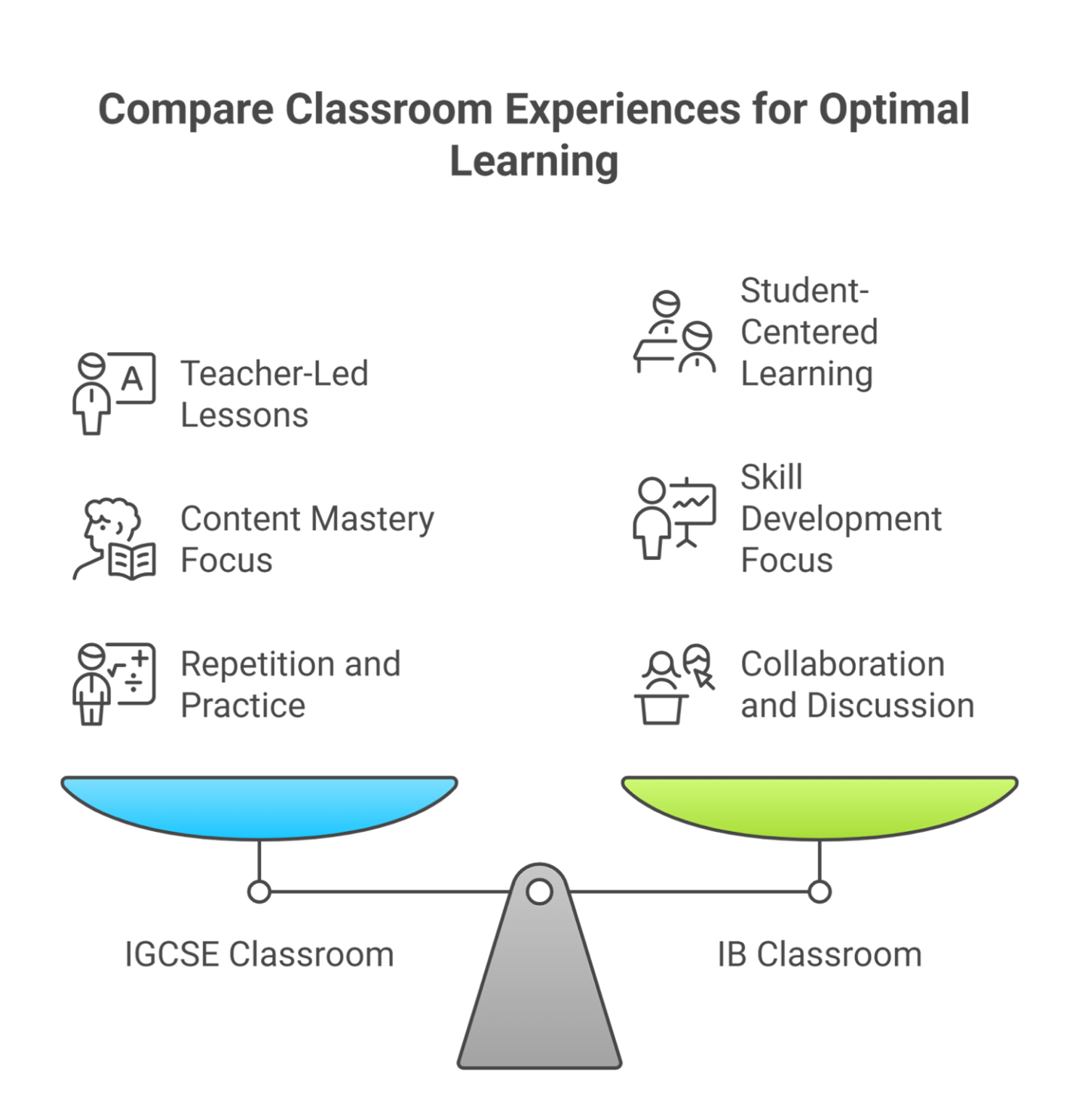
For parents, daily classroom life matters more than curriculum theory.In an IGCSE Classroom
- Lessons are usually teacher-led
- Objectives are clearly stated
- Students focus on mastering content
- Homework reinforces classroom learning
- Prefer listening and note-taking
- Excel with repetition and practice
- Are motivated by grades and benchmarks
In an IB Classroom
- Lessons often begin with a question or problem
- Students work in groups, research, and discuss
- Teachers act as facilitators rather than lecturers
- Reflection is part of learning
- Build confidence in expressing ideas
- Learn to listen and collaborate
- Develop emotional intelligence alongside academics
Stress, Pressure, and Mental Wellbeing
One of the most important, and least discussed, differences between IB vs IGCSE is how pressure is experienced.IGCSE and Performance Pressure
IGCSE assessments are exam-centric. For some children, this is motivating. For others, it can be stressful, especially if:- They struggle with timed exams
- Their self-worth becomes tied to grades
IB and Cognitive Load
IB distributes assessments across projects, presentations, and exams. This reduces exam-day pressure but introduces:- Long-term planning demands
- Multiple deadlines
- Self-management responsibilities
Teacher–Student Ratio and Individual Attention
Parents often underestimate how critical this factor is. Lower teacher–student ratios allow for:- Personalised feedback
- Emotional check-ins
- Early identification of learning challenges
Fees and Practical Considerations
Let’s address the logistical questions parents always ask.General Fee Range (Indicative)
- IGCSE schools: Often slightly lower at the middle school level
- IB schools: Higher due to teacher training, facilities, and programme requirements
- Campus infrastructure
- Class size
- Facilities and technology
- Teacher qualifications
Long-Term Outcomes: University and Life Readiness
Universities globally recognise both curricula. However, students arrive differently prepared. IGCSE students often:- Excel academically
- Adapt quickly to structured university systems
- Show strong research and writing skills
- Adapt well to independent learning
- Engage confidently in discussions and projects
The Parents’ Role in Curriculum Success
No curriculum works in isolation. Children thrive when:- Parents understand how learning happens
- Expectations are realistic
- Emotional well-being is prioritised alongside performance
Choosing With Confidence, Not Fear
The IGCSE curriculum and the IB curriculum are both excellent pathways when aligned with the right child, the right school, and the right support system. The real question is not: “Which curriculum is better?” It is: “Which environment will help my child grow into a confident, capable, emotionally healthy learner?” When parents choose with understanding, not anxiety, the decision feels lighter, clearer, and more empowering.
With campuses located in Osaka's Ikuno ward & Ibaraki's Tsukuba City, OWIS Japan delivers IB-certified inquiry-based education to children aged 3-18. We foster a multicultural environment where students grow into future-ready independent thinkers, equipped with critical thinking, creativity and a love for learning. Our commitment to rigorous academics and personal development prepares students to excel in a global landscape.