



Every child learns, but not in the same way, and not always in the way adults expect.
As parents, we often notice this early on. One child remembers stories effortlessly but struggles with instructions. Another needs to move, touch, or build to understand a concept. Some children thrive in discussions, while others prefer quiet reflection. These differences are often misunderstood as distractions, a lack of effort, or behavioural issues.
In reality, they are signs of how a child’s brain is developing.
Over the last few decades, research in neuroscience and education has transformed our understanding of learning. It tells us that children do not learn best through pressure, repetition, or rigid systems. They learn best when education aligns with how the brain grows, processes information, and forms meaning.
This insight has shaped approaches such as brain-based learning and neuroeducation, which place a child’s cognitive, emotional, and developmental needs at the centre of education. At OWIS, these principles influence not only what children learn, but how they experience learning every day.
This blog explores what neuroscience reveals about learning and how children thrive when teaching works with the brain, not against it.
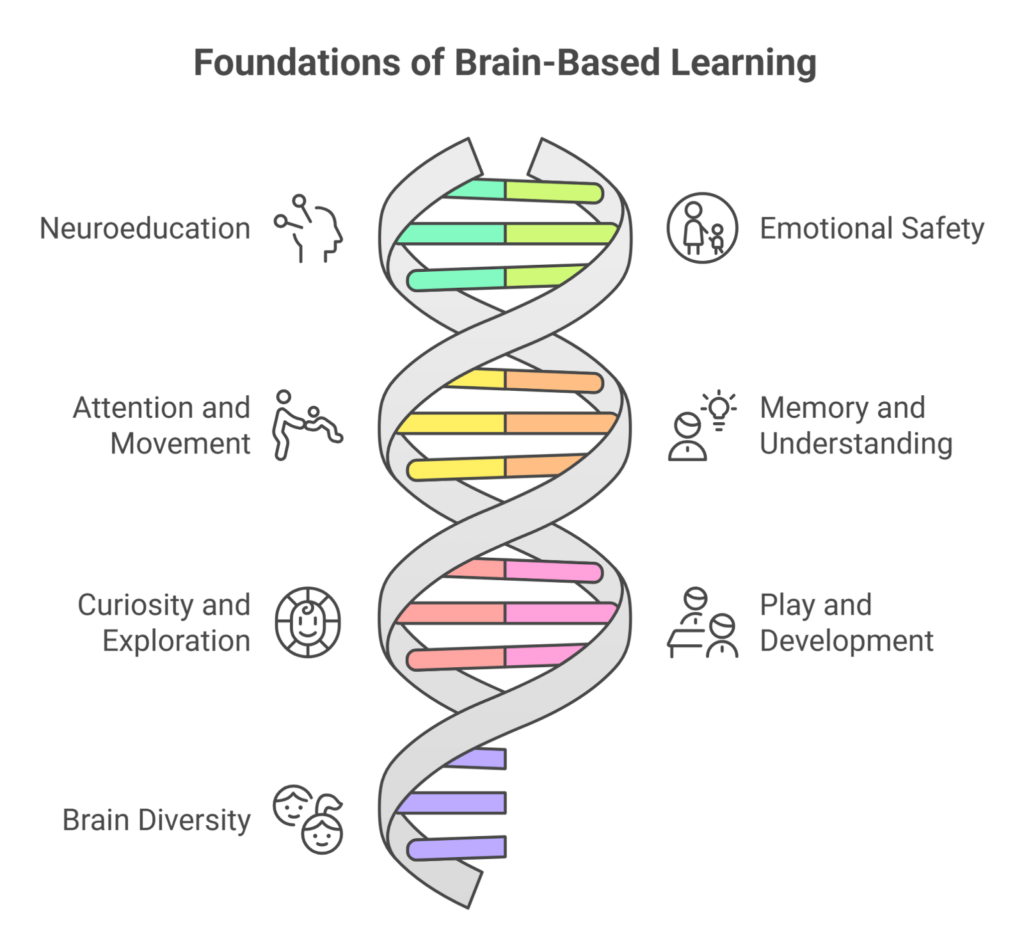
What Is Brain-Based Learning and Why Does It Matter?
To understand how children learn best, we first need to understand what brain-based learning really means.
At its core, brain-based learning is an approach that designs teaching around how the brain naturally functions. It recognises that learning is not a linear process, nor is it purely intellectual. The brain learns through emotion, experience, repetition, reflection, and connection.
Neuroscience shows that the brain:
- Learns by forming patterns and relationships
- Retains information better when it feels meaningful
- Needs emotional safety to focus and engage
- Develops gradually, not all at once
Brain-based learning responds to these realities by shaping lessons that encourage understanding, application, and curiosity rather than memorisation alone.
But how do these ideas move from research into real classrooms? This is where neuroeducation comes in.

Neuroeducation: Bridging Brain Science and Teaching Practice
Neuroeducation connects discoveries from brain science to everyday teaching methods. Instead of treating neuroscience as an abstract theory, it translates research into practical strategies teachers can use with children of different ages and learning styles.
Through neuroeducation, educators better understand:
- Why stress and fear block learning
- How emotions influence attention and memory
- Why movement supports focus
- How curiosity fuels motivation
This perspective shifts the focus from asking why a child is not learning to asking how learning can be redesigned to support that child’s brain.
As we begin to understand how learning environments affect the brain, one truth becomes clear. Development matters as much as content.
How the Developing Brain Shapes Learning in Childhood?
Children’s brains are not smaller versions of adult brains. They are constantly developing, strengthening connections, and refining neural pathways.
In early and primary years:
- Neuroplasticity is at its highest
- Experiences strongly shape learning patterns
- Emotional responses deeply affect memory
- Skills like impulse control, reasoning, and attention are still forming
This means children need learning experiences that match their developmental stage. When expectations exceed readiness, children may appear compliant but disengage internally. When learning aligns with development, children remain curious, confident, and motivated.
This naturally leads us to one of the most important foundations of learning: emotional safety.
Emotional Safety: The Foundation of All Learning
Neuroscience clearly shows that learning does not begin with information. It begins with emotion.
When a child feels anxious, judged, or constantly corrected, the brain shifts into a stress response. In this state, attention narrows, and memory formation weakens. The brain prioritises protection over learning.
When a child feels safe, respected, and supported, the brain opens up to exploration and problem-solving.
This is why emotionally responsive classrooms are essential. Teachers who build trust, encourage mistakes, and value effort help children engage deeply and take intellectual risks.
Once emotional safety is established, the brain becomes ready to focus. However, focus itself develops in unique ways.
Attention, Movement, and How Children Truly Focus
Many traditional classrooms expect children to sit still and focus for long periods. Research in neuroscience and education shows that this expectation is unrealistic, especially for younger children.
In Karnataka, about 95% of schools use activity-based learning, but it still needs to better match how children naturally learn to truly improve engagement and results.
The developing brain:
- Has limited attention spans
- Regulates focus through movement
- Learns better through active engagement
Brain-based learning supports attention by integrating:
- Short and purposeful learning segments
- Hands-on exploration
- Discussion and collaboration
- Physical movement within lessons
Movement is not a distraction. It helps the brain organise information and sustain attention. This leads naturally to stronger memory formation.
Memory: Why Understanding Lasts Longer Than Memorisation
Parents often worry when children forget what they studied. Neuroscience helps explain why this happens.
The brain remembers information better when:
- It connects to existing knowledge
- It carries emotional meaning
- It is applied in real-life contexts
- The learner actively engages with it
Rote memorisation creates short-term recall. Meaningful learning creates long-lasting understanding.
This is why learning approaches aligned with the IB Board syllabus focus on inquiry, concepts, and reflection rather than isolated facts.
When learning makes sense, curiosity follows naturally.
Curiosity: The Brain’s Natural Learning Trigger
Curiosity is not just a personality trait. It is a biological response.
When children are curious, the brain releases chemicals that increase motivation, attention, and memory retention. Curiosity encourages deeper questioning and makes learning feel rewarding rather than forced.
Brain-based learning nurtures curiosity by:
- Asking open-ended questions
- Encouraging exploration
- Valuing the thinking process
- Allowing multiple ways to reach understanding
This shift from performance to exploration transforms how children relate to learning, especially in the early years.
The Role of Play in Early Brain Development
Play is not separate from learning. It is one of the most powerful ways the brain develops.
Through play, children build:
- Executive functioning, such as planning and decision-making
- Language and communication skills
- Social understanding and empathy
- Emotional regulation
Play integrates movement, emotion, and cognition, making it a vital part of early learning. This understanding is embedded in the IB Early Childhood and Education framework, where inquiry and play are treated as meaningful intellectual work.
These early experiences lay the foundation for more complex thinking as children grow.
Brain Diversity and Learning Differences
No two brains develop in exactly the same way. Some children process information visually, others verbally or physically. Some need more time, while others need different entry points.
Neuroeducation recognises these differences as natural variations, not shortcomings.
This philosophy shapes learning environments in leading best international schools, where diversity of thought is valued.
How Neuroscience Informs Learning at OWIS?
At OWIS, neuroscience is not theoretical. It shapes daily classroom practice.
Learning environments are designed to:
- Encourage inquiry and dialogue
- Balance structure with flexibility
- Support emotional well-being
- Promote reflection and independence
Teachers guide children to make connections, ask meaningful questions, and understand their own thinking processes. This prepares students not only for academic success, but for lifelong learning.
Learning That Truly Supports Children
Understanding the neuroscience of learning helps us move beyond outdated ideas of education. It reminds us that children are developing minds that need care, challenge, and connection.
When education aligns with the brain:
- Learning becomes meaningful
- Confidence replaces fear
- Curiosity replaces pressure
- Understanding replaces memorisation
By embracing brain-based learning, neuroeducation, and insights from neuroscience and education, we create learning environments where children do more than succeed. They grow.