

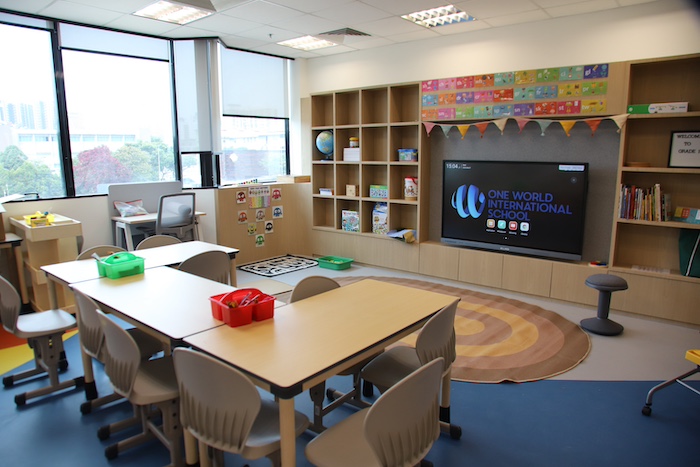
If you’re relocating to Singapore from the United States, you may notice that the term elementary school is used far less often here. In the Singapore context, what American families know as elementary school is more commonly referred to as primary school.
At One World International School (OWIS), we are an international primary school offering the International Baccalaureate Primary Years Programme (IB PYP) based on the standards of the UK National Curriculum.
In this article, we explain “elementary school” in the context of an “IB PYP school”, such as OWIS, and the difference between the local and international school systems for families relocating from the US.
We’ll unpack elementary vs primary school in Singapore, looking at:
- How the local primary school system is structured
- What elementary school typically means in international schools
- Similarities and differences in academics, languages, assessment and school life
- Factors to consider when deciding which option fits your child
- How international schools such as OWIS frame their primary/elementary years
Throughout, the focus is on helping you make an informed choice that matches your child’s personality, your family’s values and your long-term plans.
1. What “Primary School” Means in Singapore
In Singapore, “primary school” is an official term used by the Ministry of Education (MOE) for the first six years of compulsory schooling. Children typically enter Primary 1 at age 7 and complete Primary 6 at age 12.
Key features of local primary schools include:
- Compulsory education
All Singapore Citizens born after 1 January 1996 must attend primary school for six years, unless they are officially exempted. - Six-year structure
Many sources describe two broad stages:- Foundation Stage (Primary 1–4): Focus on strong basics in English, Mathematics, Science and Mother Tongue languages.
- Orientation Stage (Primary 5–6): Prepares students for secondary school and the high-stakes Primary School Leaving Examination (PSLE) at the end of Primary 6.
- National curriculum
The MOE sets a centrally designed curriculum to ensure a consistent standard across all government and government-aided schools. Subjects typically include:- English Language
- Mother Tongue Language (Chinese, Malay, Tamil or other approved languages)
- Mathematics
- Science (introduced from Primary 3)
- Social Studies
- Art, Music and Physical Education
- Character and Citizenship Education
- PSLE as a key milestone
At the end of Primary 6, students sit for the PSLE, a nationwide examination used to place them into different courses in secondary school. - Strong emphasis on bilingualism
Singapore’s bilingual policy means all students learn English plus one Mother Tongue language, which supports cultural identity while maintaining English as the main language of instruction.
For many families, a local primary school offers:
- Strong foundation in core academic skills
- Structured environment and clear benchmarks
- Deep exposure to local culture and community life
- Relatively affordable school fees compared with international schools
2. What “Elementary School” Means in Singapore
(As mentioned earlier, for the purpose of helping families from the US to understand the international school context in Singapore, we will use the term “elementary school” to refer to Grades 1 to 5 in international schools, such as OWIS, which is an IB PYP School, and not just restrict it to American international schools. )
The term “elementary school” is not typically used by the MOE. Instead, you’ll mainly see it used by international schools with American, IB or hybrid curricula. They function as the equivalent of local primary schools. In fact, guides for international American students often describe Singapore primary school as the equivalent of elementary school in the US.
Common features of elementary programmes in international schools in Singapore include:
- Inquiry-based, holistic curricula
Many schools offer the IB Primary Years Programme (PYP), known for its inquiry-driven learning and focus on developing the whole child—academically, socially and emotionally. - Integration of global curricula
International schools often blend IB PYP with curricula like the English National Curriculum or Singapore Maths, or with their own national frameworks. - Flexible, concept-driven assessment
Instead of relying heavily on high-stakes national exams at age 12, elementary schools tend to emphasise:- Ongoing teacher observations
- Project work and presentations
- Portfolios and formative assessments
- Communication with parents through regular reports and conferences
- International environment
Classrooms are usually highly multicultural, with students from many nationalities and backgrounds learning together in English.
From the parent’s perspective, international elementary schools in Singapore often appeal because they:
- Offer familiarity with US, UK or IB systems
- Provide an easier transition if your family may relocate again
- Place strong emphasis on wellbeing, social-emotional learning and global citizenship
Read more on Private vs Public Schools in Singapore

3. Elementary vs Primary School: Are They the Same?
In the Singapore context, there are some important distinctions between elementary school and primary school:
At a glance: elementary vs primary school in Singapore
| Aspect | Local Primary School (MOE) | International Elementary School |
| Common term used | “Primary school” | “Elementary school”, “Primary Years”, “Primary” |
| Governing body | Ministry of Education (MOE), Singapore | Independent or international school boards |
| Typical age range | 7–12 (Primary 1–6) | 7–11/12 (Grade 1–5 or PYP) |
| Curriculum | Singapore national curriculum | IB PYP, US, UK or hybrid curricula |
| Key exam | PSLE at end of Primary 6 | Usually no national exam at age 12; may take internal assessments or standardised tests |
| Language policy | English + compulsory Mother Tongue | English as main medium; second languages offered but often more flexible |
| Student demographic | Mainly Singapore Citizens and Permanent Residents (with limited international spaces) | Mix of expatriate and local families, multiple nationalities |
This means that in Singapore:
- “Primary school” usually signals a local MOE school.
- “Elementary school” usually signals an international school, even though the age range is similar.
So if you’re comparing elementary vs primary school in Singapore, you’re really comparing international vs local schooling at the primary level.
4. How Singapore Primary Schools Build Foundations
High-ranking education articles in Singapore often highlight how primary schools lay the academic and character foundation for future learning.
4.1 Academic foundations
Local primary schools emphasise:
- Literacy and numeracy
- Strong focus on reading, writing and speaking in English
- Structured approach to mathematics, often praised internationally
- Science and critical thinking
Science is introduced from Primary 3, building observation, experimentation and reasoning. - Mother Tongue proficiency
Learning Mother Tongue supports bilingualism and cultural identity, and is assessed in PSLE as well.
4.2 Social-emotional and character development
Beyond academics, MOE’s Character and Citizenship Education and school-based programmes emphasise:
- Respect and responsibility
- Resilience and perseverance
- Care for others and community involvement
- National identity and values
Many local schools also provide co-curricular activities (CCAs), leadership opportunities and community projects to help children grow as confident, compassionate individuals.
5. How Elementary Schools Lay the Groundwork for Lifelong Learning
International elementary schools in Singapore often describe their early years as a launchpad for lifelong curiosity, blending academics with social-emotional skills and global awareness. From blogs by well-known international schools in Singapore, you’ll often see themes like:
- Inquiry-based learning
Children learn to ask questions, explore ideas and make connections across subjects, rather than only memorising facts. - Transdisciplinary units
Instead of teaching subjects in isolation, teachers design units that link literacy, maths, science and social studies around authentic real-world themes. - Social and emotional growth
Articles frequently highlight how elementary schools support:- Confidence in expressing ideas
- Collaboration and teamwork
- Growth mindset and perseverance
- Empathy and respect for different cultures
- Balanced focus on wellbeing
Modern elementary schools integrate sport, arts, music, outdoor play and digital literacy with classroom learning, recognising that children learn best when they feel safe, connected and engaged.
Although the language and curriculum labels differ, the core goal is similar to the local system: equipping children with skills and habits that will support them long after they leave elementary/primary school.

6. Key Differences Between Elementary and Primary School in Singapore
When parents research elementary vs primary school in Singapore education, they’re usually trying to understand how daily school life, expectations and outcomes might differ. Here are some of the most meaningful differences.
6.1 Curriculum philosophy
- Local primary schools
- Follow the Singapore national curriculum, which is known for rigour and a strong focus on mastery of core subjects, especially Maths and Science.
- Learning is structured with clear standards and national benchmarks at each stage.
- International elementary schools
- Often follow IB PYP, UK or US curricula, with a strong emphasis on inquiry, concepts and skills that transfer across subjects.
- There is typically more flexibility in how content is delivered, with integrated projects and student-driven investigations.
6.2 Assessment and exams
- Primary (local)
- Regular school-based assessments and exams, culminating in PSLE, which can influence the secondary school pathway.
- Elementary (international)
- Assessment is usually more continuous and formative: portfolios, projects, teacher feedback, and sometimes standardised tests from external providers.
- There is usually no equivalent of PSLE, though some schools still place students into differentiated groups for certain subjects.
6.3 Language and cultural environment
- Primary (local)
- Strong and compulsory emphasis on Mother Tongue languages, reflecting Singapore’s multicultural policy.
- School culture is more deeply rooted in local traditions, festivals and community life.
- Elementary (international)
- English is usually the main working language. Second languages (such as Mandarin or additional foreign languages) are offered, but families often have more choice and flexibility.
- The environment is highly international, exposing students to peers from many countries, which can be helpful for globally mobile families.
6.4 Class size, teaching style and support
- Local primary schools typically operate with larger class sizes, though many schools use small-group support and targeted programmes where needed.
- International elementary schools often highlight:
- Smaller classes
- Specialist teachers for languages, arts and PE
- Learning support teams and counsellors
- Individualised learning plans when needed
6.5 Fees and admissions
- Local primary schools
- School fees for citizens are heavily subsidised, and even for Permanent Residents and international students, they are generally far lower than international school fees.
- Admissions follow MOE rules and phases, with priority typically based on citizenship, distance and other criteria.
- International elementary schools
- Fees are higher and vary widely, reflecting campus facilities, class size and support services.
- Admissions are handled directly by schools, often with rolling enrolments and entrance interviews or assessments.
All you need to know about Primary Vs Secondary schools
7. Choosing Between Elementary and Primary School in Singapore
There’s no one-size-fits-all answer to elementary vs primary school. Instead, it helps to consider a few guiding questions:
7.1 What are your long-term plans?
- If your family intends to settle in Singapore for the long term, a local primary school can offer:
- Strong grounding in national curriculum
- Deep integration into local community life
- A clear pathway into local secondary schools and beyond
- If you expect to relocate to another country, or if your child may eventually attend universities overseas, an international elementary school with IB, UK or US curriculum may provide smoother transitions.
7.2 What kind of learning environment will help your child thrive?
Think about your child’s temperament and learning style:
- Does your child respond well to structure, clear rules and academic challenges?
- Or do they flourish with more project-based, exploratory learning and lots of discussion?
Both primary and elementary schools in Singapore aim to develop well-rounded learners; they just navigate that journey in different ways.
7.3 What is your budget?
For many families, fees are a major factor:
- Local primary schools are generally the most affordable option.
- International elementary schools represent a significant investment, but may be supported by company allowances or chosen for their curricula and environment.
7.4 What languages and culture do you want to prioritise?
- Families keen for their children to be deeply rooted in Singapore’s bilingual culture often prefer local primary schools.
- Families looking for a global mix of cultures and languages may gravitate towards international elementary schools.
8. How International Schools Like OWIS Approach the Primary Years
While this article has focused on broader differences, it can be helpful to see how specific schools in Singapore position their elementary vs primary school offerings.
One World International School (OWIS)
At One World International School (OWIS), the primary years are anchored by the IB Primary Years Programme (IB PYP) for learners aged roughly 3–11.
Key features highlighted in OWIS information and partner articles include:
- A future-focused primary school programme that combines IB PYP with the English National Curriculum, helping students build strong literacy and numeracy while exploring big ideas through inquiry.
- Emphasis on hands-on learning, units of inquiry and reflection, encouraging children to question, connect and take action in their communities.
- A warm, inclusive, multicultural environment, which supports social-emotional learning alongside academics.
In everyday terms, OWIS combines the rigour of structured curricula with the flexibility and curiosity-driven approach that many parents associate with international elementary schools.
9. FAQ: Elementary vs Primary School in Singapore
1 Is there a difference between elementary and primary school in Singapore?
Yes, mainly in how the terms are used:
- Primary school usually refers to local MOE schools for children aged 7–12.
- Elementary school typically refers to the equivalent age group in international schools, often following IB, US or UK curricula.
The age range and purpose are similar, but the curriculum, assessment style, language policy and environment can differ.
2 What age is primary or elementary school in Singapore?
- Local primary schools: Typically 7 to 12 years old, Primary 1 to Primary 6.
- International elementary schools: Usually 5/6 to around 11/12, depending on how the school labels Kindergarten, Grade 1–5 or Years 1–6.
3 Is Singapore primary school the same as US elementary school?
Functionally, yes. Guides for international families describe Singapore primary school (six years from age 7) as the equivalent of US elementary school.
The main difference is curriculum:
- Singapore primary schools follow the MOE national curriculum with PSLE at the end of Primary 6.
- US elementary schools use state or district curricula and different forms of assessment.
4 Can my child move between a local primary school and an international elementary school?
Transfers are possible but involve:
- Admissions processes at international schools, which may include placement tests or interviews.
- Application procedures for local schools (if moving back) that are governed by MOE guidelines and subject to space and eligibility.
Because curricula, subjects and textbooks may not match exactly, some children may need short-term support to bridge any gaps.
9.5 Which is better: elementary or primary school in Singapore?
There’s no universal “better” option—only what’s better for your child and your family. A local primary school may be ideal if you want:
- Strong grounding in Singapore’s national curriculum
- Deep immersion in local culture and bilingual policy
- More cost-effective schooling
An international elementary school may be better if you:
- Need an internationally portable curriculum (IB, UK, US)
- Value a multicultural environment with students from many countries
- Prefer inquiry-driven, project-based learning and flexible assessment
10. Bringing It All Together
When families first search “elementary vs primary school in Singapore”, they’re often expecting a simple vocabulary explanation. Instead, they discover a whole landscape of educational philosophies, pathways and possibilities.
Here’s the heart of it:
- Primary school in Singapore is the core of the national system—six years of compulsory education that provide strong academic foundations, bilingualism and a shared experience for many local children.
- Elementary school, as referred to by American families, broadly is the international counterpart. This could be an American curriculum school or a generic way to refer to all international schools in Singapore, including OWIS, which is an IBPYP School.
Both aim to help children:
- Become curious, confident learners
- Build solid literacy and numeracy skills
- Develop character, resilience and empathy
- Lay the groundwork for lifelong learning
To find out more, please contact our Admissions Team to request a callback.