

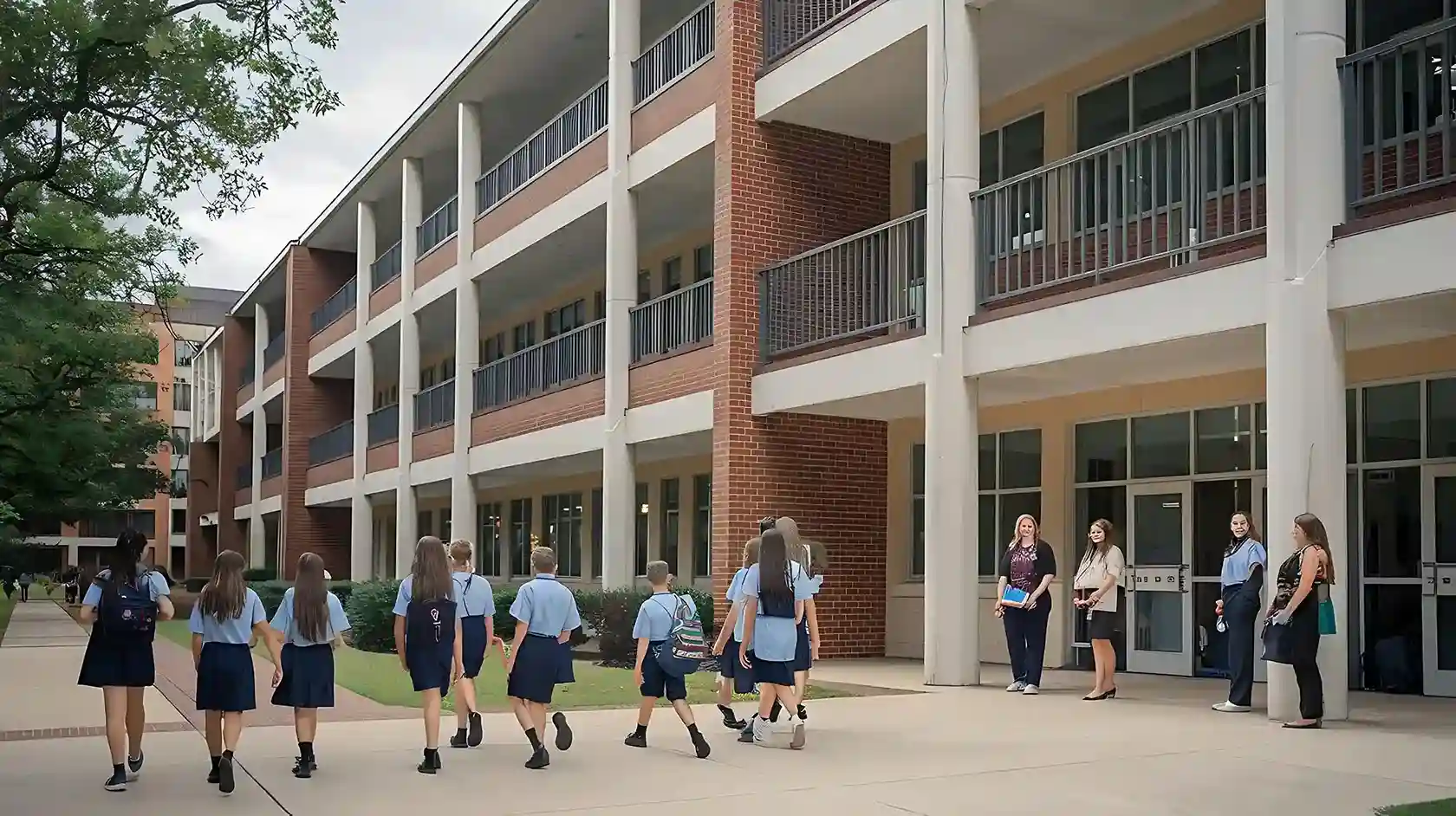
Choosing between Montessori schools vs traditional preschool can feel like a high-stakes decision – especially in 2026, when parents are thinking not just about ABCs and 123s, but also about independence, creativity, emotional regulation, and future-ready skills in an AI-shaped world.
Across education systems worldwide – and particularly in education-focused hubs like Singapore – Montessori and traditional preschools tend to sit at opposite ends of the spectrum in how they view the child, the classroom, and the purpose of early learning. Montessori schools are designed as child-centred, mixed-age learning communities where children move at their own pace using hands-on materials in a carefully prepared environment. Traditional preschools, on the other hand, are often teacher-directed, follow a more fixed daily schedule, and prioritise readiness for primary school through structured lessons, worksheets, and whole-group instruction.
In Singapore, both models have grown in popularity over the past decade. Guides to Montessori preschools consistently highlight benefits like independence, self-discipline, and confidence, supported by multi-sensory activities and child-sized, accessible resources. Traditional preschools and kindergartens remain the default for many families, offering structured programmes aligned with national expectations, bilingual instruction, and a clear progression into primary school.
Recent research has raised the stakes of this choice. Large-scale studies up to 2025 suggest that high-fidelity Montessori preschool programmes can boost reading, memory, and executive functions (like self-control and flexible thinking) by the end of kindergarten, sometimes at lower cost than conventional preschool models. At the same time, traditional programmes still offer advantages in predictability, alignment with mainstream primary schools, and a clear structure that some children genuinely need.
So is one clearly “better” in 2026? Not exactly. But they are different in ways that matter.
Quick answer: Montessori schools vs traditional preschool (2026 snapshot)
If you only have a minute, here’s the short version:
-
Choose Montessori preschool if your child thrives on independence, hands-on activities, and following their curiosity. Research increasingly suggests Montessori supports strong executive function, social skills, and academic outcomes through child-led learning.
-
Choose traditional preschool if your child prefers clear instructions, predictable routines, and direct teaching – or if you want a programme that closely mirrors the structure and expectations of most mainstream primary schools.
In 2026 specifically, Montessori’s emphasis on self-direction, concentration and problem-solving lines up well with the skills highlighted in new research and global education reforms aimed at life in a digital-first, AI-rich world.

The rest of this guide breaks down the benefits and differences in detail – including a comparison table, research highlights, and how schools in Asia (including Singapore) are blending Montessori-style methods with modern curricula.
- BilinWhat is a Montessori preschool?
A Montessori preschool follows the educational philosophy developed by Dr Maria Montessori over a century ago and refined through global practice and research. At its core, it is:
- Child-centred and self-directed – Children choose from a range of purposeful activities rather than being led through identical lessons as a group.
- Multi-age – Classrooms typically group children aged about 3–6 together, allowing younger children to learn from older ones and older children to consolidate learning by helping peers.
- Hands-on and sensory-rich – Specialised materials (for practical life, sensorial exploration, language, maths and culture) are designed so children can learn abstract ideas through concrete experiences.
- Respectful and calm – The environment is intentionally ordered, beautiful, and child-sized. Movement, choice and quiet focus are built into the day.
In Singapore, Montessori preschools and kindergartens often emphasise:
- gual learning (e.g., English and Mother Tongue) woven into daily activities rather than delivered only in formal language blocks.
- A strong focus on independence – from putting on shoes and serving snacks to caring for classroom plants and materials.
- Practical life skills (pouring, cleaning, buttoning, food preparation) as core curriculum, not just “chores”.
What does the teacher do in a Montessori classroom?
Montessori teachers are sometimes called “guides”. Their role is to:
- Observe each child’s interests and developmental stage.
- Introduce materials one-to-one or in very small groups.
- Step back so the child can work independently for sustained periods.
- Maintain the environment and social norms (e.g., returning materials, respecting others’ work).
Rather than directing the entire class from the front, the teacher moves quietly around the room, supporting individual learning journeys.
What is a traditional preschool?
“Traditional preschool” is a broad label, but generally refers to teacher-directed programmes where:
- The teacher leads most activities – Circle time, direct instruction, songs, group games, and theme-based lessons (e.g., “Fruits”, “Community Helpers”).
- The curriculum is standardised – Children of the same age typically follow the same lesson sequence, often aligned with national early childhood frameworks.
- Workbooks and worksheets are more common, especially for literacy and numeracy readiness.
- Assessment is more explicit – Teachers may use checklists, tests, or graded tasks to track progress.
In Singapore and similar systems, traditional kindergartens often:
- Emphasise school readiness for formal primary schooling at age 7.
- Offer clear bilingual instruction, e.g., scheduled blocks for English and Mandarin/Tamil/Hindi, etc.
- Follow fixed daily timetables combining academics, play, music, and physical activity.
Traditional preschools are not inherently “old-fashioned”; many have adopted play-based, inquiry elements. But the overall orientation is more structured and teacher-led than Montessori.

Montessori schools vs traditional preschool: key differences at a glance
Here’s a high-level comparison to anchor your thinking:
| Aspect | Montessori Preschool | Traditional Preschool |
| Core philosophy | Child-centred, self-directed learning, respect for individual pace | Teacher-centred, group instruction, readiness for primary school |
| Classroom age group | Multi-age (often 3–6 years together) | Single age or narrow bands (e.g., Nursery, K1, K2) |
| Daily schedule | Long, uninterrupted work cycles; children choose tasks within broad limits | Short, timed blocks for different subjects and activities |
| Learning materials | Specialised Montessori materials; hands-on and self-correcting | Mix of toys, books, worksheets, teacher-made resources |
| Role of teacher | Guide/observer; individual presentations | Instructor/manager; leads whole-group lessons |
| Assessment style | Continuous observation; minimal formal tests in early years | More explicit assessments, checklists, and sometimes tests |
| Discipline & behaviour | Grounded in respect, natural consequences, and self-regulation | More external rules, rewards, and sometimes punishments |
| Independence | Strong focus on self-care, self-direction, and peer teaching | More adult-managed, especially for routines and transitions |
| Fit for children who… | Are curious, self-driven, or benefit from freedom within structure | Prefer clear instructions, predictable routines, and group learning |
This table is simplified – real schools often blend elements from both columns – but it captures the main benefits and differences that matter when comparing Montessori schools vs traditional preschool.
Benefits of Montessori schools in 2026
Over the last decade, more rigorous research has moved Montessori from “alternative” to “evidence-backed” – especially at the preschool level.
1. Stronger executive function and self-regulation
Executive functions (working memory, impulse control, and flexible thinking) are crucial for everything from managing emotions to planning tasks and solving complex problems. Studies in authentic Montessori preschool settings show:
- Clear gains in inhibitory control and cognitive flexibility in 3- and 4-year-olds over the course of a Montessori year.
- A national randomised controlled trial (RCT) of public Montessori preschool in the US (published 2025) found significantly better performance in reading, memory, and executive function by the end of kindergarten compared to non-Montessori peers – benefits that grew over time instead of fading.
In practice, the Montessori environment supports executive function by:
- Allowing children to choose tasks and stick with them until completion.
- Offering materials that require steps and sequencing (e.g., pouring, sorting, multi-step maths activities).
- Encouraging children to manage their own movement, materials, and social interactions within clear boundaries.
2. Academic and non-academic outcomes
Multiple reviews and meta-analyses suggest that Montessori preschool can support:
- Higher or comparable academic outcomes in language and maths compared with traditional programmes, especially when Montessori is implemented with fidelity.
- Better socio-emotional skills, including cooperation, empathy, and a more positive experience of school.
These findings matter in 2026, as education systems globally are emphasising the integration of cognitive and social skills instead of chasing grades alone.
3. Love of learning and intrinsic motivation
Montessori classrooms are designed to make learning feel like purposeful work rather than a performance for adult approval. Children:
- Receive fewer external rewards (stickers, stars) and more natural satisfaction from mastering tasks.
- Get to repeat activities until they feel confident, without pressure to “keep up” with the group.
Over years, this often translates into self-driven learners who see challenges as interesting rather than intimidating.
4. Cost-effectiveness at scale
This may surprise many parents: the 2025 RCT on public Montessori found that three years of Montessori preschool from ages 3–5 cost about US$13,000 less per child than traditional preschool programmes, largely due to efficient multi-age classrooms and higher student-teacher ratios supported by peer learning. While private Montessori schools can be fee-heavy, the model itself can be efficient and scalable when implemented thoughtfully – a factor policymakers are watching closely heading into 2026 and beyond.
Benefits of traditional preschool in 2026
Traditional preschools remain the default choice in many countries for good reasons.
1. Familiar structure and alignment with primary school
Traditional preschools mirror the structure most children will experience in primary school:
- Clear timetables
- Whole-group lessons
- Textbooks or workbooks
- Direct preparation for exams in more academic systems
For children who can feel anxious in very open-ended environments, this predictability can be deeply reassuring.
2. Strong focus on foundational literacy and numeracy
Traditional programmes often allocate more explicit time to:
- Learning letter-sound relationships and practising handwriting
- Working through early maths concepts with teacher-led explanations and practice
- Frequent revision and repetition using worksheets or guided tasks
This can work well for children who respond to direct teaching and for families in highly exam-oriented systems.
3. Easier to understand for many parents
Because traditional preschools resemble the schooling experiences that most parents themselves had, it’s often easier to:
- Interpret progress reports and assessments
- Reinforce learning at home using similar methods
- Communicate with teachers about grades and expectations
For some families, this familiarity is a genuine advantage.
Montessori schools vs traditional preschool in Singapore and similar systems
In Singapore, early childhood education is not compulsory, but the vast majority of children attend some form of preschool before starting formal primary school at age 7. Over the past few years, there has been a noticeable rise in:
- Montessori kindergartens and preschools, highlighting independence, bilingual learning, and hands-on materials.
- Hybrid models that blend Montessori principles with local requirements and international curricula.
Parents comparing Montessori schools vs traditional preschool in this context often weigh:
- The desire for play-based, child-centred learning versus concerns about keeping up with academic expectations.
- How well their child’s personality matches either a freedom-within-limits setting (Montessori) or a clearly directed, group-based setting (traditional).
- Practical considerations such as location, fees, bilingual offerings, and continuity into primary school.
How modern schools blend Montessori and contemporary curricula
Many forward-looking schools now blend Montessori-style principles with globally recognised curricula like the IB PYP or proprietary Montessori-inspired programmes. Two examples within wider Asian and global schooling networks illustrate this trend (kept brief, so we stay focused on the broader comparison):
One World International School (OWIS) – child-centred, inquiry-led early childhood
In Singapore and other campuses, OWIS offers early childhood programmes based on the IB Primary Years Programme, underpinned by the English National Curriculum. Their early years classrooms are:
- Play-based and inquiry-led, with a strong focus on communication, socio-emotional, motor, and cognitive skills.
- Designed to encourage independence, curiosity, and collaborative learning, echoing several Montessori values (such as student agency and a prepared environment) even though they are not strictly Montessori.
For parents who like the child-centred ethos of Montessori but want a fully IB-aligned pathway into primary and secondary school, schools with this profile can be a compelling option.
Global Indian International School (GIIS) – Global Montessori Plus (GMP)
GIIS, a multi-country school group with strong preschool offerings in Singapore and across Asia, runs an award-winning Global Montessori Plus (GMP) curriculum. GMP:
- Combines the classic Montessori approach with modern preschool best practices and technology.
- Emphasises holistic growth through pillars such as language, numeracy, emotional and universal values, and the broader 9GEMS framework (covering academics, sports, arts, leadership, and more).
- Targets future-ready skills and entrepreneurial thinking – for example, activities like selling garden materials or presenting student-made products resemble real-world projects layered onto a Montessori foundation.
In other words, some modern schools are no longer “purely” Montessori or purely traditional; they sit in a third space, blending Montessori’s independence, structure, and hands-on learning with global curricula, bilingualism, and 21st-century skills.
How to choose: questions to ask yourself in 2026
When you compare Montessori schools vs traditional preschool, the best decision is less about rankings and more about fit. Here are practical questions to help narrow it down:
1. What is my child like right now?
- Do they often start their own activities and get deeply absorbed?
- Or do they prefer adults to initiate play and give instructions?
- How do they react to changes in routine?
Children who are naturally self-directed or very curious often thrive in Montessori environments; children who crave explicit direction may feel safer in traditional settings – at least initially.
2. What are my long-term priorities?
If your top priority is:
- Executive function, creativity, and intrinsic motivation → Montessori has growing research support.
- Early mastery of specific literacy/numeracy benchmarks and alignment with test-oriented systems → Traditional preschools may feel more aligned.
You can, of course, find schools that blend both.
3. How does the school actually implement its philosophy?
Whatever label a school uses, it’s essential to:
- Visit the classroom and observe: Are children engaged? Is the atmosphere calm or chaotic?
- Ask how teachers handle behaviour, conflict, and mistakes.
- Check whether Montessori schools follow the model with fidelity (multi-age groups, full work cycles, trained Montessori teachers) or are simply “Montessori-inspired”.
4. How does the school prepare children for the next step?
- If your next step is a traditional primary school, ask how Montessori graduates transition into more teacher-directed environments. Many do very well because of their strong concentration and self-management.
- If your child will continue in an IB or international pathway, ask how early childhood programmes align with later curricula.
FAQs: Montessori schools vs traditional preschool
1. Is Montessori better than traditional preschool?
There is no universal “better”. Montessori preschools often show advantages in executive function, social skills, and sometimes academic outcomes, especially when implemented with high fidelity. Traditional preschools can be better suited to children who crave structure and to families in highly exam-oriented systems. Your child’s temperament and your context should guide your choice.
2. Is Montessori preschool more expensive?
Private Montessori schools can be more expensive at the point of enrolment because of specialised materials and teacher training. However, high-quality research on public Montessori programmes suggests that, at system level, Montessori can actually cost less than traditional preschool due to efficient multi-age classrooms. Fees vary widely by country and school, so it’s best to compare specific campuses.
3. Do Montessori children struggle when they move to traditional schools?
Studies following Montessori preschool graduates into later grades generally show strong or above-average performance in reading, maths, and social skills, not greater struggle. Some children may need time to adjust to increased tests and homework, but their independence and executive skills often help them adapt.
4. Which is better for shy or highly active children?
- Shy children may blossom in Montessori environments where they can work quietly at their own pace without constant group pressure.
- Very active children can benefit from Montessori’s built-in movement (walking around the room, choosing activities), but they may also need clear boundaries; a well-run classroom of either type can provide this. The quality of the teacher matters more than the label.
5. How does the choice look in 2026 and beyond?
Emerging research and global education trends suggest that the skills most needed in the future – executive function, creativity, self-management, collaboration – are strongly nurtured in child-centred environments like Montessori and inquiry-led programmes. At the same time, literacy, numeracy, and digital fluency remain essential and are often the strengths of structured traditional programmes.
That’s why many schools, including those with Montessori roots or IB profiles, are increasingly blending the two – using child-centred methods within clear curricular frameworks and future-ready programmes that speak to a 2026 world of AI, global mobility, and flexible careers.
Final thoughts
Choosing between Montessori schools vs traditional preschool in 2026 isn’t really about picking a “winner”. It’s about understanding:
- How each model shapes your child’s thinking, behaviour, and sense of self.
- How well a specific school lives up to its stated philosophy.
- How the preschool years connect with the kind of learner – and person – you hope your child will become.
If you can, visit at least one Montessori and one traditional preschool, sit at the back of the classroom, and simply watch the children:
- Are they engaged?
- Do they look relaxed and curious?
- Could you imagine your child in that space?
Let that real-world observation sit alongside the research and comparisons in this guide. The right environment – whether Montessori, traditional, or a thoughtful blend – is ultimately the one where your child feels safe, inspired, and eager to learn, every single day.