

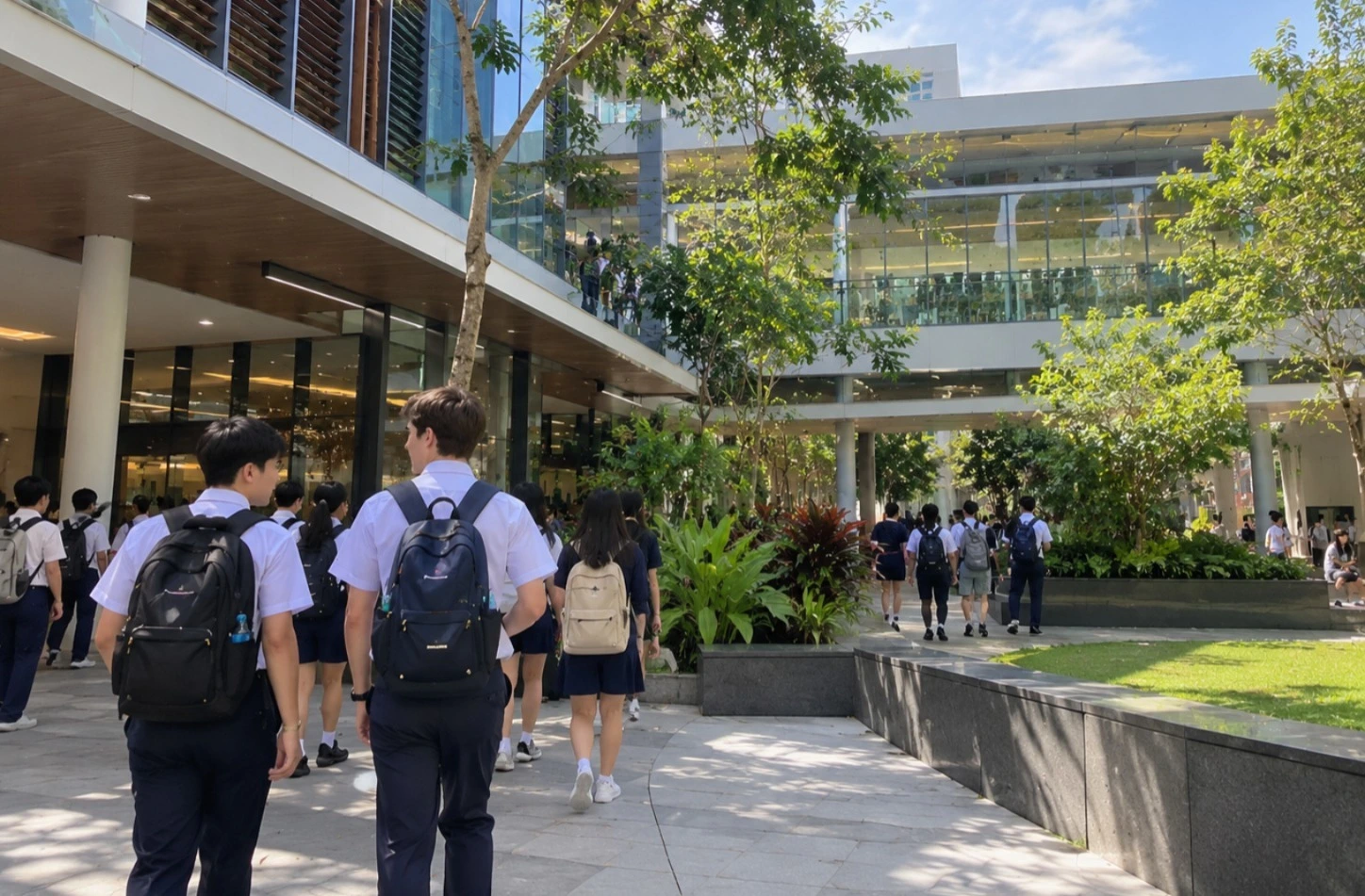
Five schools to consider with guidance on curricula, costs and facilities plus how to find a community for your child.
Executive Summary: Which International Schools Should Parents Consider?
The best international schools in Singapore for your child are those that offer a relevant curriculum, effective teaching, individual support and a friendly school community within a reasonable financial plan.
OWIS Singapore, Tanglin Trust School, UWCSEA and Dulwich College (Singapore) are four schools to consider. Families looking also at Malaysia will be interested in the International School of Kuala Lumpur.
These five choices are not ranked, reflecting a range of options rather than a list of the top five schools for every need. Check directly with each school about their programme for your intended 2027 entry, fees and any other concerns.
An International School Choice Is a Family Decision
Choosing an international school means evaluating more than just exam results. You are also considering the social elements of day-to-day school life.
Maybe you are moving from India and want your child to transition smoothly from their current school. Perhaps you are already in Singapore and considering what an international curriculum could bring. Maybe your teenager needs certain subjects to access a specific university course.
These are all very different situations which will lead to very different shortlists.
A school might offer an appealing qualification but fail to provide the one your child needs. Another school might boast extensive facilities but require a lengthy commute. A third might seem a perfect match at first but prove to have nuanced needs around learning support.
This guide aims to help families research beyond the school name, focussing primarily on Singapore with one wider Asia option for families with an open relocation destination.
What Makes a School International?
An international school usually offers students an international or overseas curriculum, and typically has an enrolment of diverse nationalities. There is not, however, one uniform system of education for international schools.
Some schools follow a primarily British-based pathway. Others blend an American curriculum with multiple graduation options. Some provide International Baccalaureate courses, while others teach using their own curriculum until internationally-recognised qualifications are reached.
For interested parents, there are three key differences between schools:
Curriculum: What children study and how they progress through the education system.
Programme authorisation: Whether the relevant educational body has approved the school to offer a specific program.
School experience: How children learn and the opportunities that exist within the school environment.
The international nature of a school should also be seen in the way children learn about, discuss and engage with diverse perspectives.
Ask yourself how international-mindedness is reflected in an average classroom, rather than focussing on a list of nationalities.
Five International Schools in Singapore and Asia Worth Considering
The following profiles are unranked and provide information based primarily on published educational offerings and questions to parents to ask when considering a school. They are presented in no particular order.
OWIS Singapore: Kindness, Inquiry and International Learning
One World International School Singapore is a good choice if you want your child to have academic learning combined with kindness, empathy and an international perspective. Its education philosophy centres on a holistic approach and developing confident lifelong learners. Singapore
OWIS has Nanyang Campus in Jurong, Digital Campus in Punggol and Newton Campus in central Singapore. Current campus information states that Nanyang and Digital Campus are accredited for the IB Primary Years Programme, Cambridge IGCSE and IB Diploma Programme. Digital Campus is also registered to provide Cambridge International A levels.
Newton is a candidate school for the PYP. Candidate Status for the PYP is not the same as authorisation and does not guarantee that authorisation will be granted. Singapore
These differences are important considerations when choosing between a school on campus.
OWIS is a great choice to consider if you are looking to experience a multinational community, inquisitive learning and a school ethos which puts relationships at the heart of education.
What parents need to consider: ask how teaching staff support new joiners to the school to engage fully, how they communicate academic progress and which language or learning support options are relevant to your child.
Begin with the OWIS education model and campus overview, then discuss the specific programme available for your intended entry.
Tanglin Trust School: A British-Based Pathway With Later Study Options
Tanglin Trust School provides a British-based pathway with options for A levels and the IB Diploma Programme in Sixth Form. Its published information highlights progression towards these qualifications through the earlier school stages. Tanglin Trust School, Singapore
This is worth investigating for families interested in continuing a British education or for teenagers considering the breadth of study.
A levels typically offer greater focus on fewer subjects: the IB Diploma maintains study across six subjects plus its core requirements. Neither route is suitable for all learners.
Tanglin Trust School’s campus is on Portsdown Road: its published information includes a Junior Arts Centre incorporating specialist spaces for areas such as art, music, drama and dance. Tanglin Trust School
What parents should investigate: ask about the guidance on pathway options, the range of available subjects and their entry requirements. For younger children, investigate classroom routines and the support for an individual’s learning.
UWCSEA: A Learning Programme That Builds Links Between Areas of Learning
UWCSEA describes five interconnected elements of its learning programme: academics, activities, outdoor education, personal and social education, and service. UWCSEA
Its curriculum focuses on conceptual understanding as well as knowledge and skills.
This makes it worth exploring for families interested in how learning extends from within the classroom, across personal development and into the wider world.
Its current Grade 9 and 10 information describes a bespoke UWCSEA programme which is part of its High School Diploma pathway: in Grades 11 and 12, students complete the IB Diploma Programme or a selection of IB courses according to their interests. Parents should investigate current cohort information rather than assuming that previous curriculum descriptions for older grades still apply. International school in Singapore
What parents should investigate: ask about the inclusion of the five programme elements within a normal weekly timetable, how students cope with competing commitments and the support for new arrivals.
For an older student, ask for a clear explanation of the course progression and qualifications on offer.
Dulwich College (Singapore): British-Based Learning and Specialist Facilities
Dulwich College (Singapore) publishes a British-inspired lower secondary curriculum followed by IGCSE and IB Diploma study. Its youngest learners work according to the UK Early Years Foundation Stage. Dulwich College (Singapore)
The school is worth considering for families interested in this progression and for opportunities across academic, sporting and creative areas.
Its Bukit Batok campus includes libraries, a Performing Arts Centre, swimming pools, sports fields, gymnasiums and outdoor learning spaces. Dulwich College (Singapore)
Facilities offer a possibility, but parents should investigate how these are embedded within their child’s timetable.
What parents should investigate: ask how regularly students access specialist spaces, what activities are provided and whether any require selection or incur additional charges. For secondary entry, find out about the range of available subjects and the guidance offered prior to undertaking examination courses.
International School of Kuala Lumpur: A Wider Asia Option
The International School of Kuala Lumpur, or ISKL, is relevant to families considering Malaysia as an alternative to Singapore. It should be viewed as a potential relocation option rather than a commuting alternative.
ISKL publishes high school pathways including the full IB Diploma, Advanced Placement courses and other combinations. Its Grade 11 and 12 information outlines opportunities to personalise study with approved courses. iskl.edu.my
The school’s Ampang Hilir campus is in Kuala Lumpur. iskl.edu.my
What parents should investigate: ask about how previous study will map onto the new programme, the graduation requirements and how courses will support future university aspirations.
Compare the suitability of a school alongside housing, residence requirements and an overall family adjustment. A promising school is only one aspect of a successful international move.
Compare learning, locations and learning priorities
This comparison outlines the published features discussed above. It is not a ranking and the availability of particular programmes should be confirmed for the relevant campus, age group and intake.
| School | Location | Published educational pathway | Useful comparison question |
| OWIS Singapore | Jurong, Punggol and central Singapore | PYP, IGCSE and IBDP at Nanyang and Digital Campus; additional campus-specific provision | Which campus matches my child’s stage and support needs? |
| Tanglin Trust School | Portsdown Road, Singapore | British-based progression; A levels or IBDP in Sixth Form | Would my child benefit from specialisation or broader study? |
| UWCSEA | Singapore | Concept-based learning; bespoke Grade 9–10 programme; later IB study | How do academic and wider programme expectations fit my child? |
| Dulwich College (Singapore) | Bukit Batok, Singapore | British-inspired learning; IGCSE and IBDP | How do subject choice and specialist activities work together? |
| ISKL | Ampang Hilir, Kuala Lumpur | High school options including IBDP and AP | How will existing study transfer into the new pathway? |
A curriculum comparison is only useful if it is applied to a specific need. For instance, a teenager interested in engineering would research mathematics and science prerequisites, not simply whether their school provides an international qualification
How to Choose Between International Curricula
Select a curriculum based on your child’s learning progression, subject preferences and likely destination. Knowing the jargon can help, but understanding teaching and assessment practices are more important.
Understand the main terms
The IB Primary Years Programme (PYP) offers an inquiry-based framework for young learners. Parents should assess the progression of inquiry as well as the establishment of secure literacy and numeracy skills.
IGCSE refers to international secondary subject qualifications. Availability of subjects, examining bodies and timings need to be compared if there are likely to be transfers.
The IB Diploma Programme is a two-year pre-university qualification where students study six subjects plus three core elements including an extended essay, theory of knowledge and creativity, activity and service.
A levels encourage more specialist study. Advanced Placement (AP) is a series of courses and examinations that are sometimes incorporated into a school’s graduation requirements.
Think about the next transition
For families considering another international transfer, ask how the school documents learning outcomes and facilitates transfers.
For those relocating from India, ask for an explanation of year-group placements as grade names, and therefore likely ages, vary. Simply labelling a ‘grade seven’ does not mean that the same curriculum coverage has taken place
For secondary education, ask the prospective school to review the previous subjects undertaken before making a decision.
International School Fees: Compare the Whole Commitment
The most useful comparison of fees will include the same academic year and consider both recurrent and entry costs. Simply comparing the headline tuition fee does not consider the total commitment.
For families considering schooling from 2027, make sure that you are comparing the 2026/27 fees with those due in 2027/28. Do not assume that any given listed amount will remain the same
| School | Official fee information | What to check before budgeting |
| OWIS Singapore | Campus fee information | Campus, grade, support charges, transport and applicable tax |
| Tanglin Trust School | Published fee schedule | Tuition, enrolment charges and capital levy |
| UWCSEA | School fees | Tuition, development levy and entry charges |
| Dulwich College (Singapore) | Tuition fee factsheet | Year-group fees, entry charges and optional activities |
| ISKL | Tuition and fees | Malaysian ringgit costs, entry fees, tax and examinations |
The schools’ published schedules indicate different categories of charges. UWCSEA lists a development levy, Tanglin identifies enrolment and capital levy charges and ISKL indicates that external examination fees are charged separately. UWCSEA
Request each school to provide a written estimate of tuition, compulsory charges, transport, meals, devices and relevant support.
When comparing school costs across countries, present costs in your household budgeting currency using a dated exchange rate. This should be kept distinct from an official quotation from the school on fees.
Consider facilities: seek meaningful access
Facilities are valuable if they contribute to regular, purposeful learning. Their value is determined by the opportunities for access, teaching and participation.
A theatre could be useful for classroom drama, public speaking and productions. A laboratory is important if experimentation and interpretation of evidence take place. Outdoor spaces are valuable in facilitating observation, physical development and collaborative activities.
Use similar questions when assessing each school:
| Area | Parent question |
| Science and technology | How often will this year’s group use specialist spaces? |
| Sport | What participation is available beyond selected teams? |
| Arts | Can beginners participate alongside experienced students? |
| Digital learning | How do devices support thinking and responsible use? |
| Outdoor learning | How is it connected to classroom learning? |
At OWIS, the learning programmes overview provides a starting point for exploring experiences beyond academic subjects. Ask which opportunities apply to your chosen campus and year group. OWIS
What Parents Should Look for Outside the Curriculum
The experience in the classroom will decide whether the school is right for your individual child.
Responsive teaching
Ask how teachers spot gaps, stretch confident learners and clarify explanations; ask for anonymous work showing the feedback and improvement over time.
A helpful answer will describe a cycle: what teachers see, what they have done differently and how they know it has helped.
Language and learning support
Support for English as an Additional Language helps children to access learning while they learn English. This is different to support for a learning difficulty, although some children may need both.
Ask who provides the support, how it fits into the timetable and if there are additional fees. Share any relevant information in advance so the school can assess provision realistically.
Belonging and well-being
Ask how new friendships are encouraged, who your child should talk to and how concerns are logged, followed up and shared with parents.
For younger children, observe the atmosphere and routines, while older children and teenagers may benefit from asking about mentoring, guidance on workloads and opportunities to help out.
Kindness matters when it is shown in day-to-day relationships.
A Practical Shortlisting Framework
Start with the must-haves, then move on to comparisons between the schools that meet them.
First, identify your non-negotiables: an appropriate setting, necessary support, required subjects, an acceptable overall fee and a realistic commute.
Next, create a simple evidence table:
| Priority | Evidence to request |
| Academic suitability | Course information and examples of assessment |
| Individual support | Provision, staffing and review arrangements |
| Daily experience | Timetable, transport and activity arrangements |
| Communication | Reporting schedule and named contact |
| Continuity | Placement explanation and transfer guidance |
After each visit, document what is confirmed, what needs clarification and how your child reacted.
For instance, a confident speaker may be enjoying a lively collaborative classroom but a quieter child may need time to observe before engaging. Ask how the teachers would help both, rather than assuming that a particular classroom style is needed by all.
Admissions Guidance for a 2027 Start
Contact shortlisted schools when your likely location and start date is clear. Query for current vacancies, entry requirements and application timelines.
Prepare previous reports, identification documents and any relevant information on language or learning needs per each school’s checklist.
For older students, confirm subjects before accepting a place since an offer of admission does not necessarily guarantee access to all preferred courses.
OWIS provides an admissions overview outlining their direct admissions process; use it to initiate a conversation with a campus representative on eligibility and next steps. OWIS
Coordinate school admission with relocation arrangements. Ask about documentation and start dates before finalising housing or travel.
Common Mistakes to Avoid
The first is to choose by reputation alone. A familiar name does not necessarily provide the right support, subject combination or everyday experience.
The second is assuming a curriculum label will guarantee the continuation of studies. Course coverage and assessments can differ significantly between schools.
The third is to compare fees of different years or overlook compulsory entry charges.
Finally, do not decide from a website. A visit and detailed conversation can uncover how well the school understands your child’s needs.
Key Takeaways
- The five schools discussed are worthy consideration but are not ranked.
- Match curriculum choices to your child’s stage and next transition.
- Compare full costs across the correct academic year.
- Assess facilities using regular student access.
- Investigate teaching, support and belonging before deciding.
- Confirm campus-specific information for your 2027 intake.
- Choose a School That Supports Your Child’s Next Chapter
The right international school should offer your child a suitable academic pathway and confidence to participate, ask questions and develop relationships.
OWIS Singapore is a strong option to consider if kindness, international-mindedness and holistic learning are important family priorities. Compare its campuses, discuss your child’s needs and use a visit to understand the everyday experience.
A thoughtful shortlist moves you from “Which school sounds impressive?” to a more useful conclusion of “We understand how this school could support our child.”
Frequently Asked Questions
- What are the best international schools in Singapore?
All international schools in Singapore have strengths and weaknesses, and there is no best option for every family. Consider unranked schools such as, OWIS Singapore, Tanglin Trust School, UWCSEA and Dulwich College (Singapore), comparing what curriculum, teaching, support, cost and location is needed for each child.
- Are the schools in this article ranked?
Schools are listed as unranked options for consideration, with no scores or positions given. The list is not exhaustive and the order is for presentation purposes only, reflecting no educational quality or value.
- What should parents prioritise when choosing an international school?
Prioritise academic suitability, effective support and general welcome, before thinking about overall cost, transportation and admissions eligibility. Ask for evidence as to how a school would support an individual child.
- What curricula are available at OWIS Singapore?
OWIS lists PYP, Cambridge IGCSE and IBDP at Nanyang and Digital Campus, with the latter registered to deliver Cambridge International A levels. Newton is currently a PYP candidate school. Check what is provided at a particular campus for a child’s intake.
- How much do international schools in Singapore cost?
Costs vary depending on a school, campus, grade and academic year, and should be asked about as tuition plus any compulsory entry charges, transport and relevant support. Check school-specific information against a schedule, making sure that tax and other costs are included.
- Is the IB curriculum better than a British-based curriculum?
Both have their strengths and weaknesses and should be compared according to learning expectations, range of subjects, assessment and future progression, as well as teaching quality and individual needs.
- Can children transfer from Indian schools to international schools?
It may be possible depending on what a receiving school requires and can provide, and a request should be made for a review of a child’s previous learning, language needs and subject continuity. Particular care is required for transfers taking place at examination stages.
- What facilities should parents look for?
Look for safe, age-suitable facilities where children spend time, asking how classrooms, libraries, laboratories, sports areas and creative spaces support learning. Access and teaching are more important than a range of facilities.
- When should families apply for 2027 admission?
Enquiries can be started as soon as an expected start date is known, being aware that deadlines and vacancies vary depending on a school and grade. Check whether an application would be for 2026/27 or 2027/28 and request relevant information.
- Should parents compare Singapore schools with schools elsewhere in Asia?
It makes sense if other destinations remain open, comparing schools with a residence, housing, transport and general family considerations in mind. ISKL is an unranked Kuala Lumpur option worth investigating within this process.